It may feel like the pandemic is over, but if you are planning a trip, there are specific things you need to do in order to protect yourself. In this talk, experts from the fields of health, travel insurance, and emergency assistance tell you how to prepare.
The WendyPerrin.com team was joined by experts on Covid medicine, travel insurance, and travel emergency assistance:
Dr. Timothy Triche, Professor of Pathology at the University of Southern California’s Keck School of Medicine
Stan Sandberg, Co-Founder of travel-insurance comparison site TravelInsurance.com
Sheri Howell, Vice President of air-medical-transport and crisis-response provider Medjet
(6:40) What travel insurance covers and does not cover during this stage of the pandemic
Stan Sandberg of Travelinsurance.com explains what travel insurance covers these days (Covid and otherwise), plus the ins and outs of successfully protecting your investment.
(23:14) The health tools we have for managing Covid concerns when we travel
Dr. Timothy Triche, Professor of Pathology at the University of Southern California’s Keck School of Medicine, lays out the tools we have to combat Covid when we travel, including why you still want to wear a mask on planes—and which type of mask.
(39:29) Getting yourself home if you run into trouble during a trip
Sheri Howell of Medjet—the membership program that provides global air medical transport, travel security, and crisis response—talks about how and when travelers who are stuck abroad can get home, how Medjet handles members who contract Covid, and how Medjet responds to a security threat or other crisis.
(52:20) Wendy and the experts take questions from the audience
The panelists field questions including how to get medical treatment overseas, whether it’s possible to obtain antivirals ahead of travel, the ideal timing for buying insurance before a trip, and whether Medjet has any age or geographic exclusions.
Is there any affordable airfare anywhere in the world this year? And, if so, where? Air travel watchdogs Brett Snyder, founder of Cranky Concierge, and Gary Leff, founder of View From the Wing and Book Your Award, reveal what you can expect from airlines and airfares in 2022: when to buy your tickets, how to choose the safest flights, where to find business-class bargains, how to get the most value for your miles, and much more.
Two years’ worth of pent-up travel demand has suddenly been unleashed, and now it seems like everyone in the world is flooding back to Italy, France, and Greece all at once. Given the sold-out hotels and astronomical pricing in dream locations such as Paris and Italy’s Amalfi Coast, where can you still get a Covid-safe and iconic experience this summer? In this talk, we discussed your smartest options.
Wendy’s big tip: Go to a country the first summer after it re-opens. If you wait until the second summer, you’ll encounter the sort of sky-high demand that we’re now seeing in Italy, France, and Greece (which were all open throughout last summer). Consider countries that did not reopen in a sustained, workable manner until after last summer—countries that include Norway, the Netherlands, Israel, Australia, and New Zealand. For under-the-radar trip ideas and unique opportunities for this summer—including cruise deals galore—watch the video below.
May and June are booked solid in France and Italy, but availability of charming 4-star and 5-star accommodations can be uncovered here and there in July and August if you know where to look. A city break in August this year—in Paris, Rome, or Florence—will be hot but could be a way to avoid some of the crowds that are flocking to the beach areas. London is lovely in August—not too hot or crowded.
May and June are sold out, but in July and August, there is good availability for charming hotels in the Douro Valley and the Alentejo. Plus, much of Spain’s Basque Country is off the beaten path and has milder temperatures. However, as in France and Italy, the coastlines and beach areas are packed.
Croatia just dropped all Covid-related entry requirements, and it’s busy but not sold out. The key to a fabulous experience of Croatia this summer is flexibility in your travel dates. Check hotel availability before you book your flights. Also, combining Croatia with nearby countries (Montenegro or Slovenia, for instance) is easier now than it was earlier in the pandemic, since nearby countries have dropped their Covid-related entry requirements too.
Lots of activities in Switzerland are outdoors, and there are many opportunities for hiking. Also, because the country is small, many things can be done in a day trip. That gives travelers more hotel options, as there are many places where they can base themselves and still enjoy the country. Nina also recommended that if you can’t find availability in Italy this summer, consider the Italian region of Switzerland (such as Lake Lugano and Ticino).
Norway and Scandinavia (starts at 18:50) Jan Sortland
Norway has so much more than fjords: There are mountains, forests, and more than 200,000 islands. And even in the last days of August and in September, it’s dark enough at night that you can see the Northern Lights!
Beaches in Hawaii and Mexico, and ski resorts in summertime (starts at 22:20) Meg Austin
Meg is seeing summer specials in Hawaii and on Mexico’s Riviera Maya. She also recommends that families consider ski resorts in summertime: There are a ton of outdoor adventure activities on offer, and top places to stay are much more affordable than in ski season.
Zach says that, since there’s a lot of sargassum on Mexico’s Riviera Maya this summer, he is pointing travelers to Mexico’s Pacific Coast instead. There are now four nonstop flights a week from New York’s JFK to Puerto Vallarta, which is also the gateway to Punta Mita. Travelers should also think about Mexico City for its lively arts and culinary scene. Mexico City is relatively cool in summer because it’s 7,000 feet above sea level; temperatures are only in the 70s during the day and the 50s at night. The museums and restaurants are all open in summertime, and there’s good value to be found because hotels are eager for visitors.
Prices for cruises in Alaska, the Caribbean, Canada, and the Mediterranean are lower now than they were before the pandemic. There’s still a lot of availability on Alaska cruises, which is highly unusual so close to summertime, so that’s a real pocket of opportunity now. In terms of safety, Tom says now is a good time to cruise because there are relatively few passengers onboard, because the ships are still monitored by the CDC, and because there’s plenty of staff onboard (unlike in many hotels nowadays). Take advantage of this moment, as cruise ships may be packed full again in 2023. There are also great deals for solo travelers.
Thailand, Vietnam, Cambodia (starts at 37:15) Dan Fraser
Dan says that traveling in Southeast Asia right now is like traveling there 30 years ago. The number of tourists is about 10% to 15% of the usual number. Many people have the mistaken impression that Southeast Asia is not a summer destination: Thanks to a wide variety of environments, many places are at their best in July and August, such as Koh Samui in Thailand and Nha Trang in Vietnam.
Wendy and the WOW Listers take questions from the audience. (starts at 43:28)
To start planning your own trip, reach out to one of the recommended local experts on The WOW List using Wendy’s introduction form—that way, you’ll be designated a VIP traveler and get the other benefits of using Wendy’s WOW approach to securing an extraordinary, safe trip. If you’re not sure who the right WOW Lister is or where to go that will meet your specific trip needs and goals, use the Ask Wendy questionnaire for a personalized recommendation.
Here are links to some of the useful resources that we mentioned during the Zoom:
If you’re vaccinated, what do and don’t you need to worry about when traveling internationally during Covid? We interviewed Dr. Timothy Triche on this topic on May 4, 2021, during WOW Week, our series of virtual get-togethers addressing today’s most pressing travel questions. Unlike some of the talking heads we see in the media, Dr. Triche is an experienced world traveler who is able to assess and explain Covid risk in the context of the type of international travel that our sophisticated readers do. Fast forward the video to 6:45 if you’d like to skip the intros and get straight to the meat and potatoes of our interview.
Dr. Triche is a Professor of Pathology at the University of Southern California’s Keck School of Medicine. He is the Co-Director for the Children’s Hospital Los Angeles Center for Personalized Medicine and, before that, headed its Department of Pathology and Laboratory Medicine for 20 years. He has been working on coronavirus solutions since the start of the pandemic. He was responsible for developing the DNA-sequencing-based Covid-testing program at Children’s Hospital/USC Keck School of Medicine, and he is actively engaged in vaccine development efforts designed for use in places like Africa that lack ready access to health care.
In our conversation, Dr. Triche explained—in clear and understandable language—many topics of concern to travelers, including:
•What variants are, how they spread
•How vaccines offer protection and to what degree
•How to gauge risk in various locations around the world
•Interpreting CDC and State Department warnings
•Air travel risk, including long-haul vs. short flights and airports
•Traveling with unvaccinated children
•Traveling between the first and second dose of vaccine
•The risk factor of cruises
Dr. Triche answered many additional questions, and shared his own travel plans, so be sure to watch the video.
Updates emailed to us by Dr. Triche since his talk:
July 28: This study helps explain why the Delta variant has become so prevalent: Infected individuals produce far more virus than they would when infected with the original version, making it more transmissible. Dr. Triche points out that “99% of the cases are occurring in unvaccinated persons,” and advises that “the prudent traveler will check before departure and look for adverse trends like rapidly increasing case numbers.”
May 26: This study found that people who have been infected with Covid possess long-term immunity that lasts many years. “If we are lucky, vaccinated individuals will show the same pattern,” says Dr. Triche. He points out that people who contracted the original SARS virus—the coronavirus identified in 2003—remain immune to it today. “I’m getting optimistic that this may be like the original SARS story, where people remain immune 18 years later,” says Dr. Triche.
May 21: People in Los Angeles County who have been fully vaccinated have only a 0.03% chance of getting coronavirus. Of those who become infected after vaccination, the vast majority have no symptoms. “This is by no means unique to L.A.,” writes Dr. Triche. “This is what happens in any country with widespread vaccinations.” A vaccinated traveler’s chance of dying from Covid is about one chance in a million, he adds.
May 6: These numbers show that mRNA vaccines (Pfizer and Moderna) are highly effective against the most worrisome coronavirus variants.
May 5: These data about long-term immunity help answer the question: How long will I be protected after vaccination? No one knows yet, says Dr. Triche, but likely at least the better part of a year or more. These findings show that even if your antibody levels fall, you are still protected.
Excerpts from the video, edited for clarity and length:
Variants
Q: A lot of people are worried about traveling to a place where there is a variant. They think, oh my gosh, there’s a new variant in that city—I’d better avoid that entire continent. Which variants do we need to worry about?
DR. TRICHE: People keep talking about variants. But they’re confusing two things. There’s lineage—in other words, something that spreads from Person A to Person B—and lineage is also often called a variant. That doesn’t mean nearly as much as the particular constellation of mutations in that lineage or variant. And unfortunately, the variants pick up new mutations over time, and they still call it the same variant. What matters most is the group of mutations in any variant.
The reason this happens is that mutations are like roulette. It’s like going to Las Vegas: Every time that virus makes a copy of itself, there’s a chance it will pick up one of these mutations. If [the mutation] makes it work better from the virus’s viewpoint, it’s going to become common in that population. And so, unfortunately, these mutations are going to happen around the world, over and over, as long as this pandemic goes on. All that really matters is: Does it make a difference for your immunity? And the answer is: Some mutations diminish your immunity, but they don’t make you non-immune.… Let’s just pretend that it takes 10 million viruses to infect you, even if you were not immune, with a normal strain.… With a bad mutant strain, it might take less than that. Even so, if you’re vaccinated, the chance you would encounter enough viral particles to overcome your immunity is very low, probably less than one chance in 10,000. So, unless you’re in extraordinary circumstances, you’re going to be immune to all the variants in the world right now.
Vaccines, India, Brazil, and South Africa
Q: Are there countries that we should avoid because of a variant? How comfortable can we be that current vaccines are going to protect us against the variants out there?
DR. TRICHE: I wouldn’t worry so much about the variants. Remember, you’re likely immune against all the current variants if you’ve been vaccinated. It’s just the level of your immunity: Let’s say that your immunity could be measured as five-plus, four-plus, three-plus, two-plus, one-plus. Your immunity for the original variant that the vaccine was made against is five-plus; your immunity for the nastiest variants might be three-plus. However, in this scheme, it takes one-plus to be immune. So you’re covered—it’s just that the coverage is less assured, less guaranteed for some of the nasty variants, depending on your immune system and the magnitude of your exposure. What worries me most is going into an area with a high prevalence of the nasty variants of the virus. Remember, I said earlier, there’s no such thing as an absolute guarantee of immunity for anybody at any time, because it is possible to overwhelm your immune system. I mean, if you drink a quart of viral isolates, you’re probably going to get the disease, regardless of how immune you are, because you’re going to overwhelm your immune system. What worries me is going into an area where the virus is endemic, everywhere you turn, and you’re getting exposed to it over and over again. I fear that there’s a chance that you’re simply going to overwhelm your immunity. And so I worry less about variants than I do about the local prevalence of the disease. So, back to your first question: Personally, I would not be traveling to Brazil or to India right now. In contrast, South Africa has improved dramatically.
Q: Have they almost reached herd immunity now in South Africa?
DR. TRICHE: That’s what it looks like, yeah, because the rate of decline in South Africa now is extraordinary and unprecedented. I would never have dreamed this would happen. And there’s really only one explanation. It’s not that suddenly everybody got vaccinated. It’s because they got vaccinated and also so many people got the virus and they are testing and social distancing. I mean, it was rampant, as you know, out in the Cape Town area, and then eventually, throughout South Africa—it just tore through the population. And now it’s in a precipitous decline, which is what you see when you reach herd immunity. So it sure looks like they are, yes.
Q: As for India, you say that the problem in India was really caused not by the viral strains or mutations, but by human behavior. I mean, isn’t the spread of this virus really, in the end, all about human behavior?
DR. TRICHE: Absolutely. To be fair, I would say it’s like 95% human behavior and 5% strain. The reason the strain is relevant is because if one version of the virus is more transmissible than the other, that would mean nothing until you pack them into some sort of religious festival with 100,000 people standing next to one another. Guess what happens with the more transmissible variant? More people will get sick, and it’ll spread through the population more successfully and efficiently. But if the crowd never occurred in the first place, the virus has no place to go. So the combination of a more transmissible virus and a lot of people hanging around together is a real bad combination. And that’s what happened in India: They had a bunch of religious festivals and political gatherings. And, of course, then it went absolutely exponential.
Air travel
Q: So you want to avoid masses of people. Do you consider airports to be masses of people?
DR. TRICHE: Not like what we saw in India or Brazil or South Africa. In an airport, presumably, there are so many safeguards. One of the reasons I think things are going so well in South Africa now is that now they have many, many safeguards in place: You get tested at the airport for positivity, you get tested for symptoms. Everybody arriving gets tested, everybody leaving gets tested. When you put those types of measures in place, you limit the possibility of spread. And, let’s be honest, most of the pandemic has been driven by so called “super-spreader events.” So what you don’t want is the so-called Typhoid Mary—the person who doesn’t know that they are about to come down with it, and they go have dinner with 100,000 people. Guess what happens? 100,000 people now get the virus.… An airport’s not like that. It is transient exposure, and many people have been cleared. So the probability of there being a problem in a place like an airport is minuscule, compared to a religious festival or political rally.
Q: When people worry about the airplane flight, a big factor they consider is the length of the flight. Are they right? What are the most important things to consider about an airplane flight to minimize your risk?
DR. TRICHE: [Worrying about the length of the flight] is like saying, The longer I live on this planet, the greater my probability of getting hit by an asteroid. We don’t spend a lot of time worried about getting hit by an asteroid, do we? So yes, a longer airplane flight is, by definition, statistically speaking, greater risk, but if the risk is so minuscule — I mean, think about everything you do in life: If you get in your car and you pull out of the driveway, you are taking a defined risk. If you pull out of your driveway twice, you’re doubling your risk. Do you not drive because of that? No, you drive despite it, right? Because your perception of risk for driving your car is very low, but, statistically speaking, it’s probably worse than getting on an airplane and taking a four-hour or an eight-hour or ten-hour flight. I mean, people get killed in cars every day, but not that many people have developed COVID from air travel. Relatively speaking, it’s relatively safe.
There have been some exceptions—and that’s what worries everybody—but the exceptions are not the rule. Personally, what I worry about much more is the off-chance that the guy sitting next to me in the middle seat is a Covid carrier, doesn’t know it, and is breathing all over me for the entire flight. In that case, the fact that I’m wearing my mask, except when I’m eating or drinking, ought to provide adequate protection. The difference between a four-hour flight and a ten-hour flight is probably minuscule, as opposed to not wearing your face mask…. But again, I emphasize, the odds are very, very low. Because the airlines have obviously gone to extraordinary lengths to clean up the air in the airplanes. It’s far cleaner now than it was pre-COVID, by the way.
Dr. Triche’s own travel plans
Q: A viewer wants to know when and where is your next international trip?
DR. TRICHE: My problem right now is our planned trip included a young grandchild who’s not vaccinated. So we are in a bit of a bind right now, because I really don’t want to take her on an international trip until she gets vaccinated. It looks like that’s going to happen anytime now, so that makes me feel a lot better. For myself, personally, I would not be averse to traveling anytime soon. Again, with all the caveats we said earlier. I’m not going to India or Brazil. And until I know a little bit more about the on-the-ground situation in South Africa—I mean, the numbers are falling precipitously, but I would certainly not want to accidentally land in a hotspot that I didn’t know about. But, you know, from what I’m hearing and reading, even that’s fair game. And certainly once you get out of the cities—and this would be true of most of Africa—you’re in a situation where, particularly in the lodges (where, from what I understand, all the staff is being tested), that’s an extremely safe environment. So, in situations where you know your destination is being tested, and people are unlikely to be spewing virus all over your dinner plate, I would feel very comfortable. The airplane travel is, I think, far less risky than being exposed to that little minibus ride from the airport with a whole bunch of people in it and you’re wondering if everybody in this bus has been vaccinated and if anybody is a carrier. Those are the scenarios that I would worry more about. I don’t want to be in an enclosed environment that’s not controlled—as opposed to an airplane, for example—for prolonged periods of time, when I don’t know the status of the other people in the vehicle with me. Same reason we’re not eating inside in restaurants right now. Because this virus is spread from person to person. And the only efficient mode of transmission is in a closed environment. If you’re outside, it’s not going to happen. Surface contamination is extraordinarily unlikely. Stay inside in a room with a few people, one of whom is exhaling the virus, and you’ve got a potential problem.
We’re Here to Help
Right now is a remarkable opportunity for global travelers who are vaccinated. When your friends say that travel is problematic as a result of the pandemic—rental cars aren’t available, service even at 5-star hotels is shoddy—the problem is they’re not planning their trips right! Travel can be spectacular now if you choose the right destination, know the savviest local fixers, and approach them the optimal way. Check out these recent trip reviews to see the difference that Wendy’s WOW approach to trip planning makes. And if you’re looking for a similarly carefree travel experience, contact us at Ask Wendy.
This summer ships will be sailing again—in the Caribbean, in the Greek Islands, on European rivers, on Alaska’s coast—and maybe out of other U.S. ports too. In this live Q&A, cruise specialists on The WOW List and cruise journalist Carolyn Spencer Brown told us how cruise lines, both large and small, are wooing travelers back onboard, putting new safety standards in place, and changing both onboard and shoreside experiences.
Our conversation touched on so many interesting aspects of what travelers can expect from the cruise experience, including:
•How cruise lines are wooing travelers back
•New safety measures on large and small ships and river cruises
•How limited capacity and fewer ships will affect availability
•How the onboard experience is changing on large and small ships
•What shore excursions will be like going forward
•Covid logistics for multi-country cruises
•Onboard testing
•Cruise lines’ vaccination and documentation requirements
•Mask requirements onboard and on shore excursions
•When to cruise
•Where to cruise
•Christmas market cruises
•Alaska cruises and whether they can make stops in Canada
•Small expedition cruises
•The cruises that are already operating in the U.S.
•How the pandemic has created opportunities for the cruise industry as a whole to improve
Right now is a remarkable opportunity for global travelers who are vaccinated. When your friends say that travel is problematic as a result of the pandemic—rental cars aren’t available, service even at 5-star hotels is shoddy—the problem is they’re not planning their trips right! Travel can be spectacular now if you choose the right destination, know the savviest local fixers, and approach them the optimal way. Check out these recent trip reviews to see the difference that Wendy’s WOW approach to trip planning makes. And if you’re looking for a similarly carefree travel experience, contact us at Ask Wendy.
We’ve gotten so many questions about travel insurance during Covid that we devoted one of our WOW Week travel talks to the topic. The WendyPerrin.com team was joined by three experts on travel insurance and evacuation assistance: Stan Sandberg of travelinsurance.com, Meghan Walch of insuremytrip.com, and Sheri Howell of Medjet. Below are the top six takeaways from our talk, and you can watch the full video above.
Many travel insurance plans have added coverage for pandemics.
Before Covid, it was standard for insurance plans to exclude coverage due to an epidemic or pandemic. Now, some plans—but not all of them—are treating Covid like any other medical illness; they will cover trip cancellation or interruption due to Covid, or medical bills if you are diagnosed with it during your trip. To confirm your policy’s particular coverage, read the disclosures or speak with an agent before you purchase.
Standalone medical coverage is cheap.
Most travelers are looking for a “comprehensive” travel insurance policy: one that covers their nonrefundable trip payments plus any medical expenses that arise during travel. If your main concern is covering illness or injury, you can save hundreds of dollars by foregoing coverage for trip cancellation or interruption. (Annual policies generally only provide medical coverage, and are a good option if you take more than four trips per year.)
For insurance that covers preexisting medical conditions or allows you to “cancel for any reason,” act quickly.
These pieces of coverage are time-sensitive, which means that you’re only eligible for them if you purchase your policy within 10 to 21 days (depending on the carrier) of making your first trip deposit. For more details on “cancel for any reason” insurance, see “Cancel For Any Reason” CFAR Travel Insurance: What It Is and How It Works.
.
Travel insurance typically covers default of a hotel or other supplier, but not of a travel agency.
Say you put down a deposit for a reservation at a hotel that subsequently goes out of business. Many plans will cover you for financial default of a hotel. However, if your deposit is being held by a travel agency or other intermediary that goes under, your insurance might not reimburse you. To confirm that your financial investment is protected, speak with a representative of the insurance provider whose policy you plan to purchase and explain your specific situation. Click here to read more about travel insurance coverage for financial default.
If travel insurance is the cake, evacuation assistance that gets you back home is the icing.
If you have a medical emergency, most policies will cover your transportation to the nearest acceptable medical facility. If you fall off a horse at a ranch in Argentina, that could mean an ambulance ride to Buenos Aires. If you want to be transported back home, you need additional coverage from a program such as Medjet: Once you are hospitalized, they will transport you back home to the hospital of your choice. See also What Medical Evacuation Coverage Do You Need?
Don’t buy the insurance your airline tries to sell you when you book your flights.
Travel insurance is not one-size-fits-all. Use a comparison site such as travelinsurance.com or insuremytrip.com to search for the most cost-effective policies that best fit your particular needs, with the coverage limits you want.
There was a lot more great info shared by our travel-insurance experts; watch the video above to hear it all. And for a primer on the basics of travel insurance, read this article.
Everyone loves Italy, but what will it really be like now that it’s reopening to travelers? We gathered Italy trip-planning specialists who live and work there for a live Q&A on May 12, 2021. The event was part of our series of live travel talks. (You can watch previous talks here, and find out about upcoming talks by signing up here. For full details about Italy’s opening plans and “Covid-tested” quarantine-free flights, see “The Countries That Are Open to U.S. Travelers and What You’ll Find There“).
The big takeaways: Travelers can still do the things they love, they can cook outdoors, they can visit wineries and olive groves, they can go to Capri and the islands, they can rent a villa, they can explore the historical sights and museums, they will likely even be able to see the opera. But all five of our guests emphasized that the minute U.S. travelers are allowed in, the most charming hotels and in-demand experiences for summer will fill up fast, given the capacity restrictions in place for safety. So if you’re thinking of going, stop thinking and start planning.
You can reach out to any of the travel specialists featured in our talk by using Wendy’s WOW List of road-tested trip planners around the world. If you contact them this way, they’ll know you’re a VIP sent by Wendy, you’ll get all the benefits that come with that, and you can start your way to earning a WOW Moment from Wendy (a complimentary, exclusive, insider travel experience).
Here’s how you can reach them. If you’re not sure who will be the right planner for your trip, write to us at Ask Wendy. As journalists, it’s our job to review and road-test trip designers—that’s how we curate The WOW List, and it’s how we make recommendations to you.
What will be accepted as proof of vaccination? 41:49
What are the mask rules in Italy? 43:41
What do you know about traveling from other EU countries to Italy? 44:40
Can you explain the “Covid-free flight” to Italy? 46:10
How is the vaccination program going in Italy? 50:19
Would you recommend Puglia, Sicily, or the Lakes region as less crowded (but equally or more interesting in terms of food and culture) than Florence, Rome, or Naples? 51:10
Are the restrictions in Italy the same as they are on the mainland? 54:28
Is it realistic to expect the authentic Italian experience in 2021? 56:26
New hotels and renovations 1:02:01
What happens if someone gets sick on a trip, will tourists have difficulties receiving medical care if necessary? 1:05:57
Recommendations for Italian winter holiday trips 1:08:03
Learn about our upcoming live Q&A travel talks
We will be doing more travel talks on specific destinations as they open and other timely topics, and our newsletter is where you’ll hear about them, so be sure to sign up. We send it 1-2/week and it’s always personally written by Wendy, Brook, or Billie — no spam. You can find our already published Zoom recordings here.
Every week more countries are reopening to U.S. travelers, but which will deliver a Covid-era experience you’ll be happy with? We asked our WOW Listers based around the world to share on-the-ground intelligence in a live conversation and Q&A on May 3, 2021. During this WOW Week talk, they shared smart options for travelers and weighed in on whether you’re better off going soon, or later this year, or next year instead.
The hour was packed with valuable trip-planning insights, which we’ve outlined here for quick reference. Watch the video above for the full conversation (start at 3:25, which is when viewers had arrived and we got started in earnest.) For a complete list of the countries that are open to U.S. travelers now, click here. And for a list of the countries where vaccinated U.S. travelers can go with no pre-trip testing required, click here.
North America
The most popular U.S. national parks will be packed this summer. Forward the video to 10:40 to learn about lesser-known yet spectacular national parks. Read reviews of superb national-park trips that our readers have taken during the pandemic, and use our questionnaire to ensure your own national-parks trip is extraordinary.
To hear about Coloradoski resorts in summertime (where you’ll find 5-star hotels at 3-star prices) and Hawaii specials, skip to 13:10. Read reviews of exciting ski-resort and tropical-resort vacations during the pandemic, and use our questionnaire for a five-star mountain or beach vacation.
To learn how to visit Disney World safely, skipping the lines and enjoying private experiences, forward the video to 16:10. Read reviews of Disney trips during the pandemic, and use our questionnaire for a low-risk, high-reward Disney trip.
For Alaska by small expedition ship (think Glacier Bay all to yourself, with no large cruise ships and everyone on your ship vaccinated), skip to 17:45. Use our questionnaire for a low-risk Alaska adventure.
To learn about safe travel to Mexico, with no pre-trip Covid testing required, skip to 20:47. Read reviews of successful Mexico trips during the pandemic, and use our questionnaire for a low-risk, high-reward experience there.
Tropical Islands
Think Belize for Caribbean beaches, coral reefs, and boating adventures, and forward the video to 25:00. Read reviews of Belize trips during the pandemic so you can understand why we’re recommending it so highly, and use our questionnaire for a low-risk, low-hassle trip there.
If your dream is a private overwater bungalow in Tahiti or Bora Bora, skip to 28:30 to learn how French Polynesia has kept Covid cases low. Read reviews of these islands during the pandemic, and use our questionnaire to get your own extraordinary experience of French Polynesia.
To learn about safe sailing in the Galapagos Islands, with few other boats around, skip to 32:00. Read reviews of Galapagos trips during the pandemic, and use our questionnaire for a low-risk, high-reward trip there.
Pre-Covid-style private-island idylls in the Maldives are addressed at 36:14. Read about Brook’s trip to the Maldives during the pandemic, and use our questionnaire for a low-risk, high-reward trip there.
“Outdoor Museums”: A Unique Moment for Iconic Sights Without the Crowds
Soak up Croatia‘s medieval walled towns and charming islands, minus the tour groups and cruise hordes that normally pack the streets in summertime. Learn more at 48:06. Read reviews of carefully planned Croatia trips during the pandemic, and use our questionnaire for your own low-risk, high-reward experience there.
Turkey‘s legendary archaeological sites are all but empty, no tour groups or cruise crowds in sight. Watch the video at 50:42, and use our questionnaire for an extraordinary Turkey trip.
In Morocco, you can stroll the winding alleyways in the medinas of Marrakech and Fez with few people around and enjoy private, plush, well-ventilated villas, with external entrances off charming courtyards, at a great value. Watch at 1:16:08, and use our questionnaire for an extraordinary Morocco trip.
Egypt has few visitors at its tombs and temples now, and you can spend most of your time outdoors, sailing in feluccas along the Nile and dining al fresco. Skip to 1:13:10 to learn more, and use our questionnaire for an extraordinary Egypt trip.
African Safaris: If You’re Vaccinated, an Optimal Moment is Actually Right Now
A well-constructed Kenya safari can be safe from start to finish, with physical distancing, private vehicles, standalone accommodations, and abundant wildlife throughout. Local infections are low in much of Africa, and in Victoria Falls, the gateway to Zimbabwe, the entire local population has been vaccinated. Watch at 1:03:18 and read reviews of safe safaris during the pandemic. Then use our questionnaire for your own low-risk, extraordinary safari.
In Botswana, Namibia, and Zambia, private and socially-distanced experiences are easily had now, and you will pay much less this year than next. (As we learned from professor of pathology Dr. Timothy Triche in our to-be-published-soon WOW Week Zoom talk on May 4, the situation in South Africa has improved dramatically, it looks like herd immunity has been reached there, and the Pfizer and Moderna vaccines are highly effective against the South Africa variant.) Watch at 1:05:50, and use our questionnaire for a low-risk, high-reward safari.
Western Europe: Summer and Fall Possibilities
Consider France in the fall, once the summer crowds from other European countries have dissipated. Forward the video to 41:20, and use our questionnaire for an extraordinary trip to France.
Italy’s iconic museums and monuments, as well as transportation around the country, are all operating at reduced capacity, so book ahead to get the timing you want. A WOW trip should be feasible starting in July. Watch at 56:10, and use our questionnaire for an extraordinary trip to Italy.
Fall is a lovely time for Italy’s many outdoor delights, from ancient ruins to village-to-village hikes to cooking experiences on farms and in vineyards. Skip to 59:00 and use our questionnaire for safe itineraries in Italy’s countryside this fall.
Thanks to the success of the vaccination roll-outs in the U.S. and the United Kingdom, travel without quarantine could resume between the two countries as early as this summer. Watch at 1:01:17, and use our questionnaire for an extraordinary trip to the U.K.
Most travelers have no inkling of the extraordinary experiences they can get around the globe, if they only knew to ask…and knew the right fixer to arrange them. That’s why we invited our 2019 WOW Listers to reveal their favorite insider experiences that nobody is asking for but should be.
Uncovering these types of encounters and adventures is part of Wendy’s “WOW Moments” project—her mission, on behalf of sophisticated travelers, to make their travels more rewarding than they thought possible. See Wendy Wants To Amp Up Your Trip! to find out how you can unlock a WOW Moment too.
What dream do you want to make happen this year? Which of these is calling to you?
When you’re a parent who lives to travel, one of life’s biggest challenges is to pull together family vacations that are sophisticated enough for you, yet kid-friendly enough for your offspring. I’ve taken my own boys (now 15 and 16) to more than 50 countries, and you can see a few of our favorite places from more recent trips in the first Instagram post below. I also asked the trip designers on my WOW List of Trusted Travel Experts to share their ideas for other unusual and exciting family vacations. What would you add? Tell us in the comments below.
There’s a big difference between the lowest price and the best value for your money. One way to get a high-value trip is to time it right. (That’s the goal behind our “Where to Go When” series, which highlights shoulder-season deals and off-peak benefits for every month of the year.) We asked the Trusted Travel Experts on our WOW List to share smart strategies to make your trip dollars stretch further. Here’s what they had to say about maximizing travel value and finding shoulder-season discounts around the globe.
Southeast Asia
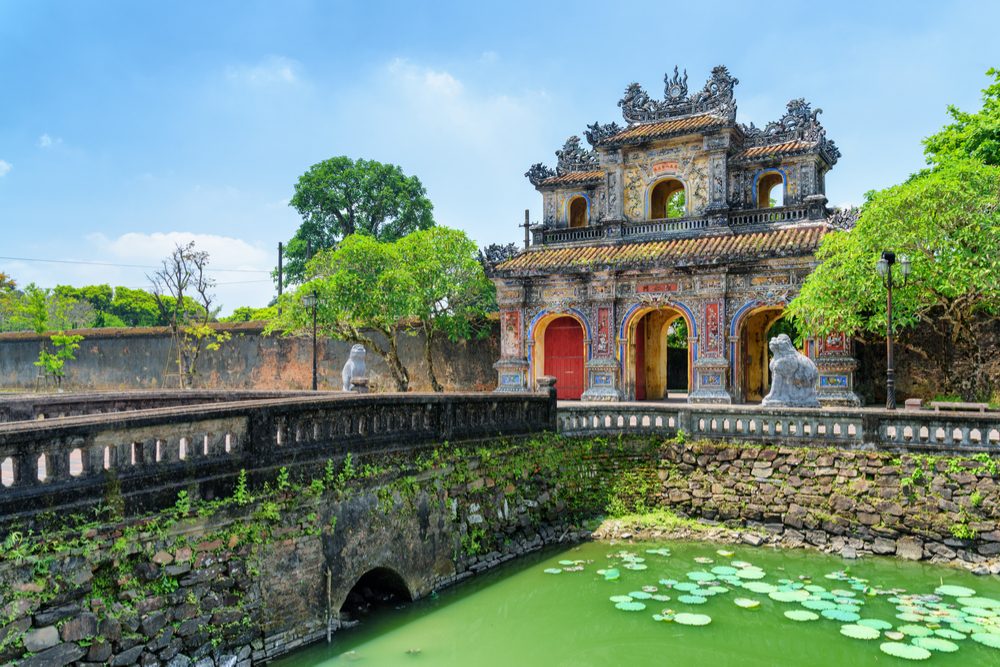
View of the East Gate (Hien Nhon Gate) to the Citadel and a moat surrounding the Imperial City with the Purple Forbidden City in Hue, Vietnam. Photo: Shutterstock
“A trip to Southeast Asia can be pricey due to hotels, but the good news is there are large variances in low-season and high-season pricing that can sometimes save you up to 20 percent. Koh Samui, Thailand, is great in May and June, when the weather is dry and hot, and the hotels are quite empty, with good pricing. Phuket, also in Thailand, is great at the end of October, right before the November high season. Laos has great value, as well as nice weather, in May and June. Vietnam is usually better than Thailand for New Year’s, as there are fewer hotels with minimum-length-of-stay requirements and mandatory gala dinners—which can add thousands to your trip. There are tricks and recommendations wherever you go, not only to maximize your value, but also to avoid any unnecessary expenses that can really increase your overall trip costs. For a multi-country trip that includes Thailand, Vietnam, Laos, and Cambodia, the best value across all countries would have to be May.” —Sandy Ferguson
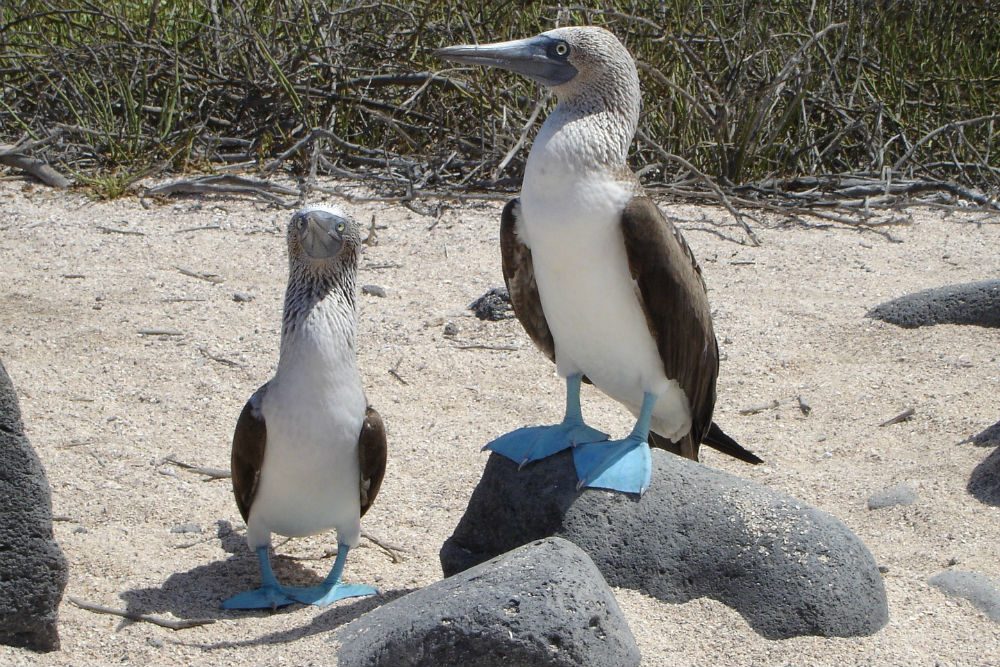
Blue-footed booby, Galapagos Islands. Photo: Pixabay/Peter Stuart Miller
“I always ask if people can travel between Thanksgiving and Christmas, or the week starting January 3. Those are the weeks when occupancy on the best Galapagos cruise ships can drop dramatically. Think ahead, book in advance, and you might just score a great deal!” —Allie Almario
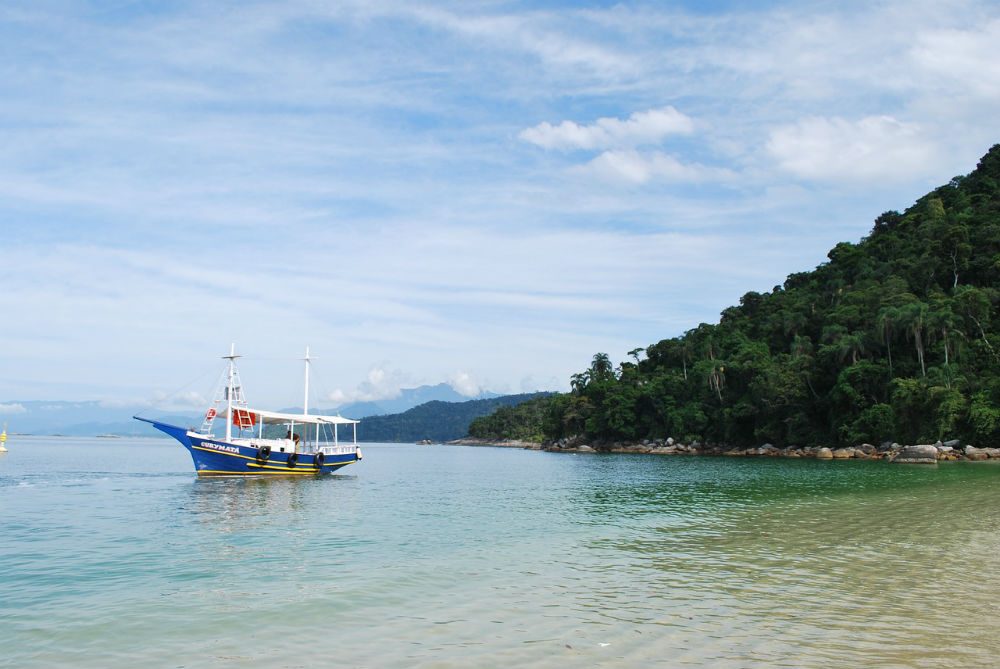
Angra dos Reis on Brazil’s Costa Verde. Photo: Pixabay/gabrielvannini
“Traveling during the northern hemisphere’s summer is a great idea. On the Costa Verde, our winter (June–August) is a beautiful time to visit, with pleasant temperatures between 65 and 85 degrees, and less than a third of the average rainfall of the summer months. Yet hotel rates are significantly lower, and you can often get four-nights-for-the-price-of-three deals.” —Paul Irvine
A cheetah in Botswana’s Okavango Delta. Photo courtesy Wilderness Safaris/Dana Allen.
“Green Season, which is November through March, is a fantastic time to visit Botswana because the prices can be as much as 40% less than in peak season. The intermittent rain that falls is not disruptive to the safaris, and given the abundance of green grass, the grazing species—such as wildebeests, zebra, antelope, etc.—are having their offspring, and the predators tend to be more prolific as well. Photographic opportunities are at their very best.” —Julian Harrison
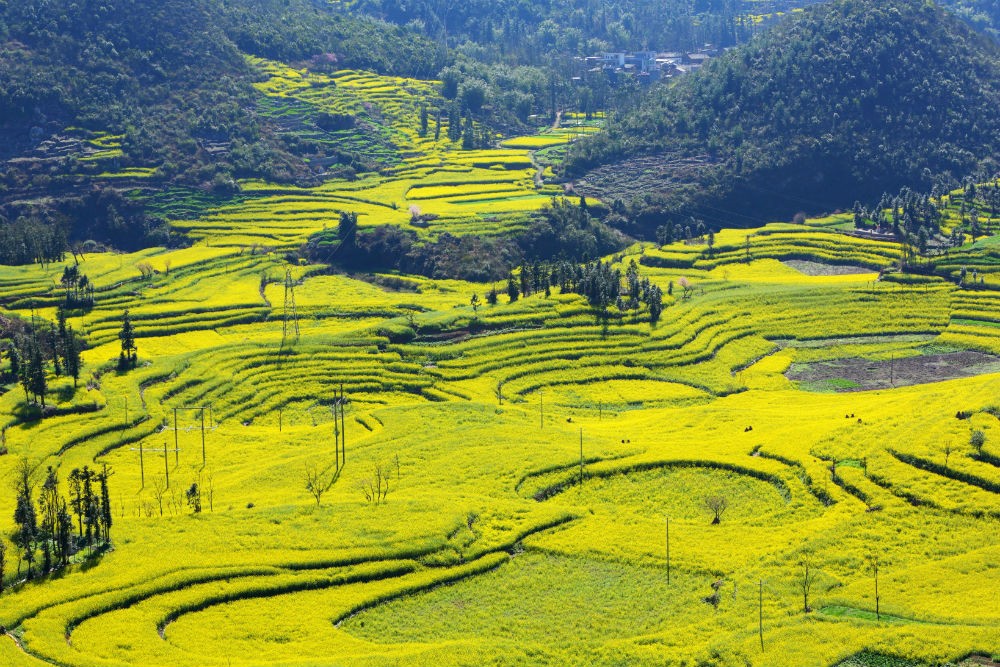
Rapeseed field in Luoping Yunnan, China. Photo: WildChina
“High value doesn’t necessarily mean a low price. It’s about getting the maximum experience for what you spend. Our top tip: Consider traveling to China in winter, when you can take advantage of hotel deals and get your pick of the best guides. It’ll be cold in the North but in the South, spring arrives early. Visit Yunnan province in December to see the region’s speciality ham being cured.” —Mei Zhang
Udaivilas Oberoi hotel in Udaipur, India. Photo: Oberoi Hotels
“In India our tourist season is from October through March, though prices are at a premium over Christmas and New Year’s. If we had to choose, we would recommend being in India in February or March. By negotiating a package rate with a hotel group such as Taj or Oberoi (who have award-winning hotels throughout the region), we can ensure a top-end trip with a great per-night discount.” —Victoria and Bertie Dyer
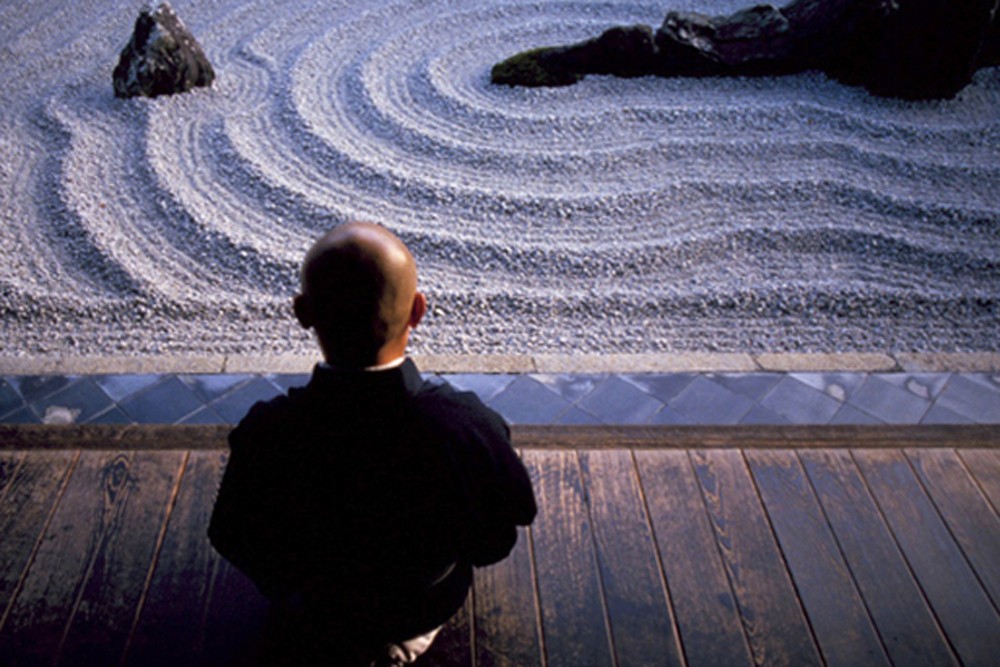
A Buddhist monk contemplates the zen garden at Zuiho-In Temple in Kyoto, Japan. Photo: Ben Simmons
“Traveling to Japan during March and April can be very expensive and the crowds overwhelming (in Kyoto especially). Why not go to Japan right after Golden Week ends in early May and enjoy a beautiful and less hectic time to be in-country? Warm days and comfortable evenings make it a great time to go, plus you’ll be avoiding rainy season, which typically begins mid-June. I would say the same holds true for October travel vs. the peak autumn foliage times of mid- to late November.” —Scott Gilman
A cheetah in Botswana’s Okavango Delta. Photo courtesy Wilderness Safaris/Dana Allen.
“Safaris are not inexpensive these days, but if you have some flexibility with dates, you can save up to 45 percent by going in June vs. July to Tanzania, or in November vs. October to Botswana. Seasonal cost differences can be massive, and ‘low season’ doesn’t mean ‘not great season’—it means fewer people, which can be great for you! Also, it’s important to remember that a very large percentage of lodge costs go toward conservation of wildlife, wild places, and community development. A wonderful client of mine once said, ‘Unfortunately, I don’t get a tax deduction for my travel, but I think of it as an investment in my and my family’s spiritual equity. It’s less risky than investing in Wall Street, and the dividends are guaranteed and last forever!'” —Cherri Briggs
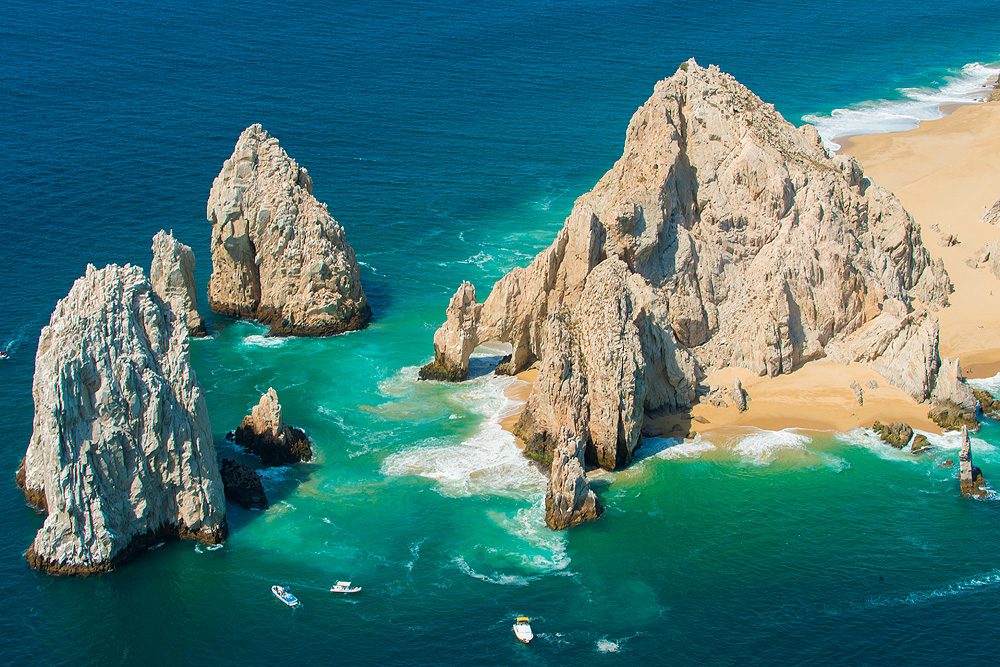
“It can be tough to get a good fishing charter in October, when all the tournaments happen. If you can brave the warmest time of the year, the last week of September is the best time for fishing, and since it’s low season, you will get the best rates. For the Christmas/holiday season in Los Cabos, book in the month of December for the next December holiday: That way you get your pick of properties and don’t have to just accept whatever is left. If you are interested in Cabo for the holidays, avoid the crowds by traveling the first week instead of over New Year’s. Cabo gets booked up starting December 27! ” —Julie Byrd
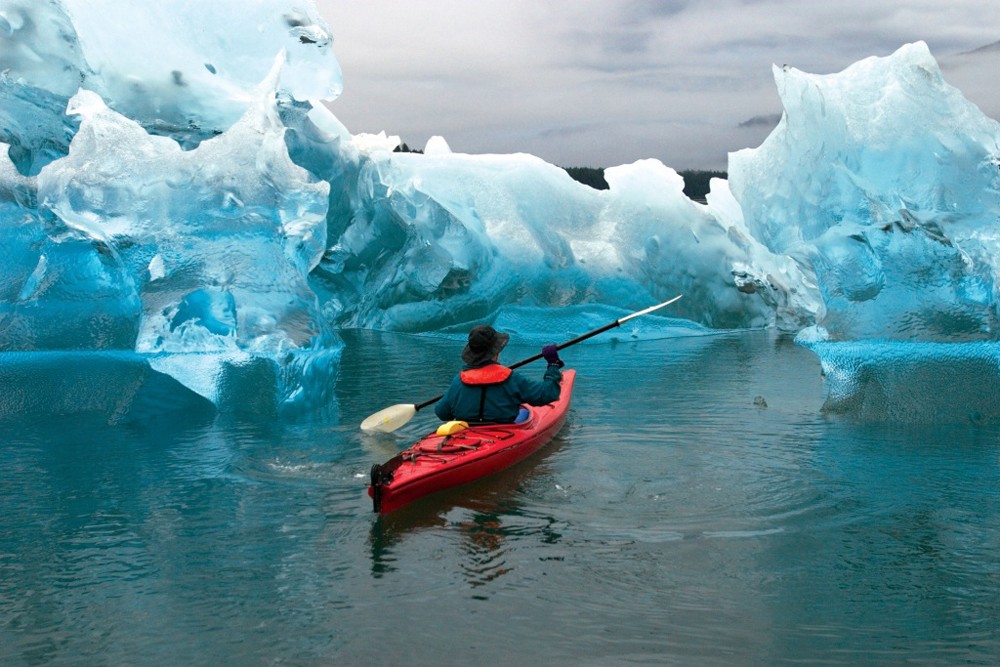
Kayaking through sculpted icebergs in Tracy Arm-Fords Terror Wilderness, Tongass National Forest, Southeast Alaska. Photo: Lindblad Expeditions/ Ralph Lee Hopkins
“April and September are shoulder season for Alaska small-ship cruising. Alaska is still packed with amazing wildlife and epic glaciers, but there is less big-cruise-ship traffic and fewer tourists than in high season.” —Ashton Palmer
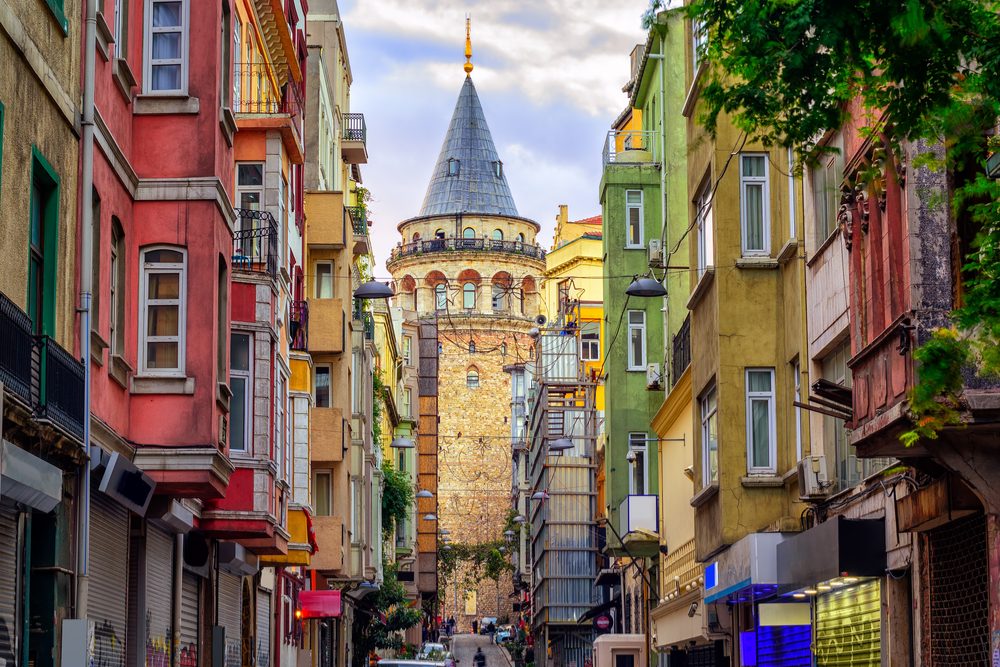
Galata Tower and the street in the Old Town of Istanbul, Turkey. Photo: Shutterstock
“Turkey in winter is a bargain: low airfares, no crowds, hotel rates are reduced. You just need to bring a winter coat. And İn Antalya people swim in the sea through December.” —Earl Starkey
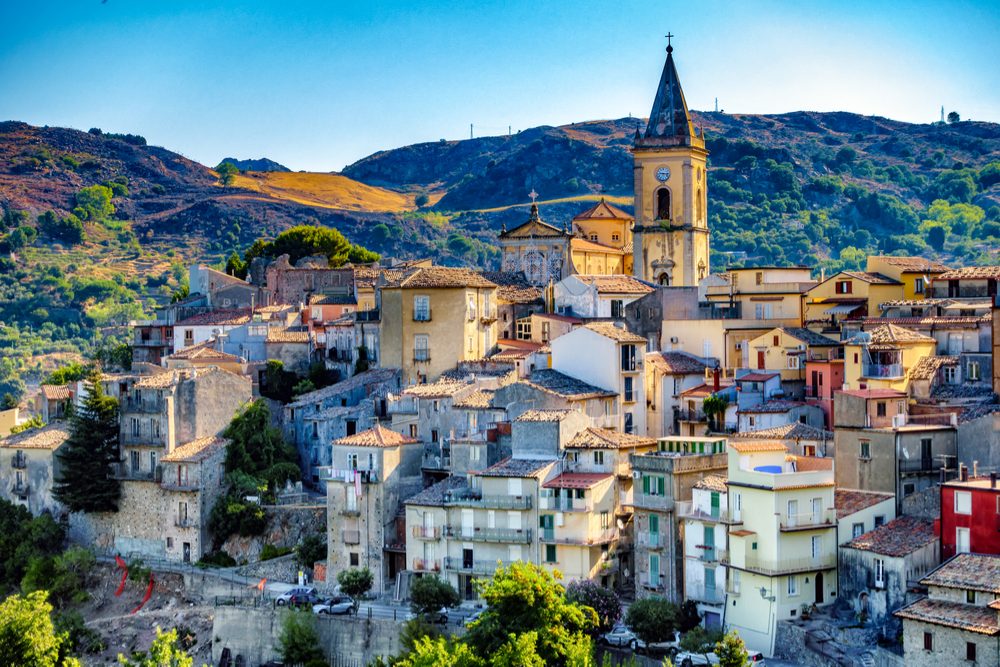
Mountain village Novara di Sicilia, Sicily, Italy. Photo: Shutterstock
“While Sicily is primarily visited from March through November, the so-called ‘off season’ can mean better value for your precious travel time. The weather is cooler, but you’ll get the warmth of the local seasonal harvest festivals and the holidays. The sea might be rougher, but the clouds and winter sun provide for amazing visual contrasts when visiting the ancient sites (with no crowds to get in your way). And the autumn / winter is an ideal moment to dive into some unique culinary adventures, from discovering the ancient roots of Palermo street food to preparing almond pastries in Agrigento to learning about secret traditions of Granita on a snow-capped Mount Etna.” —Marcello Baglioni
“Travel to Sri Lanka in March and make the most of your holiday. As the peak season recedes, the weather is still pleasant, the Sri Lankan grub remains delicious, and your holiday is bound to be a bit easier on the wallet. If you really want to avoid the crowds, try climbing the more challenging Pidurangala rock, which sits opposite Sigiriya rock: You won’t be disappointed!” —Miguel Cunat
“Weather in Tel Aviv in January/February is in the high 60s / low 70s. Winter is actually the perfect time to come to Israel if you don’t like the heat. The winters are gorgeous.” —Jonathan Rose and Joe Yudin
When we announced The 2019 WOW List, we asked the expert trip designers who earned a spot to think about the next great places to travel—places that are under the radar for most of the traveling public but that sophisticated travelers would appreciate knowing about. Often these locales are at that perfect moment when there’s just enough infrastructure that you get the creature comforts you want, but not too much infrastructure that the tourist masses have arrived.
If you’re like me, you crave that feeling of being cut off from the world, and you’ll travel far to get it, whether that means trekking to the Arctic Circle to see the northern lights or sailing to secret atolls in French Polynesia. The good news: There are places I’ve found that give you that remote feeling but don’t require venturing to the ends of the earth via five inconvenient flights, two ferries, and a dogsled. These places let you lose yourself in vast landscapes and give you the space, scenery, seclusion—and sometimes even silence—that, to my mind, make a trip extraordinary.
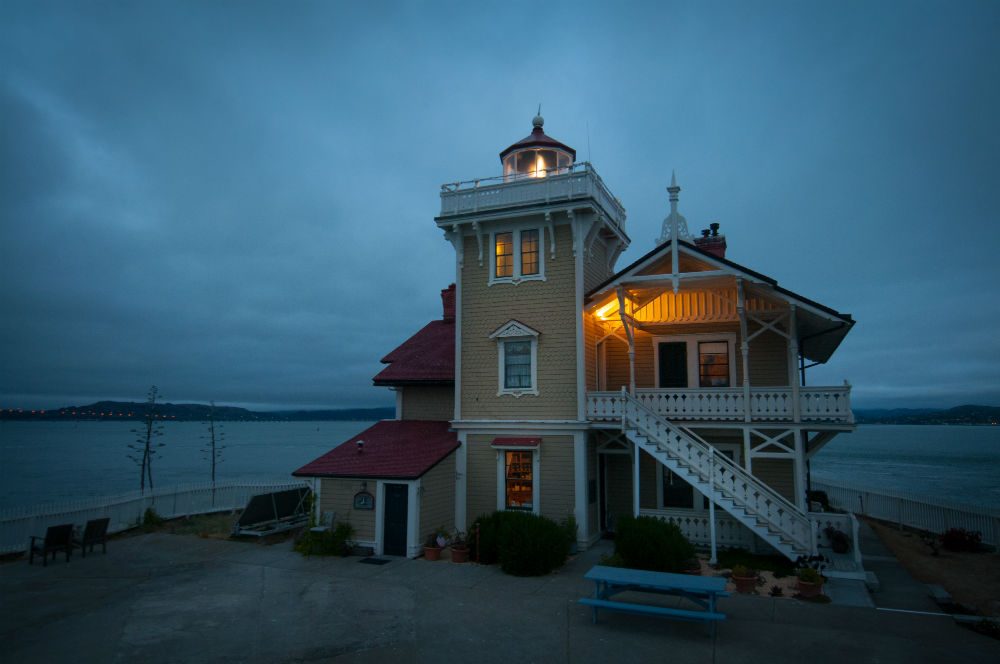
East Brother Light Station, San Francisco Bay
East Brother Light Station is on an island in San Francisco Bay, only 12 miles from downtown. Photo: Tim Baker
Tens of thousands of cars drive past it every day on a bridge a couple of miles away, yet nobody knows it’s there. It’s an historic-landmark lighthouse inn known as East Brother Light Station, on a tiny island in the northern reaches of San Francisco Bay. It’s just a 30-minute drive from downtown San Francisco, plus a short boat ride, yet it feels like a world away. There’s little on the island besides the 144-year-old active lighthouse, the bed-and-breakfast inn, and a historic foghorn. And, besides the baby seagulls nesting on the rocky islet next door, the occasional yacht or fishing boat passing by, and the San Francisco skyline in the distance, there’s not all that much to see. But there’s also almost nobody to see you—and that makes it a rare escape.
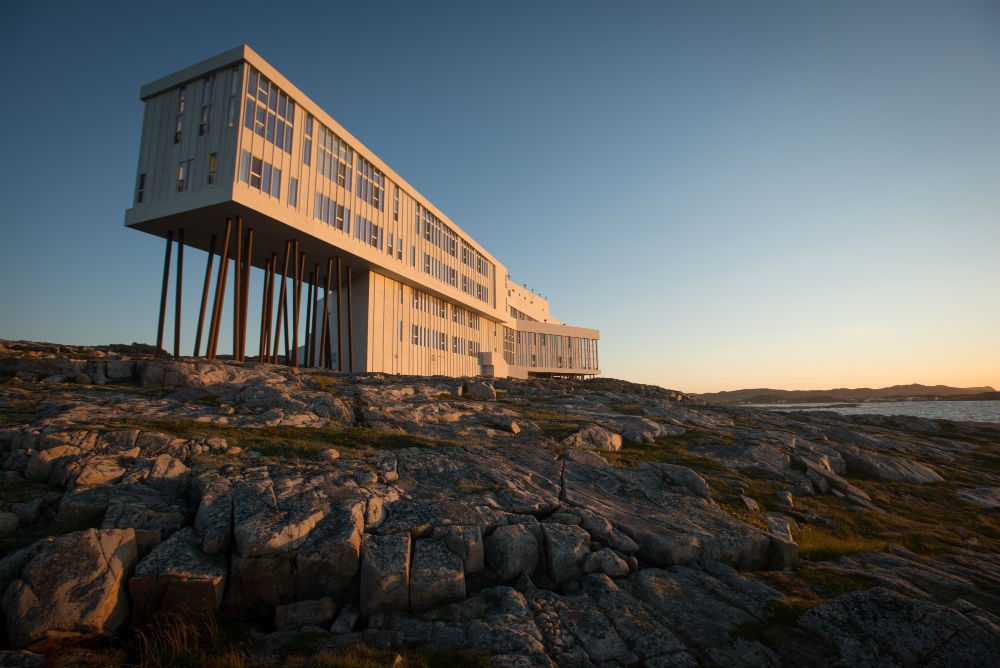
Fogo Island Inn, Newfoundland
Fogo Island Inn, Newfoundland. Photo: Tim Baker
Fogo Island, off the north coast of Newfoundland, feels like the edge of the world. When you wake up at the Fogo Island Inn, look out your window, and see nothing but immense ocean—sometimes with icebergs floating past like sculptures on the sea—you realize that the closest landfall in that direction is probably Greenland. Then you remember that you’re really just in Canada, about a two-hour drive and ferry ride from Gander (or you can fly your own plane from Gander, as we did. There are flights to Gander from many U.S. hubs via Toronto or Halifax.)
At Fogo Island Inn, rooms face the North Atlantic. You can see forever, but nobody can see you. Photo: Tim Baker
Fogo Island is unlike any place you’ve ever been because the people have a unique, soulful culture and a deep-rooted sense of hospitality, and because the Inn connects you with both. It captures the soul of its community, quite literally: The structure was built by the locals, as was nearly everything inside it—from the furniture handcrafted by the island’s traditional boat builders to the bedding woven by local quiltmakers to the hook mats whose images tell the story of the island and its people. Guests are welcomed into people’s homes and art studios and woven into the fabric of the community as if they were long lost relatives. Three nights on Fogo Island may well restore your soul more than three nights just about anywhere else. It will certainly leave you with more new friends.
Transparency disclosure: Yes, the Fogo Island Inn is an advertiser. But I visited and fell in love with the Inn and its people, community, and concept long before this website was conceived.
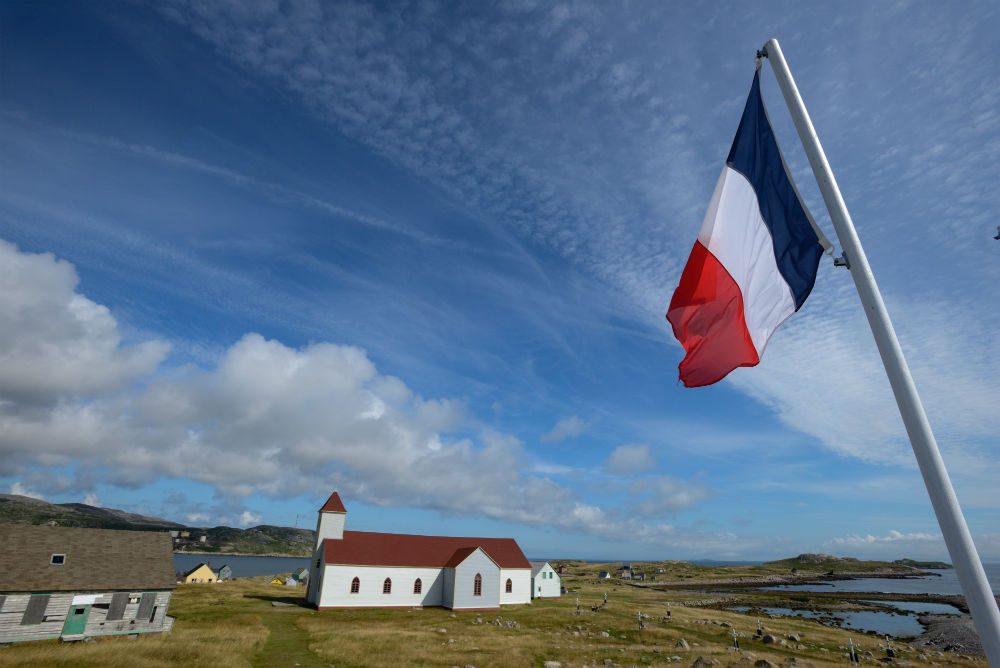
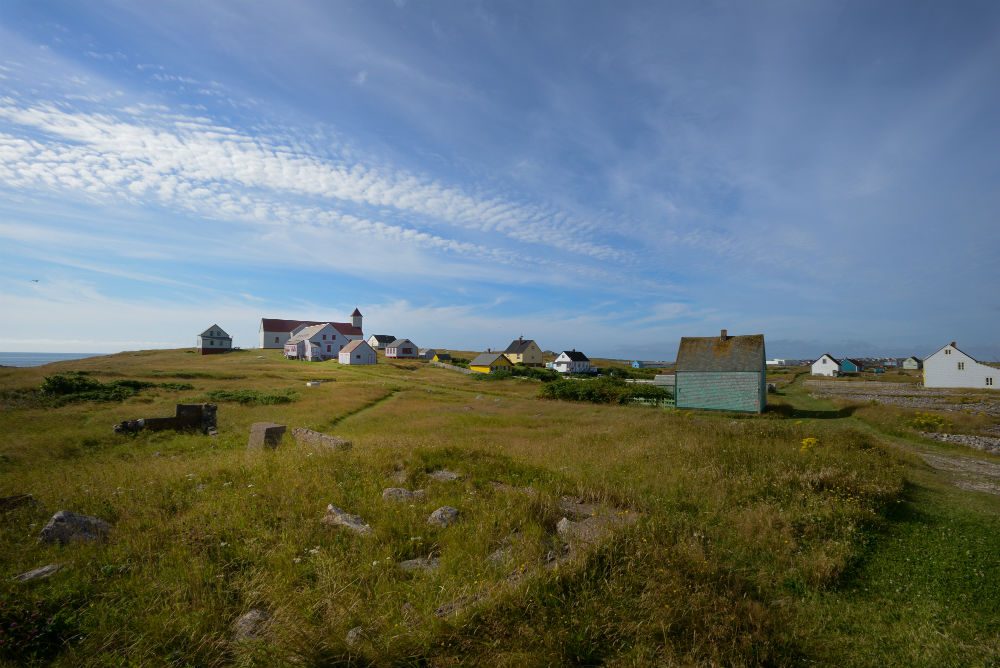
Saint-Pierre and Miquelon, France (in North America)
Saint-Pierre and Miquelon’s Ile Aux Marins (Sailor’s Island). Photo: Tim Baker
Did you know there’s a piece of France in North America? Saint-Pierre and Miquelon is the last remaining part of the French colonial empire in North America that remains under French control. It’s a windswept archipelago of eight islands that lies off Canada’s east coast, about 16 miles south of Newfoundland. So, when we were en route to Fogo Island (see above), we couldn’t resist making a little detour and checking out SPM.
Saint-Pierre and Miquelon’s Ile Aux Marins (Sailor’s Island). Photo: Tim Baker
Long story short, don’t go expecting fabulous French food, shopping, or culture. Go to discover an isolated oddity with a unique heritage, a guillotine, and a Basque festival. The easiest way to get there is to fly from Montreal, Halifax, or St. John’s (Newfoundland’s fun and charming capital city that is worth an even longer detour).
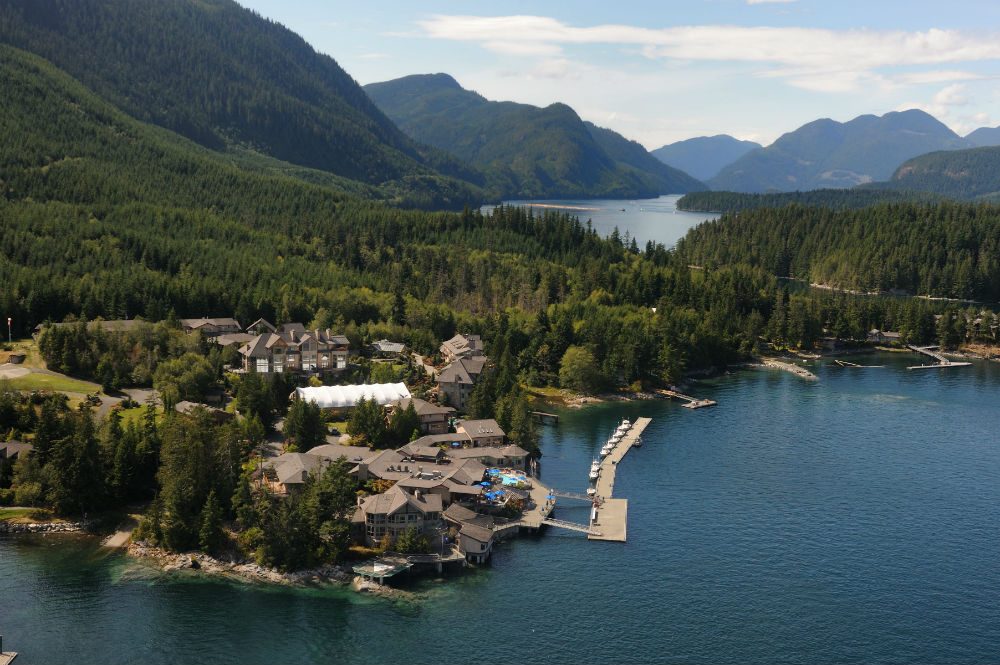
Sonora Resort, British Columbia
Sonora Resort in the Discovery Islands, British Columbia. Photo: Tim Baker
A fishing lodge set on its own island in western Canada’s Discovery Islands, Sonora Resort feels much farther away than just a 50-minute helicopter or sea plane flight from Vancouver International Airport. Or you can take a 2.5-hour sea plane flight from Seattle. The air and water are crystal clear, the scenery magnificent, the wildlife abundant, and the fishing opportunities world-class. You can even take a day trip, as we did, to go snorkeling with salmon. For more photos, see My Extreme Week in Canada.
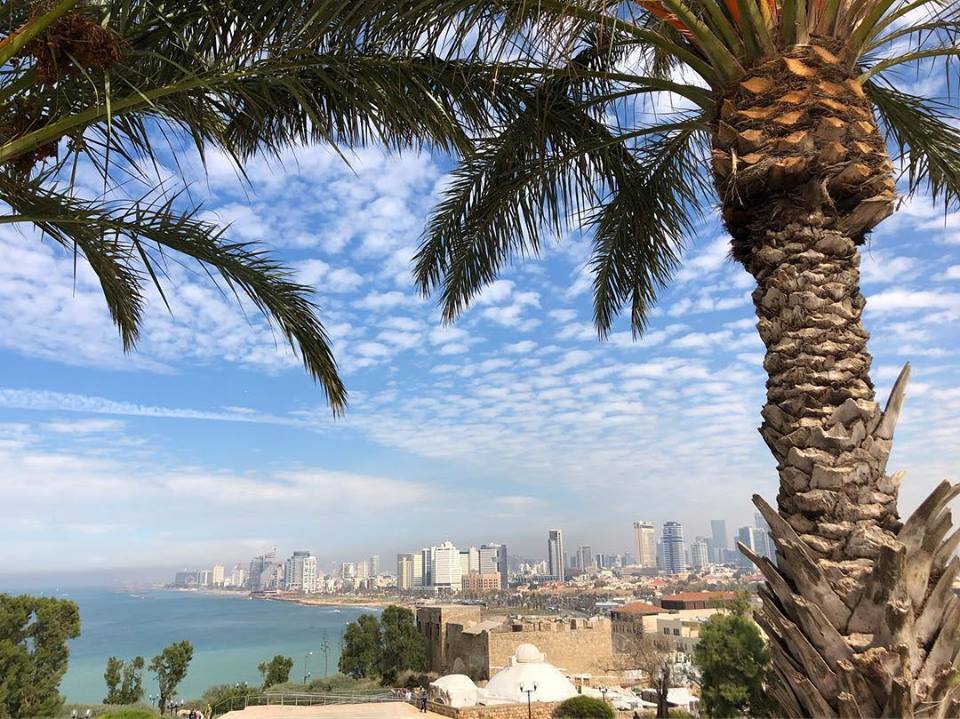
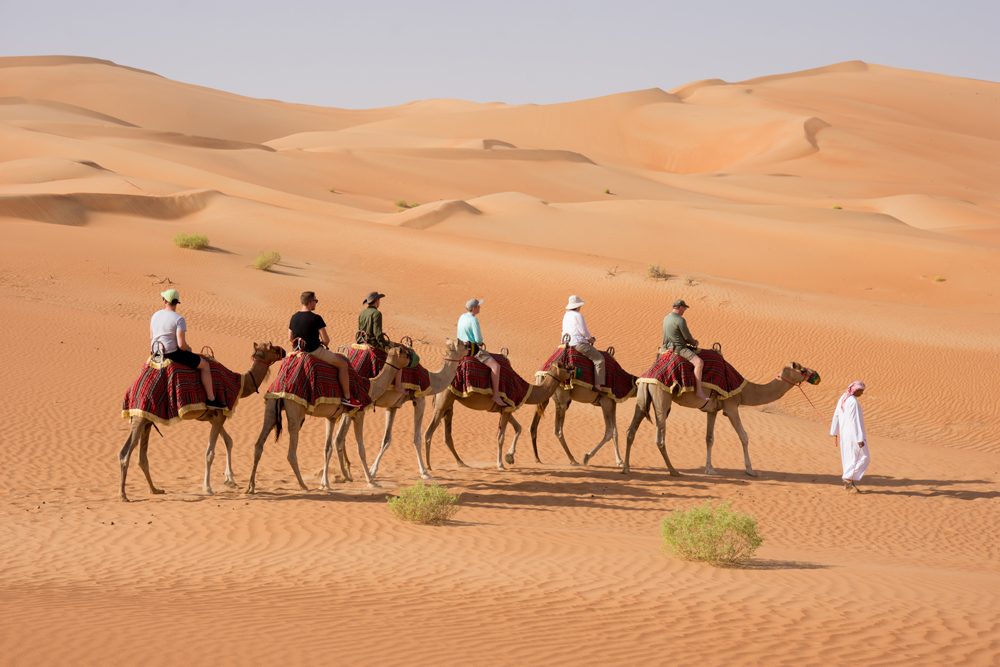
Qasr al Sarab, Abu Dhabi
Qasr al Sarab, Abu Dhabi. Photo: Tim Baker
It may be all the way in Abu Dhabi, but logistically it’s much easier to get to than the similarly spectacular desert landscapes I’ve seen elsewhere in the world—say, in Morocco or Jordan. Qasr al Sarab is just a three-hour drive, on great roads, from Dubai International Airport (a huge hub that is easy to reach via non-stop flights). But it feels like another planet. Sand dunes stretch as far as your eye can see in every direction—and the way those dunes change color, as the light shifts throughout the day, is mesmerizing.
Qasr al Sarab camel caravan, Abu Dhabi. Photo: Tim Baker
If getting lost in the dunes isn’t adventure enough for you, there’s always camel riding, sandboarding, dune bashing…. So, the next time you’ve got a layover in Dubai, make it three or four nights and head to the desert for something completely different than wherever you just came from.
Dune bashing at Qasr al Sarab, Abu Dhabi. Photo: Tim Baker
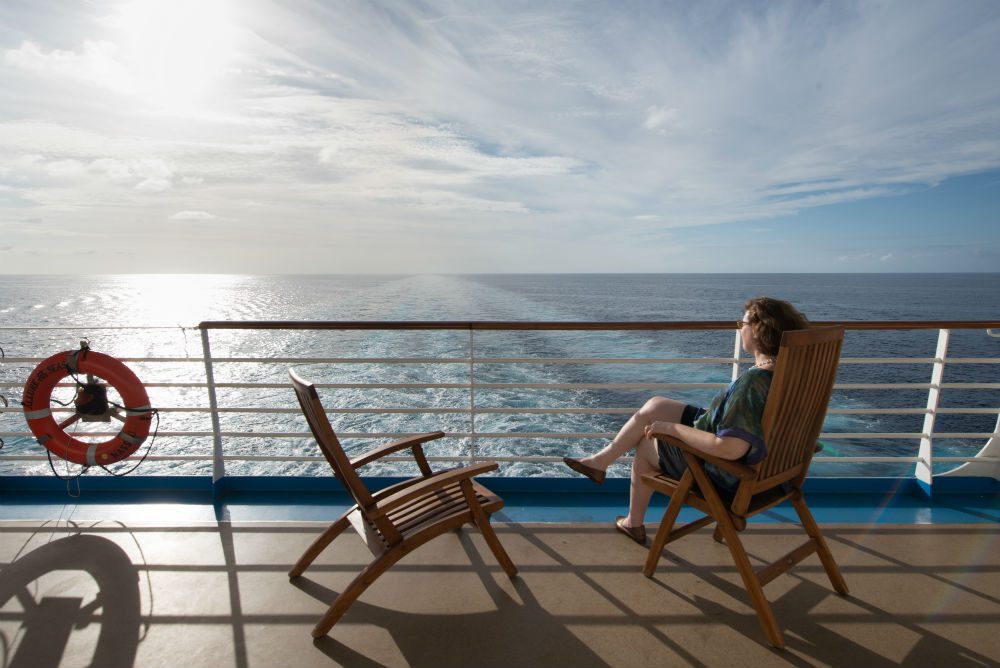
Your private balcony on a cruise ship
Yours truly aboard Royal Caribbean’s Allure of the Seas in the Caribbean. Photo: Tim Baker
In some ways, a cruise ship is like an island, only one that floats past new scenery every day. As long as you have your own private veranda where you can see forever but nobody can see you, you can enjoy that remote feeling as you ply the water toward a new port every day. Not only do you get vast landscape all to yourself, but you get ever-changing views. Even if you don’t have a balcony, you can get that remote feeling by staking out a secluded spot on deck. It’s true: No matter how crowded a ship, you can always find a hiding place on deck where nobody else is. Even on Royal Caribbean’s 6,500-passenger Allure of the Seas—the world’s second largest cruise ship—I found this public hiding place. Here’s what else I did on that ship.
Why waste your precious vacation time battling crowds and waiting in lines? Popular tourist sites the world over grow more congested every year and, sadly, the typical fixes—reserving an entry time, booking a “skip-the-line tour”—are not always a good solution. So I thought I’d share the best fixes I’ve found.
Reserving a time slot might make sense at an indoor museum (I wouldn’t show up at Rome’s Borghese Gallery or Florence’s Uffizi without one), but not necessarily at an outdoor monument. When I go to Paris, for instance, I want to hit the Eiffel Tower on a sunny, clear day; what if my entry time, reserved weeks in advance, coincides with rain and fog? Furthermore, I want to take my kids to the Louvre on a rainy day; what if I book skip-the-line tickets for what turns out to be a gorgeous day that we’d rather spend in the Jardin du Luxembourg? As for “skip-the-line tours,” aside from the fact that you can end up herded around in a big group with an annoying guide, they’re often not what they claim to be. A skip-the-line tour of the Vatican might get you past the ticket-buying line but not the security line. I’d rather be one of the handful of travelers who gets to eat breakfast at the Vatican and see it before it opens to the public.
By far the best way I’ve found to avoid crowds and bypass lines is to book your trip through the right travel fixer—someone who knows every insider trick at your destination and can leverage his/her superlative relationships there on your behalf. Such destination specialists can get you into sites at off-hours when they are empty and even into places that are off-limits to the public. The right person can get you past the mobs at Angkor Wat or ensure a crowd-free sunset at the Taj Mahal. You can even have Istanbul’s Hagia Sophia all to yourself. These Trusted Travel Experts can, in fact, arrange an entire trip that spares you from every line. And all you need to do is show up.
But if you prefer to D.I.Y. your trip, here are strategies that have worked well for me:
Sometimes there is an alternate entrance with a shorter line or none at all. In Paris, my family entered the Louvre via the Porte des Lions and saved ourselves from an hour-long line at the Pyramid entrance. At the Museum of Natural History in New York City, if there’s a line at the Central Park West entrance, you can enter via the Rose Center for Earth and Space or via the 81st Street subway station.
Go at sunrise.
A lot of people assume sunset is best, but at many outdoor iconic monuments—Angkor Wat in Cambodia, Mount Sinai in Egypt, Petra in Jordan—sunrise is better. You get equally great light for photos but fewer crowds to spoil them. Sunrise is better for seeing neighborhoods too. In popular destinations that are touristy from 9 am till midnight, it’s from 6 to 9 am that you can see the locals living their everyday lives—green grocers opening their stalls, kids going to school, fishermen delivering their catch to the fish market, etc.
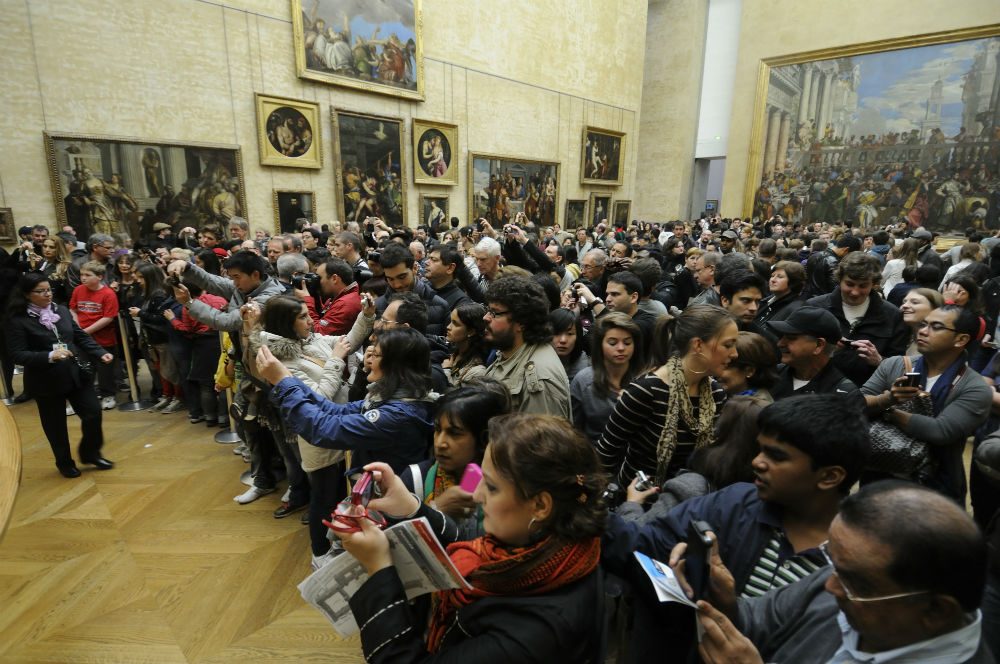
Visit museums on a night they’re open late and you’ll likely avoid mobs like this one, in front of the Mona Lisa at the Louvre. Photo: Wendy Perrin
Go at night.
Not all landmarks are accessible at night, but those that are are usually worth seeing at that time. The Lincoln Memorial in Washington, D.C., for instance, is beautifully lit and especially poignant at night. Park rangers are actually there to answer your questions until 10 pm. Remember that world-class museums are usually open on at least one night of the week. London’s Tate Modern, as just one example, stays open till 10 p.m. on Fridays and Saturdays. The Eiffel Tower admits visitors until midnight in summertime—and sparkles at night too.
Some famous attractions, like the Lincoln Memorial in Washington, D.C. are more beautiful at night—and less crowded. Photo: Pixabay
Take the stairs.
A two-hour line at the Eiffel Tower elevators—which we skipped by taking the stairs. Photo: Tim Baker.
I’m no athlete, but I’ve climbed to the tops of dozens of bell towers, fortresses, palaces, and cathedrals, and I am here to tell you that the effort has always been well worth it, not just because of the views but because the great majority of visitors don’t make it there. Sometimes the journey itself is a highlight. If you’ve ever followed the circuitous, increasingly narrow route into the cupola of St. Peter’s Basilica in Rome, you know what I mean. My family saved at least two hours at the Eiffel Tower by climbing the 670 steps to the second floor and taking the elevator from there to the top, rather than waiting in the scary elevator line at the base.
Buy the right pass.
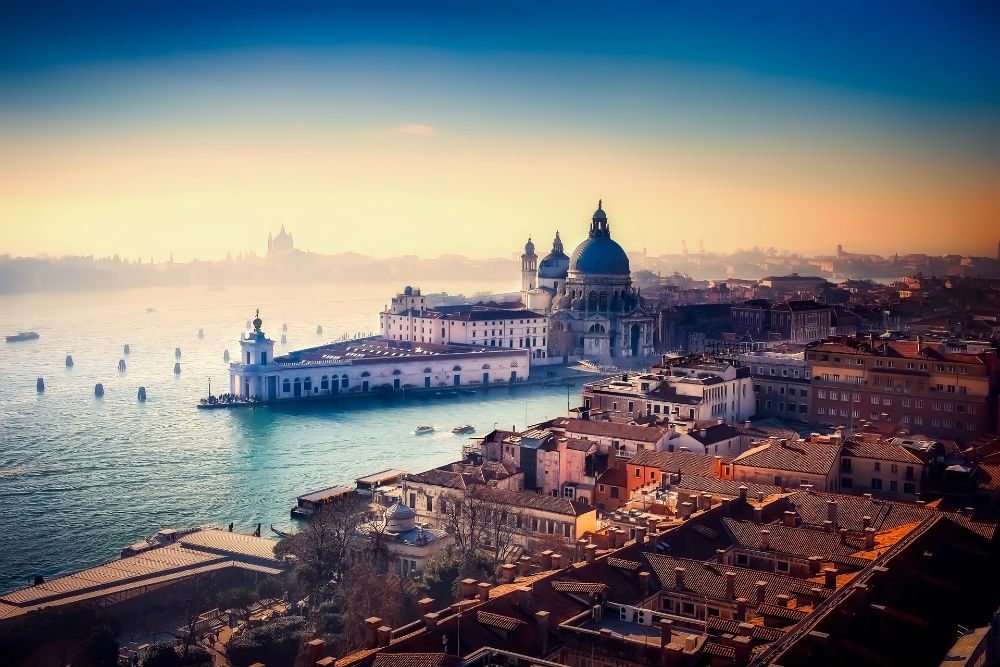
Venice, Italy. Photo: Pixabay
Some cities sell city museum passes that let you bypass the line. For instance, the Paris Museum Pass and the Vienna Pass let you skip the line at dozens of museums and monuments in those cities. If you don’t need a multi-day museum pass because there’s really only one museum you want to see, sometimes you can buy a combination ticket for just three or four related museums (the world-famous one you want to see, plus other lesser museums you’re not interested in). Buy the combo ticket at one of the lesser museums with no line, then use it to skip the line at the museum you want. For example, in Venice, a ticket to the four Museums of St. Mark’s Square allowed me to skip the line at the Doge’s Palace.
Arrive at the visitor center before it opens.
World-famous sites with visitor centers tend to attract a lot of tour buses. You want to arrive long before they do. At Gettysburg, for instance, be the first inside the Museum and Visitor Center when it opens at 8:00 am (April 1 – Oct 31). If you have no reservation for the U.S.S. Arizona Memorial at Pearl Harbor, get there before it opens at 7:00 am because that’s when tickets for that day are available on a first-come first-served basis.
Travelers, you’ve had this dream: You’re looking at a map trying to decide where to go next, wondering how to choose from all the frontiers you’ve never seen, the cultures and cuisines you’ve yet to savor, the landscapes you have yet to explore. The key, of course, is to choose those locations that are still under-the-radar, not overrun by hordes of tourists. Iceland, as just one example of a hot spot, was blissfully empty a few years ago; now that everyone’s caught on, its Golden Circle is teeming with tour buses filled with Americans.
We have the same dream as you, but we also have a way to make it a reality. To help you choose the lesser-known gems, we turned to destination specialists who live and work in these countries and have first-hand insight into which places have reached that perfect moment when there’s just enough tourism infrastructure to offer the creature comforts you want, but not too much attention that the tourist masses have arrived. Sounds nice, right? In this video, Trusted Travel Experts from Wendy’s 2018 WOW List share the next great places. Where will you go?
My aunt Ruth, a wise woman, once popped into a city hall and asked to speak with the mayor. The mayor was produced, and Aunt Ruth said, “I bring you greetings from Ringwood, New Jersey!” The mayor, whose town was also called Ringwood, responded with a guided tour. It was one of the highlights of Aunt Ruth’s only trip to England.
It took me years to learn how to do this sort of thing. Meanwhile, I wasted some unique opportunities. I once moved to a town where the local beauty shop was called the Bull Cheka Hair Salon and Tire Repair, and guess what: I never even went inside! Instead, I drove by the Bull Cheka approximately 5,000 times, burning with curiosity. I didn’t need my hair braided or my tires repaired, but I did need female company. I should have invented any excuse—a sudden need for a manicure or a henna rinse—to get myself through that door.
Since then, I’ve become a lot more like Aunt Ruth. You can only learn so much about a place without getting to know the people. It does no good to hang back. You must get out there and meet people. Make friends. Here’s how.
1) Rent a home. Do not stay in a hotel. This is elementary. Hotels are for people from out of town. Rent a house or an apartment in a neighborhood where people buy vegetables, do laundry, and get their hair done.
2) Start your day at a coffee bar. Make small talk with the barista. Do this every day. Same bar, same time, same drink, same barista. Be part of a neighborhood’s morning commute.
3) Go to a community event—a church supper, a croquet tournament, a trade show for farm equipment—and learn as much as you can. Pick something outside your comfort zone and don’t be afraid to sound stupid. There are actually people who come to life when you ask them what a driveshaft is.
4) Carry a sketchbook. Discover the contemplative magic of sitting in a public place and sketching rooftops and telephone wires. Why should you do this? To avoid taking hundreds of photos with your smartphone, and to practice paying attention.
5) Likewise, lose the earbuds. Life is a sensory experience. Stop, look, and listen. My first-grade teacher taught me that.
6) Volunteer. Trash Removal Day at the local playground? Grab a plastic bag and go.
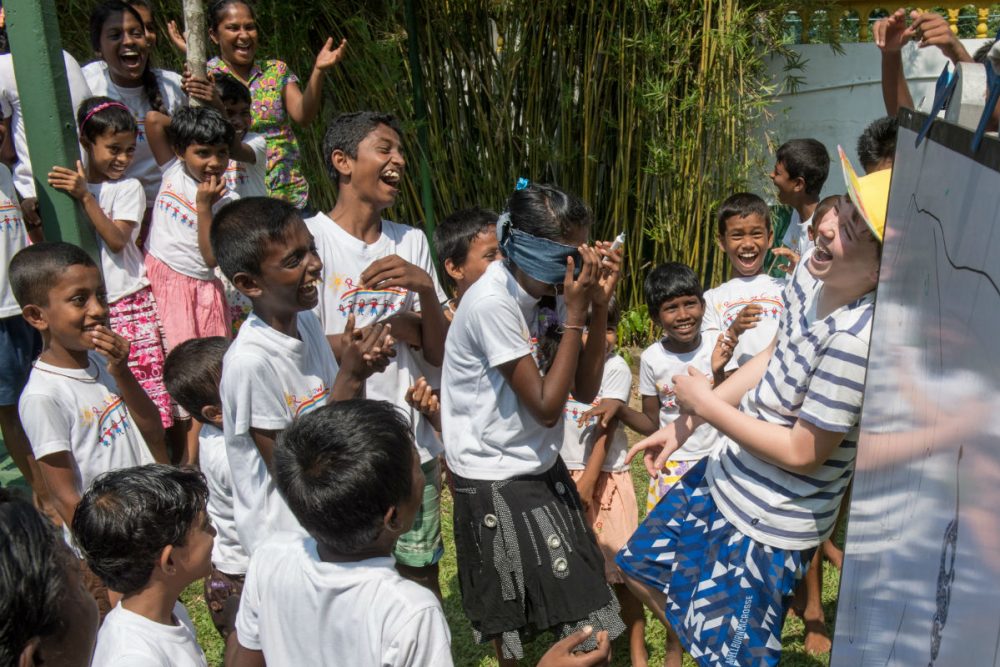
When Wendy’s family visited Sri Lanka, they spent the day volunteering at a local school, where her sons made fast friends with the students. Photo: Tim Baker.
7) Let your passions guide you. There are people all over the world who love knitting, dachshunds, backgammon, vintage motorcycles, Italian hand puppets, you name it. Go to your Web browser and find them. Be creative with your use of search words. Try typing the name of your destination plus “chat english” or “community events.” To find the places where local people gather, you’ll need to make Google your friend.
8) Find a local chapter of your 12-step group. A New York stage actor told me about attending an AA meeting in Colombia; he was the only one in the room who didn’t speak Spanish. Top that for nerve.
9) Register at Meetup.com. The site lists all kinds of local events, many of them free. It has led me to Zumba classes, French lessons, woodland hikes, and a Scottish lady who taught me to darn socks.
10) Follow the students. University neighborhoods are magnets for the young, the intellectually curious, and the frugal. Poetry bars and kimchi pancakes are found here.
11) Patronize local markets and shopping malls, and don’t just stroll around taking pictures of the wares. Vendors hate that. Instead, learn how to prepare a local dish and buy all the necessary ingredients, including the spices. Now prepare the dish.
12) Brave the supermarket. If you really want to sample local life, you’ve got to shop at a grocery store. I can promise you an adventure. I once found a rack of leopard-print bras next to a refrigerator advertising “live bait.”
13) Talk to strangers. If the stranger is wearing a frog costume and carrying a blowtorch, disregard this rule.
14) Take public transportation. Every time you ride the bus you become part of the human pageant. It’s like stepping into a Bruegel painting. There is comedy, romance, and drama. This doesn’t happen in a cab.
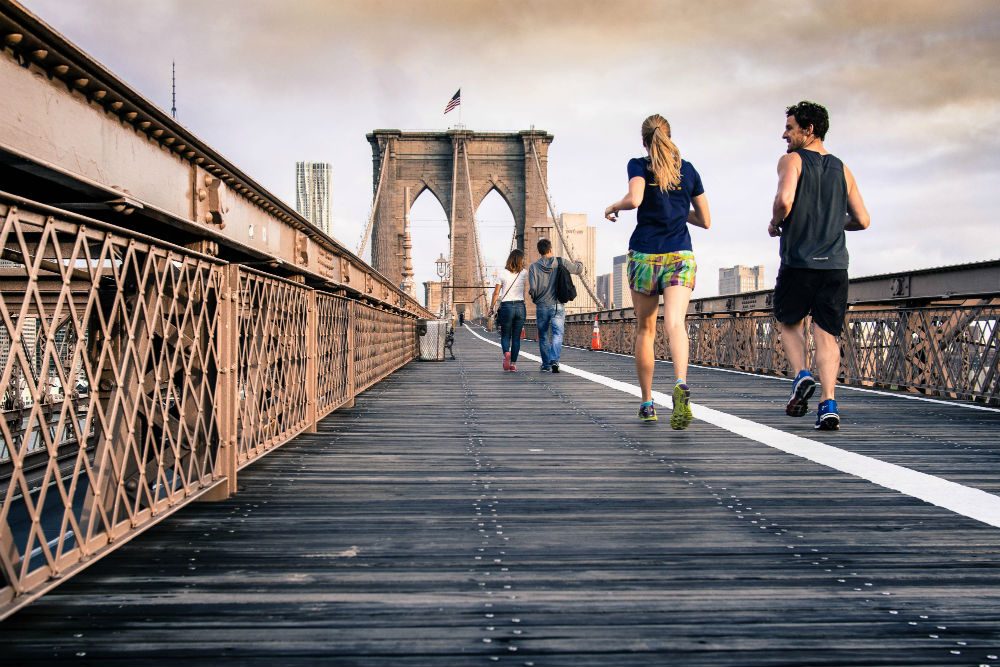
15) Go for a run. If you don’t want to run alone, find a running club. In Tanzania, I ran with the Hash House Harriers; in Togo, my companions were the local gendarmes. There is always someone to run with.
Find a running group to join; you’ll meet people and see more of the place you’re visiting.
16) Visit a church, a synagogue, a mosque, or a temple. Every major religion has a tradition of welcoming the stranger. You’re a stranger, so be welcomed.
17) Be sporty. Ride a bicycle, fly a kite, join a game of pickup basketball, climb a rock. If you don’t know how to climb a rock, find someone to teach you.
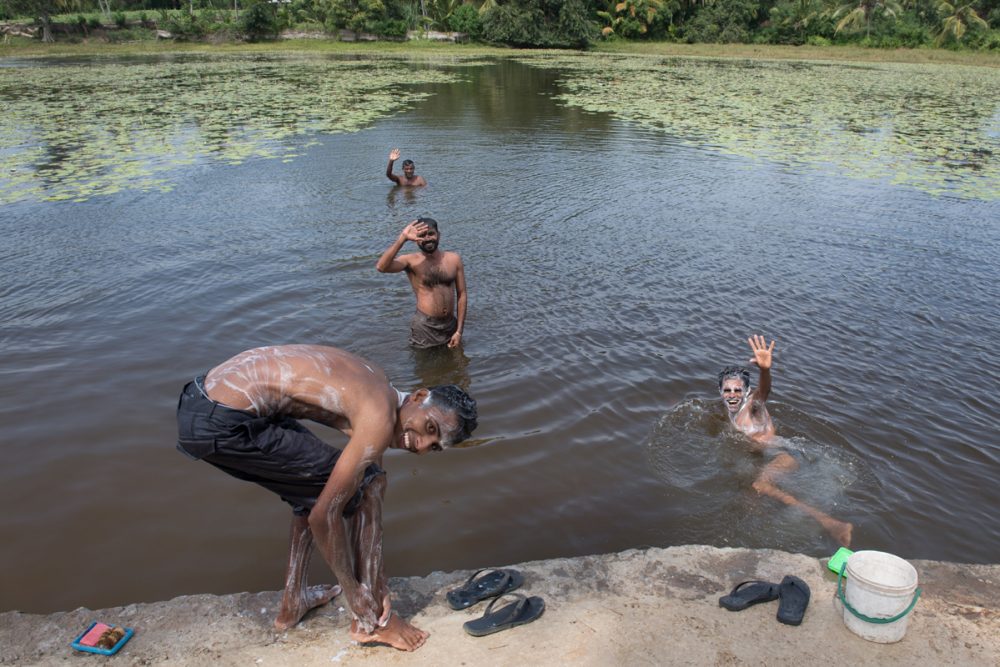
Bath time at the lake, on Wendy’s family trip to Sri Lanka.
18) Go to a communal bathhouse. I have not done this. I am too chicken. But I’m told by experts that it is the best way to immerse yourself in local culture.
19) Visit the local swimming hole. This one I can handle. Bring a towel and don’t expect the water to be even close to body temperature.
20) Go to the port and ask a fisherman to take you fishing. Be prepared to get up early.
21) From a musician friend: “If you hear music or singing, follow it, and maybe join in, if they’ll let you.” I wish I had thought of this one. I once heard somebody whistling Handel’s Messiah from an upper storey as I walked through a village in France. I wonder what would have happened if I had whistled back.
22) Go to an art gallery at lunchtime and take the owner out for a sandwich.
23) Join the club. Rotarians, Rastafarians, and writers of romance novels all belong to organizations. Reach out to them and say hi.
24) Visit an ESL classroom and let the students interview you.
25) Look for an anglophone society. That’s how I made friends when I moved to France. I googled “anglophone club” and the name of my town, et voila! Lectures, classes, and activities galore.
26) Go to a park. Not the kind that birders like, with quiet woodland trails. You want dogs and balls and kids and ponies and rowboats and ice skates for rent. Couples walking hand in hand. Furtive adolescents. A hurdy-gurdy man.
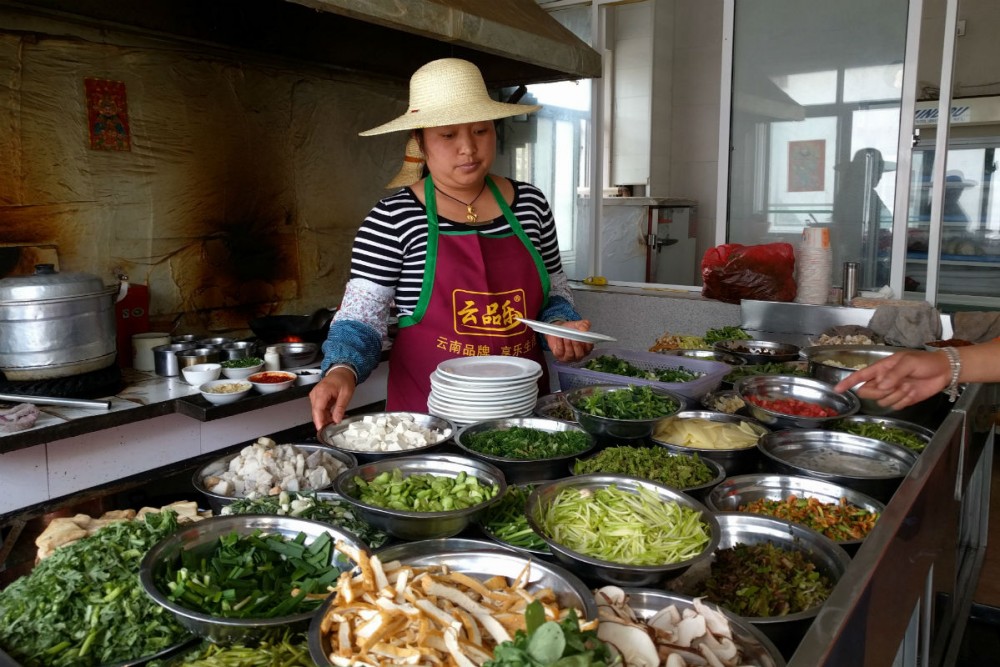
27) Never choose a restaurant because it’s safe. Dining out should be an adventure. If you can’t read the menu and have to order with your hands, you’re off to a good start.
At this very local lunch spot near Dali, China, there is no menu. Diners choose to their ingredients and the cook stir-fries them up with whatever sauce she thinks best. Photo: Billie Cohen
28) Chat with bartenders. A good barman is full of wisdom.
29) Visit a barbershop or a hair salon. There are a dozen variations on this theme. My 18-year-old went to Bali and came home with a tattoo that took many hours to execute. He got to know the tattoo artist very well.
30) Buy your gifts in a hardware store. You know those dish sponges with the clear plastic handles that dispense soap? My Parisian mother-in-law fell in love with one on a trip to America. If you want a good gift, think tools.