For sun in winter, value for money, less jet lag, few tour groups, and an outstanding diversity of landscapes and experiences, it’s hard to beat South America. From celeb-magnet beach towns in Brazil to coffee-region haciendas in Colombia to Amazonian lodges in Ecuador to heli-hiking in Chile to top-value wine regions in Argentina—not to mention the Galapagos Islands and Patagonia—South America doesn’t get old. The following reviews show you what’s possible when you plan your trip with a Trusted Travel Expert for South America. Here’s what it means to get a WOW trip.
Uruguay: “In-the-know South Americans spend their vacations in this small country that packs a really big punch…”
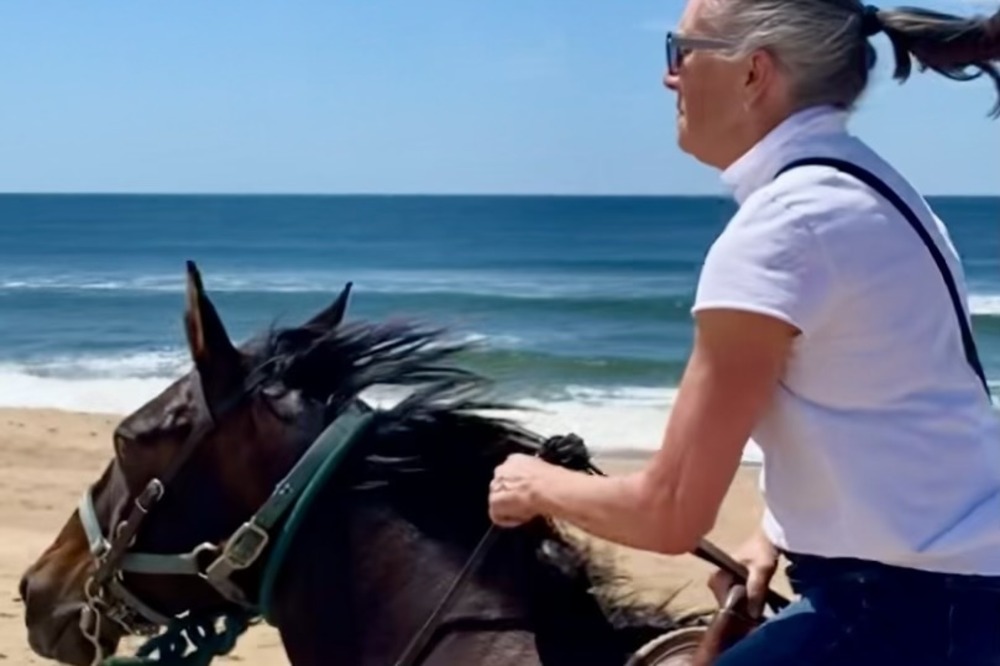
Traveler Jeannie Mullen riding the trusty steed Indio in “unforgettable” Jose Ignacio.
“Uruguay is a SLEEPER! While it may fly under the radar with most Americans, in-the-know South Americans spend their vacations in this small country that packs a really big punch. Brazilians and Argentinians also apparently invest there because the Uruguayan economy is so strong. Paul and Lucinda planned an outstanding, diverse and well-paced 12-day trip for me.
Universally described as muy tranquilo, Uruguay boasts fantastic family-owned wineries, distinctive restaurants with world-renowned chefs, unique and interesting hotels and resorts, beautiful boho chic beach towns, sprawling estancias with an authentic gaucho culture, rolling farm country, the second-largest river on the continent, a penchant for all things vintage, and history, art and architecture. After spending time in Carmelo, historic Colonia del Sacramento, Montevideo, Punta del Este and the unforgettable José Ignacio, I’ve decided that if I ever decide to live outside the United States, I’m heading to Uruguay.” —Jeannie Mullen
To get your own WOW trip, start with our trip questionnaire, reached via the black button below.
Peru’s Amazon rainforest—from monkeys to macaws—and people of the high Andes
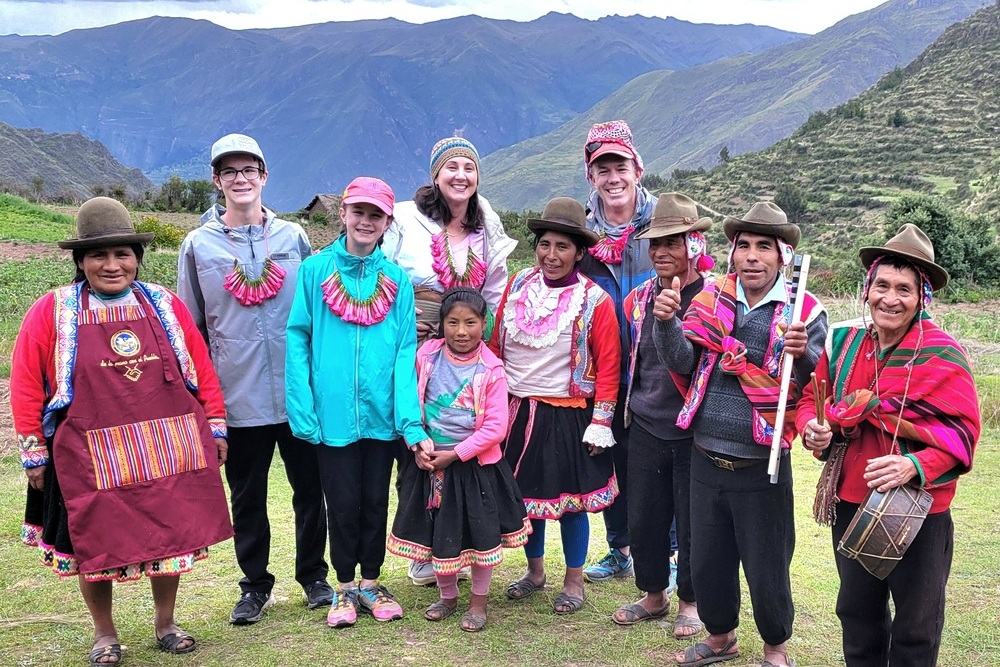
Traveler Audrey Moore and family with new friends in the Andes. Photo: Traveler Audrey Moore
“Our trip to Peru was one my family will remember forever. We started in the Amazon rainforest and saw so much wildlife at the Tambopata Research Center. This really felt like a special place, and we felt very far away from civilization. My kids loved the birds, monkeys and boat rides. The morning watching the macaws at the clay lick was a highlight.
We absolutely loved our time in the Sacred Valley and Cusco. The resort at Sol y Luna was so nice that we had to force ourselves to leave to go adventuring each day. Our favorite day of the trip was the day we spent at the Lamay village. It was so special to make friends and see how people live a simpler life high in the Andes. We also loved our one-day hike on the Inca trail into Machu Picchu—incredible!
The locals treated us with such kindness everywhere we went. There is so much to see and do in Peru…10 days just wasn’t enough!” —Audrey Moore
To get your own WOW trip, start with our trip questionnaire, reached via the black button below.
Colombia glows—from colorful arts, salsa dancing and rum tastings to swimming in bioluminescent waters
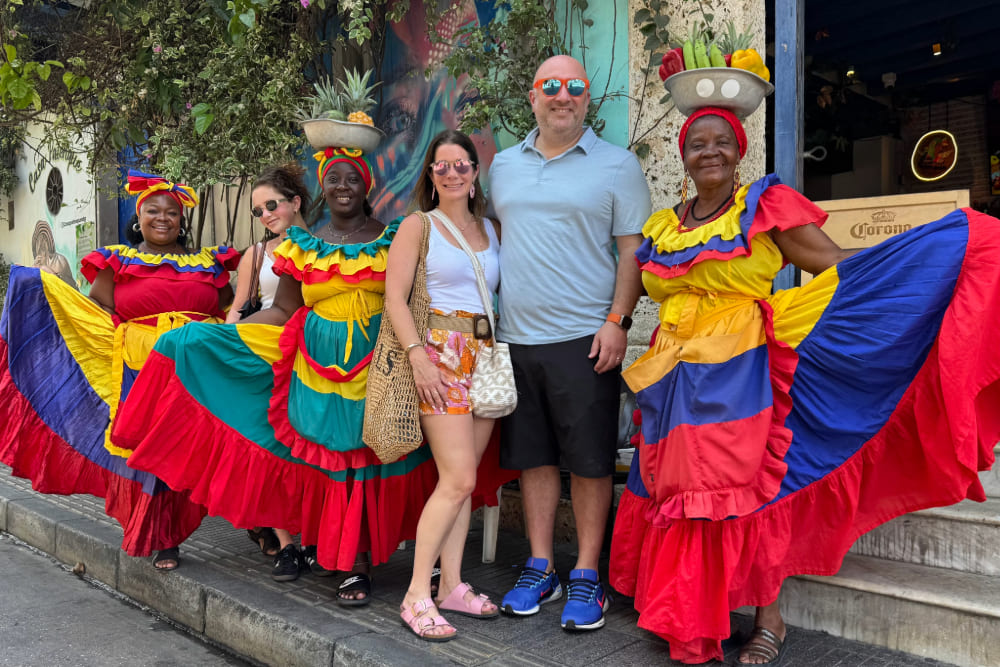
Traveler Lauren Schor and family with the iconic Palenqueras of Cartagena.
“Boris and his team put together a fabulous five-night getaway for our family of three. From our first conversation, I knew he understood exactly what we were hoping to get out of this trip—culture, food, activities, and some time to unwind. We took an easy five-hour direct flight from New York to Cartagena. We spent three nights relaxing at the Sofitel Barú beach resort, which is brand-new and a 90-minute drive from the airport and the city. Boris had suggested we do the bioluminescent plankton night activity, which we all loved! Swimming in the warm water with glowing microorganisms around us was incredible!
We spent another two nights at Casa Pestagua, a beautiful boutique hotel in the walled city. Cartagena is a colorful, picturesque, walkable small city with beautiful spots around every corner. Boris arranged some amazing activities for us: a private salsa dancing lesson in a nightclub; a chocolate, rum, and exotic fruit tasting; a street food tasting and street art walk; a historical tour of the city; and a cooking class on our last morning.
People back home were surprised to hear that we were going to Colombia because of the country’s history and reputation, but we never felt one bit unsafe. If you’re thinking about going to Colombia, go now, before it gets too popular and crowded, and definitely let Boris plan your trip!” —Lauren Schor
To get your own WOW trip, start with our trip questionnaire, reached via the black button below.
Brazil and Argentina: exploring ecosystems with “jaw-dropping” diversity, galloping in a gaucho town
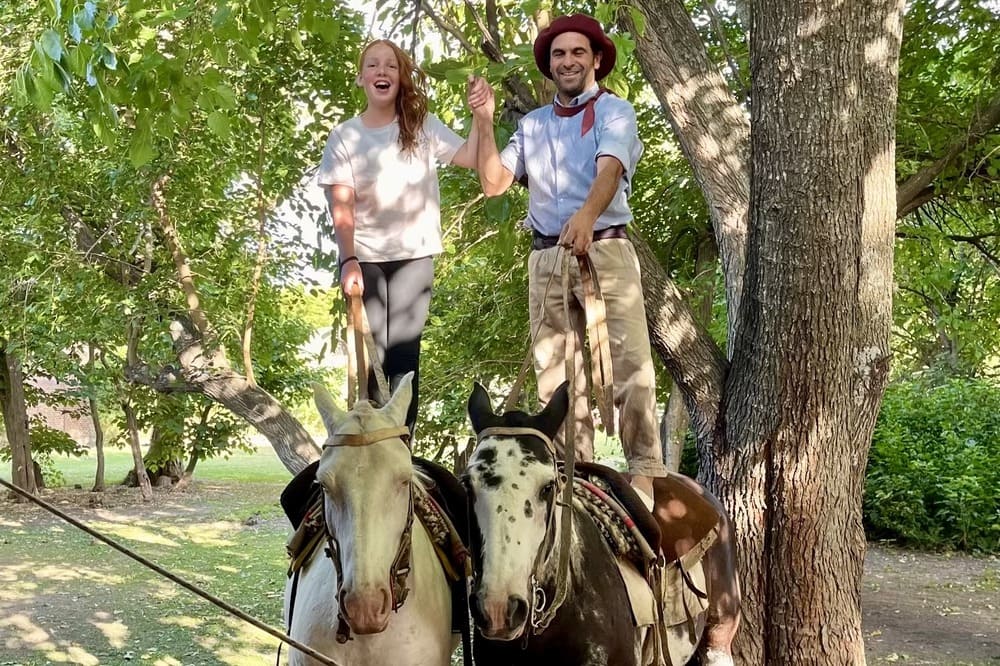
Gauchos take a stand in San Antonio de Areco, Argentina. Photo: Traveler John Strachan
“We spent a magnificent three weeks visiting Brazil and Argentina with our 11-year-old daughter and 13-year-old son. We hit six locales in 21 days (Rio, Paraty, and Iguazú in Brazil; Buenos Aires, Iberá National Park, and San Antonio de Areca in Argentina), but Paul and Lucinda’s itinerary made it work seamlessly.
Rincón del Socorro in Iberá National Park is one of the most wondrous places I have ever visited. My wife says the closest thing is safari in Kenya, and it felt very Out of Africa. It is a former farm that was bought and rewilded by the family that founded The North Face. What they have done is stunning. We stayed in one of their old cottages and spent the next few days exploring different nearby ecosystems on foot and e-bikes, in jeeps and a boat.
Right now, we live in Quito. People here weekend in the Galápagos. The Amazon is a four-hour drive away. This region is a biodiversity paradise. But I have never seen so many species of animals so active in one vista as I did in Iberá. While our portion of the Andes has among the highest concentration of bird species in the world, the trees, forests, and mountainous terrain often hide them from view. In the wide-open wetlands of Iberá, they are all right there in front of you—storks, rheas, egrets, herons, ducks, caracara, grebes, geese, macaws, parrots, cardinals, flycatchers, swallows, and more—mating, dancing, building nests, wading, hunting. It was jaw-dropping. So was the number of active mammals we saw—foxes, boar, four species of deer, capybaras, and peccaries. Also, turtles, snakes, and caimans. This place would be on every human’s bucket list if it were more widely known.
Then we stepped back in time, to the gaucho town of San Antonio de Areco. We had a quiet little three-room inn to ourselves. At night, we sat around the outdoor fire listening to legendary local troubadours play guitar and sing songs of old. It felt like we were treasured guests in a good friend’s home. The local gauchos taught our daughter to gallop and even had her standing on horseback, albeit while stationary.
Paul and Lucinda’s expertise in these two huge countries was invaluable. They turned our trip into a once-in-a-lifetime experience that we never knew was possible.” —John Strachan
To get your own WOW trip, start with our trip questionnaire, reached via the black button below.
Ecuador, Peru, and the Galapagos: “Truly astounding to be that close to these magnificent, endangered birds…”
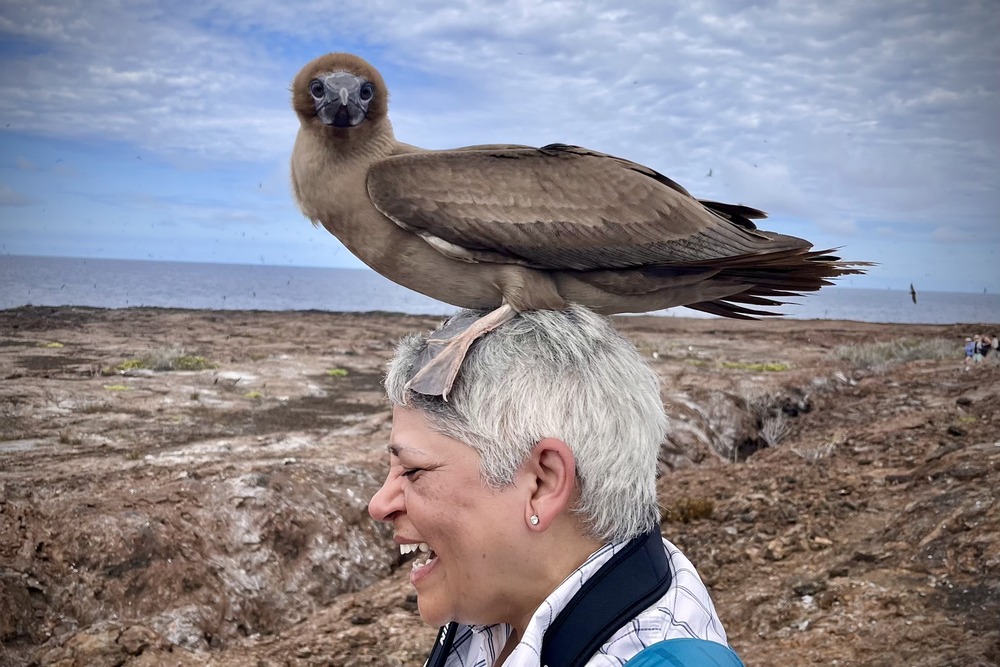
A red-footed booby “utterly unafraid” of visitors in the Galapagos. Photo: Traveler Rebel Rice
“Allie planned a trip of a lifetime for my husband and I, as well as four to six other friends. The highlight destinations of the group trip were: Machu Picchu, the Sacred Valley and Cusco; a Galapagos cruise aboard the catamaran, Elite; and the Ecuadorian Amazon at La Selva Lodge on Rio Napo. I am an experienced trip planner and traveler, but I could have NEVER pulled off this trip with this many people, in this many different places, with such superb guides and outstanding lodging.
We loved her recommendations for every single destination, the most important of which was the Galapagos catamaran, Elite. She definitely had to talk our group into the smaller boat, as well as the 7-day itinerary, because it was more expensive. However, the benefits of the catamaran Elite were well worth it. The Elite has large, comfortable staterooms, smooth motoring (except for one rough night), and superbly prepared and presented meals.
Machu Picchu reminds us of the Grand Canyon, in that the photos do NOT do the site justice. The scope of the ruin, as well as the greater insights one gains by being there, are incomparable.
If you ever had dreams of going to the Amazon, then visit La Selva, an eco-lodge on the Rio Napo. The rain forest experience is authentic and remarkable. The food is the highest quality, and they were fantastic at accommodating my dietary restrictions. We spent 4 days/ 3 nights which seemed like the right amount of time. Our favorite activity was the Macaw clay lick, where we saw a large flock of Scarlet Macaws that were then followed by 2-3 flocks of Cobalt-winged parakeets. Truly astounding to be that close to these magnificent, endangered birds. One of many wonderful things about La Selva, and the blackwater lagoon on which it sits: No mosquitoes. Really!
My husband and I ended our trip with a few days in Mindo, about two hours west of Quito in the cloud forest. We stayed at one of the best lodges we encountered, Las Terrazas de Dana. The value for money is remarkable. It’s walking distance from town, but set out in the forest. The birding was excellent, as were the other attractions in town, such as the 3 artisanal chocolate producers, the bird feeding stations, and the butterfly garden. The food in the many restaurants was delicious, as it was at the resort. We found this true throughout our time in Ecuador.
This was our 8th trip arranged through Wendy because we know that the guides will be great. They were the perfect match for our inquisitive, overeducated group.” —Rebel Rice
To get your own WOW trip, start with our trip questionnaire, reached via the black button below.
Peru: climbing Palcoyo, hiking the Inca trail, and conservation efforts at the Tambopata Research Center

Will and Kate Nury meet alpacas while climbing Palcoyo. Photo: Traveler Beth Nury
“We selected Peru as our destination due to the warm weather, direct flight, and time zone consistent with EST. Mark and his travel company did a great job of getting us acclimated to Peru’s higher altitude by starting our trip in Lima, then moving to higher elevated locations (Cusco) in preparation for our climb at Palcoyo, a lesser-known rainbow mountain with few visitors.
One trip highlight included hiking the one-day Inca Trail with our guide Johann. As with other trips booked with Wendy’s WOW List planners, the tour guides make the trip. Johann was patient with all of us (two teens and two adults that hike at different speeds!), knowledgeable about the plethora of relics we encountered, and willing to share the names of local restaurants in Cusco which were outstanding and affordable!
Another trip highlight was the Tambopata Research Center. Wildlife sightings were plentiful and the staff educated on the conservation efforts of the lodge. Temperatures are high, but the guides set a reasonable pace and planned hikes in the early morning, to avoid the afternoon oppressive heat.” —Beth Nury
To get your own WOW trip, start with our trip questionnaire, reached via the black button below.
Ecuador’s cloud forest: “It was like watching a National Geographic special, but right there in front of us…”
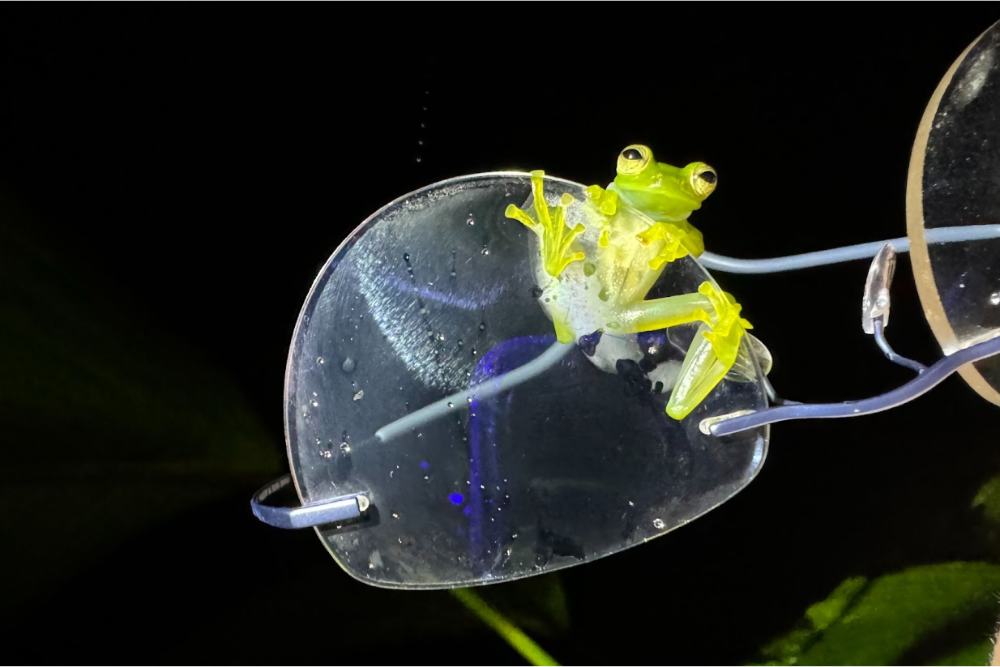
Traveler Robin Madden photographed this “Mashpi glass frog” clinging to her eyeglasses.
“We just returned from a 10-day trip to Ecuador, with our two adult sons and one of their partners, and unlike most, we did not include the Galapagos in the itinerary. We chose to visit the Amazon and stay at Napo Wildlife Center, and Mashpi Lodge in the Cloud Forest. These two places were chosen due to their commitment to the local communities and preservation of the incredibly biologically diverse ecosystems in which they are each set. Carmen on Jordan’s team put together a seamless experience.
Though remote, the Napo Wildlife Center is both elegant and comfortable. Our experience included a local guide from the indigenous community. The lodge is owned and operated by the local community—a rarity in luxury lodges. Mornings started early, 5:30, but oh, the payoff! We saw multiple species of monkeys, more than 40 different birds, caiman, river otters, and a sloth, as well as various snakes and insects.
At Mashpi Lodge, Fernando was our guide, and he is the ‘frog whisperer.’ He is a biologist who did research there prior to becoming a guide and identified a new species, the ‘Mashpi glass frog,’ which he found for us on a night walk. We had the extraordinary luck of witnessing a battle between a wasp and a tarantula. The wasp won, killing the tarantula and depositing her eggs inside to hatch in about 10 days. Fernando videotaped the whole encounter. It was like watching a National Geographic special, but it was right there in front of us.” —Robin Madden
To get your own WOW trip, start with our trip questionnaire, reached via the black button below.
Brazil: “We never felt uncomfortable or unsafe for even a minute…”
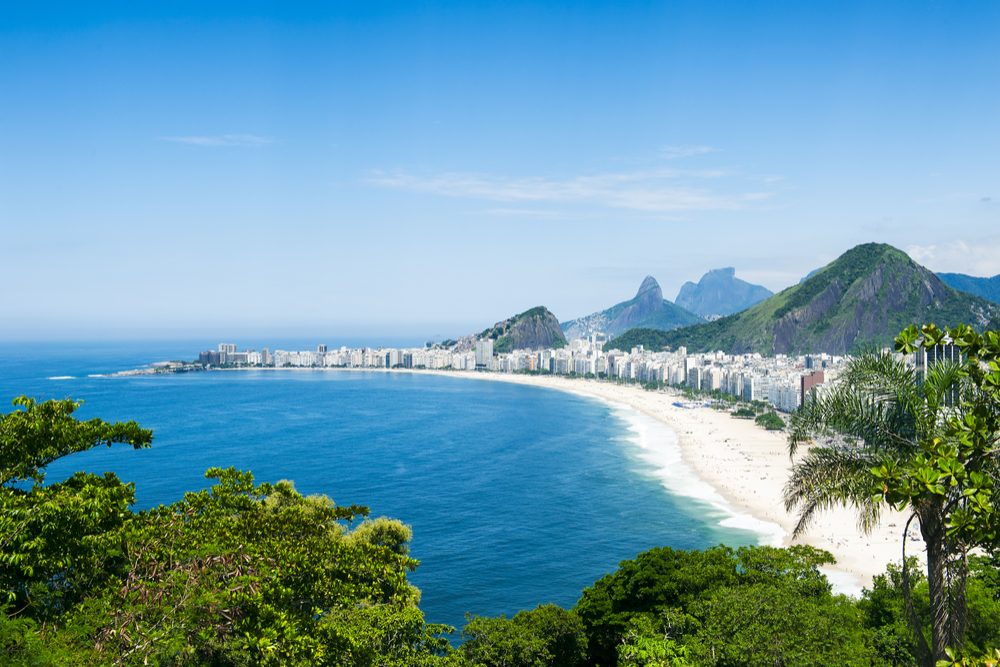
There’s nothing to fear in Rio when you’ve got the right local fixer. Photo: Shutterstock
“We booked a two-week trip to Brazil with Paul, and he came through big time. The best tour guide we’ve ever had, Lais, met us at the airport on arrival and transported us to the beautiful Hotel Fasano right on Ipanema Beach. We were able to spend two full days on the beach, where we really got a feel for the local culture.
My wife had wanted to see the dancers at Carnivale, but we didn’t arrive in Rio until it was over. Somehow Lais pulled off a miracle and found a group that was meeting in a public park and recreating their Carnivale performance. It was called a Samba Hangover Dance. We were able to hang out with the locals for a few hours and see the performance up close.
Then we went to the top of Sugarloaf Mountain, where we were met by a master craftsman who taught us how to make the best Caipirinhas we had on the entire trip. While in Rio we were able to eat at Garota de Ipanema, the cafe where Vinicius de Moraes originally saw the famous ‘girl from Ipanema’ go by before writing the lyrics to the song. On Paul’s advice, we also went to eat at Aprazivel restaurant in the hills above Rio for a delicious meal in a beautiful restaurant with an amazing view of the city below.
Next, we boarded a plane to Iguassu Falls. We stayed at the Hotel das Cataratas in the national park and only 100 yards from the falls. The hotel is the only one in the park and you often had the viewing areas to yourself. Our guide took us on a tour the next day of both the Argentinian and Brazilian sides of these gigantic, 2 ½-mile-wide falls. Seeing them was awe-inspiring, but taking a boat ride under them was exhilarating and an experience not to be missed. At Niagara Falls you get misted when taking the boat ride, but at Iguassu you actually go under the falls. It was safe and great fun.
We ended our trip with a stay in the colonial town of Paraty. We’d seen the big city while in Rio, the jungle in Iguassu, and now a peaceful, historical small town in the center of the country. Our stay at Casa Turquesa was magical. It’s a 9-room inn with a beautiful pool and lovely rooms. We enjoyed navigating the original rocky streets while visiting the shops in town. Paul had arranged a day trip on a schooner where we visited several bays and beaches and had lunch at a place that was only accessible by boat. It was a perfect, relaxing way to end our trip.
A final note about safety. In the United States we’d read traveler warnings and received a notice to beware of dengue fever from our government. Some friends were wary of us going to Brazil. In response I’d like to note that we never felt uncomfortable or unsafe for even a minute during our trip. Are there places in the city of Rio that you shouldn’t visit? Of course, just like in New York City. So don’t go there. Your guides will help you with that. I’ve told friends that Rio is like NYC, but with a better view. Even though we’d taken mosquito repellent to avoid getting dengue fever, we only used it once the whole trip and I never saw a mosquito the whole time.” —Ted Embacher
To get your own WOW trip, start with our trip questionnaire, reached via the black button below.
Ecuador & the Galapagos: “A 300-year-old hacienda that seemed like it belonged to a dear family friend…”
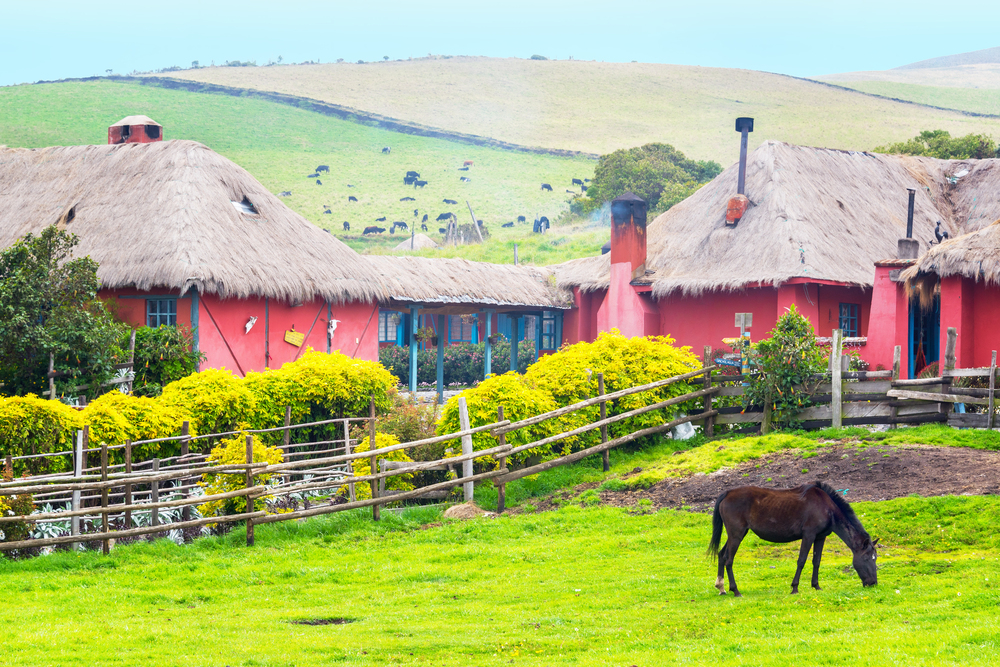
A colonial hacienda near Cotopaxi Volcano in Ecuador. Photo: Shutterstock
“We wanted a balance of active adventuring and some much-needed downtime for a spring-break trip as a family and Allie more than delivered! Between a delightful boutique hotel in Quito’s old town, Casa Eden, with proprietors who fussed over our kiddo like their own grandchild, to a 300-year-old hacienda in Otavalo that seemed like it belonged to a dear family friend (with the family’s friendly horses wandering through to say hello to visitors and the chef happily teaching us how to make empanadas or offering samples of freshly made local gelato), we had ample time to relax.
Allie set us up with fantastic drivers/guides throughout Ecuador, with special shout-outs to our guide who took us to see artisanal chocolate being made, to eat bizcochos at a super-local non-touristy spot, and to meet a weaver whose family has made award-winning textiles in the same manner for hundreds of years, as well as set us up with great hiking and exploring by foot and horseback, incredible meals, and a stop at the equator (I was skeptical of the museum but it’s a hidden gem and great for families).
Allie also connected us with a breathtaking week in the Galapagos on the Ocean Spray: We had incredible experiences snorkeling, kayaking, and on some of the smaller islands, where our naturalist, Enrique Silva, really took the time to interact with us and point out things for our kid (who was a first-time snorkeler but by the second day was cruising everywhere thanks to his help). The catamaran was very comfortable and the rooms quite large—but the real highlight was the warmth and kindness of the staff and crew (and the food—which was phenomenal).” —Katherine Sanders
To get your own WOW trip, start with our trip questionnaire, reached via the black button below.
Chile: “The terrain was so varied it felt like we had gone to a different planet each day…”
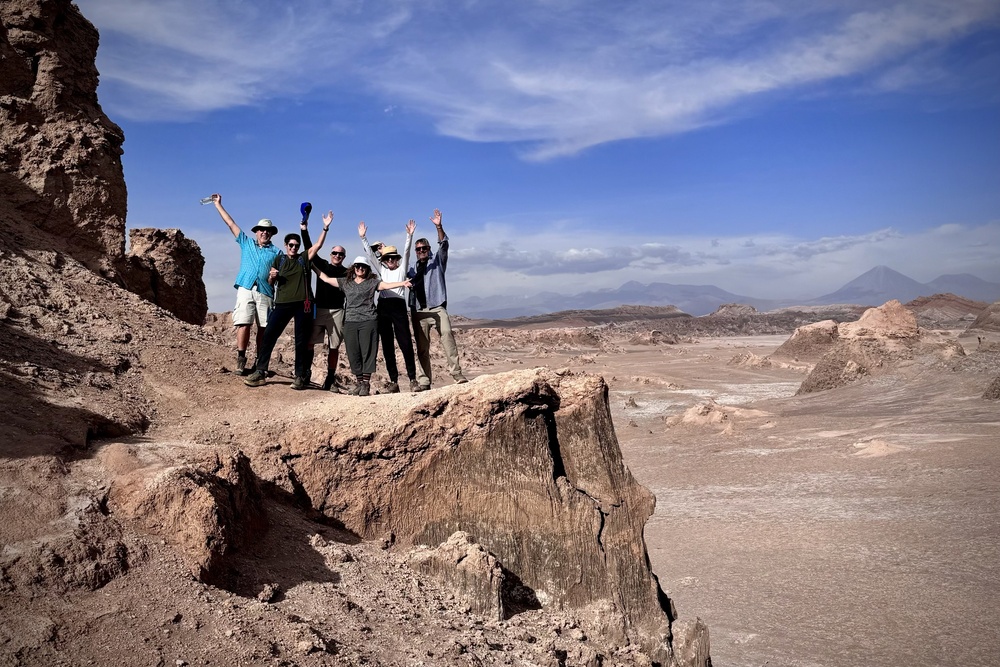
Traveler Laurie Richter and friends above Moon Valley, in Chile’s Atacama Desert.
“Visiting BOTH Patagonia and the Atacama Desert is an absolute must. The beauty and ruggedness of both places was unsurpassed. They were pristine and there were very few other people or vehicles. And they were so different from each other.
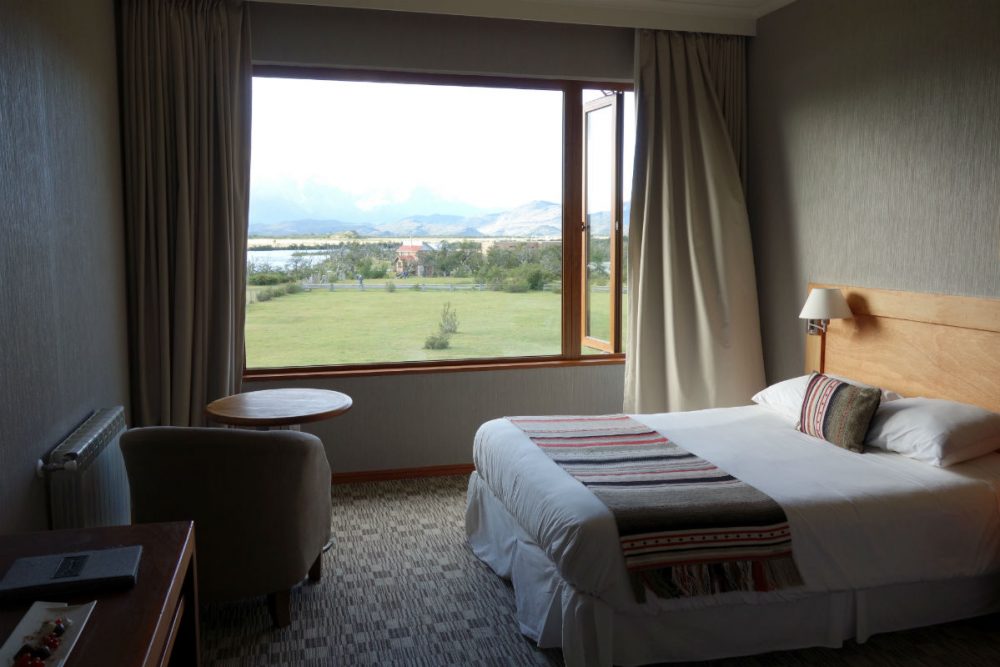
The scenery in Patagonia is breathtaking—newly formed mountains, green glacial lakes, layers upon layers of natural formations. Explora Lodge wasn’t fancy but the location was unsurpassed, and the quality of the guides and excursions available provided something for everyone. We mostly hiked and, with the windy conditions there, even a simple hike was pretty strenuous. Try out the spa and the outside hot tubs.
On to the Vik Chile in wine country, outside of Santiago. Spectacular facility in a beautiful setting with a wonderful winery. The food in the restaurant is spectacular and not to be missed. The winery tour and tasting was a highlight as well.
Then on to the Atacama Desert, which may have been the unexpected highlight for me. Again, wonderful lodging (Nayara Alto Atacama) with terrific service and, again, some of the best food you can imagine. The terrain was so varied it felt like we had gone to a different planet each day. You are at elevation (8,000 at the lodge and up to 14,350 at the geysers) so you need to be prepared for that, but everyone in our group was fine. You do spend a lot of time in the vans, as most of the hikes and sites are 45 minutes to an hour and a half away, but this isn’t Disneyland, and no lodge can be close to everything.
I can’t stress enough that, if you can afford the time and money, make sure to see both Patagonia and the Atacama Desert. Unforgettable.” —Laurie Richter
To get your own WOW trip, start with our trip questionnaire, reached via the black button below.
Colombia: “Incredibly varied landscapes, fresh and diverse food everywhere, and warm locals willing to share their stories…”
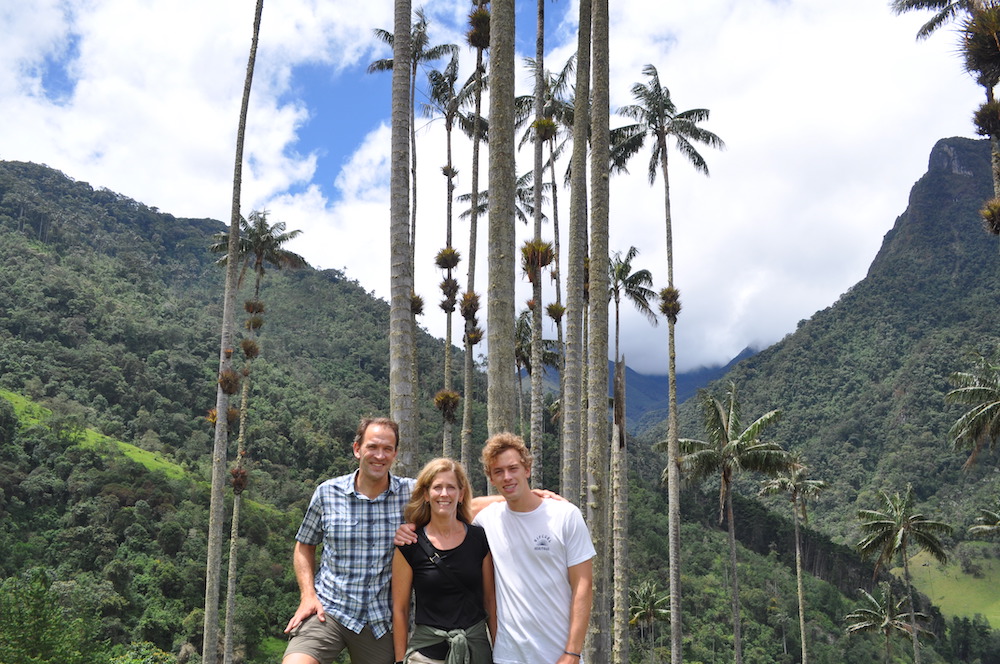
Traveler Tracy Reller’s family hiking near Colombia’s coffee-growing region.
“Colombia is a beautiful country with incredibly varied landscapes, amazing agricultural bounty (mostly done by hand—saw only one tractor the entire time), wonderfully creative, fresh and delicious food everywhere, and warm locals willing to share their stories.
Boris arranged activities that we either wouldn’t have been able to do on our own or wouldn’t have been the same. They turned out to be some of our favorite experiences. For example, we toured two different poor neighborhoods in Medellin with Spanish-speaking neighborhood leaders involved in the graffiti art transforming the neighborhood. It was fascinating to see these communities up close and to hear their stories of the violence and hopes for the future.
Another favorite experience was visiting very different markets used by locals. First, Paloquemao in Bogota—very clean, well organized, items from produce to meats/fish to home goods and flowers, beautifully presented. That was in contrast to the Barzuto market in Cartagena, where we seemed to be the only tourists navigating the dirt floors, tight winding walkways though makeshift stalls, fish and meat sitting in open hot temperatures with a French chef shopping for our cooking lesson (we only bought produce there). It was a sight to see!
Finally, we would not have known about some amazing restaurants we visited for lunch that were not even in our itinerary. One of those restaurants, in Bogota, didn’t even have a sign out front, but our guide knocked and was welcomed in. Our hotels were all wonderful and a welcome respite at the end of every day. Most outstanding were the Four Seasons Casa Medina in Bogota, Hacienda Buenavista in the coffee region, Villa Playa Tayrona, and Casa San Agustin in Cartagena.
Our guides were wonderful and really added to our experience. They were intelligent, interesting and informative. It’s a gift to get to spend time with a local, get to know them and share details about our lives. We gain a better understanding of a country and its people with a guide rather than just crossing tourist sites off a list.” —Tracy Reller
To get your own WOW trip, start with our trip questionnaire, reached via the black button below.
Bolivia: “The unobstructed expanse of the isolated sand flats makes star-gazing on the Salar de Uyuni a truly spellbinding experience…”
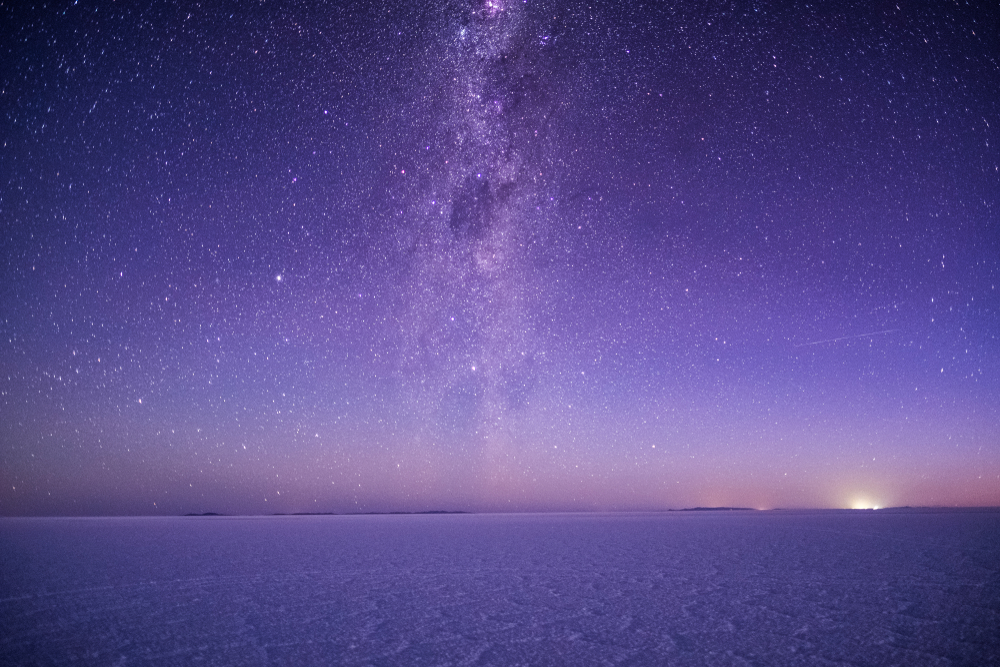
Bolivia’s Salar de Uyuni salt flats reveal a vast and bright night sky. Photo: Shutterstock
“Our trip was amazing—from visiting the salt flats to checking out a silver mine, boating on Lake Titicaca in Peru, visiting cathedrals and museums, eating delicious foods, and meeting wonderful people.
We were delighted from start to finish with Marisol and Mark’s exceptional advice and service, and a big thank-you to Wendy for the WOW Moment: The unobstructed expanse of the isolated salt flats make star-gazing on the Salar de Uyuni a truly spellbinding experience, as the full breadth and immensity of the night sky can be observed and appreciated with the telescope provided or with the naked eye. Located at altitude with almost no light pollution thanks to a sparse population, the Salar de Uyuni is one of the best places to stargaze in South America.” —Dominique Tran
To get your own WOW trip, start with our trip questionnaire, reached via the black button below.
The Galapagos Islands: “We had access to sites rarely seen by visitors…”
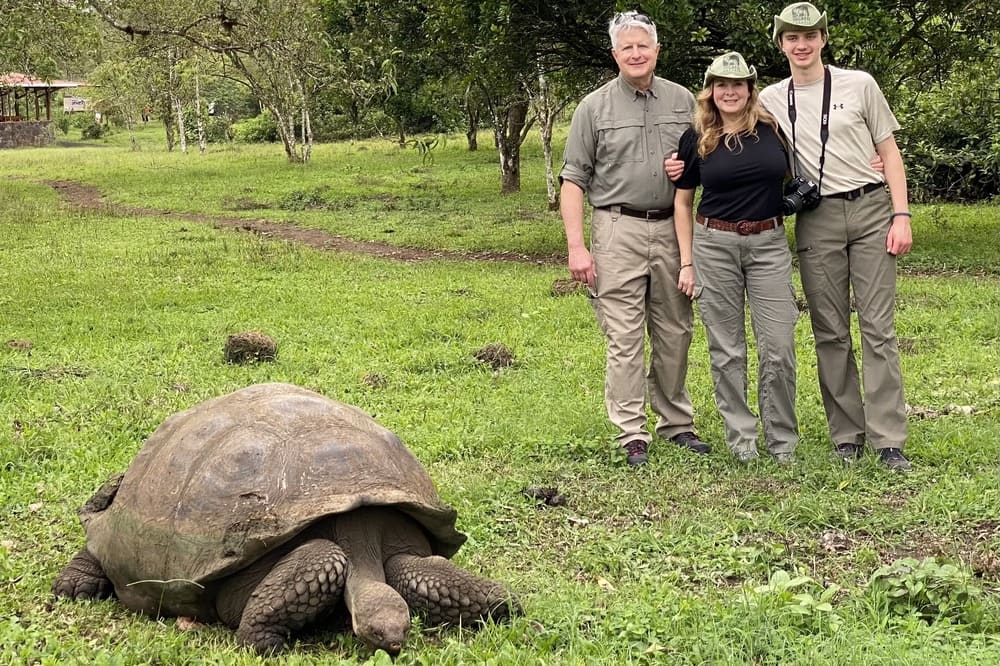
Traveler Shelby Willets with her family enjoyed some face time with a giant tortuga.
“Allie planned an adventurous 2-week land-based tip to the Galapagos for our family of 3 over winter break 2024. Traveling with our teenage son, we like to keep an active schedule. Allie understood the assignment and delivered an action-packed vacation. Highlights included a private kayaking excursion where we had access to sites rarely seen by visitors, snorkeling with playful sea lions and SCUBA diving with schooling hammerhead sharks—a bucket list item. For our WOW Moment, we were treated to a private photo shoot with the giant tortugas—perfect timing for our Holiday cards!
Since we booked our trip less than a year in advance, Allie had to work some magic to find large hotel rooms that would accommodate the 3 of us. As a result, we stayed at three different hotels. Which was not a hassle as Allie arranged for our luggage to be transported from hotel to hotel while we were out exploring. We actually enjoyed experiencing 3 different properties.
We enjoy traveling with Wendy Perrin’s trusted travel experts as it makes our vacations true vacations—we know that the details are taken care so we can relax and enjoy our time together as a family.” —Shelby Willets
To get your own WOW trip, start with our trip questionnaire, reached via the black button below.
Patagonia, Chile’s Atacama Desert, and a private astronomy evening at an observatory
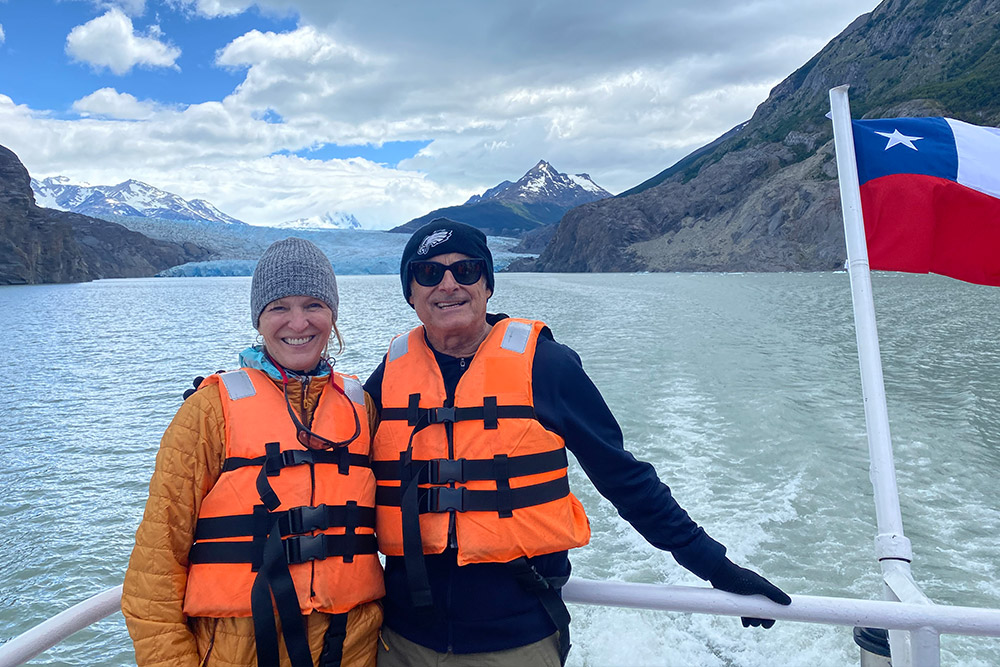
Barbara Schoenfeld and her husband enjoying a Christmas Eve cruise on Grey Lake.
“Tom designed a Christmas/New Year’s trip to Chile for our family of six. He rose to the challenge of transporting us down and back up half the length of the continent. He organized visits to both Patagonia and the Atacama Desert, securing rooms at Hotel Las Torres in Patagonia and Explora Atacama. Both were excellent choices for their top-notch adventure staff and boutique experience.
He pretty much had to plan three trips because we originated in San Francisco, New York, and New England, and we had three different time frames. He and his staff handled the transportation logistics smoothly.
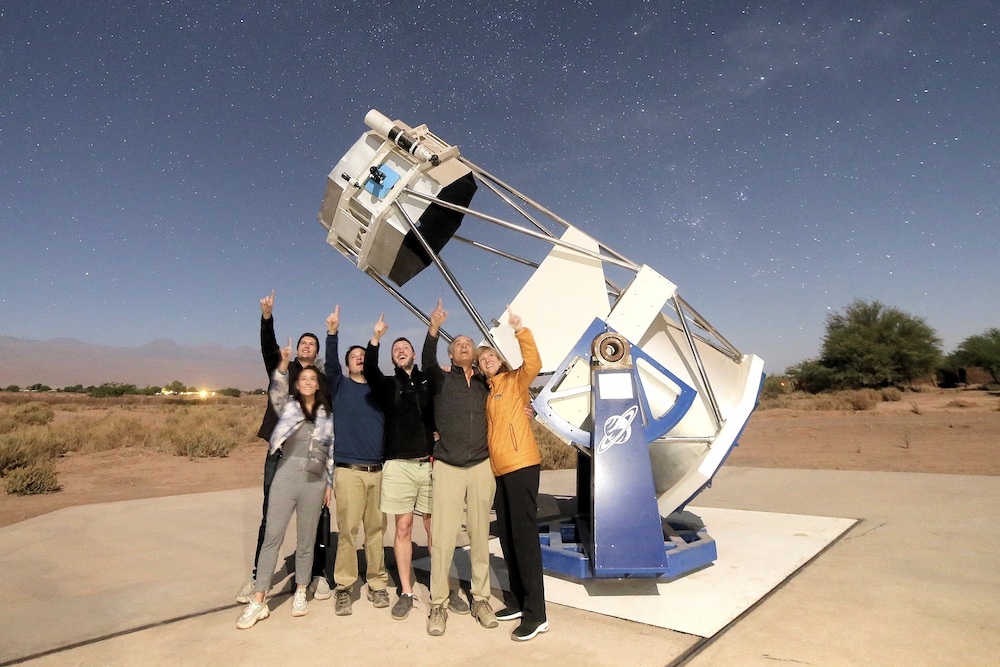
Alain Maury’s SPACE Observatory, Chile. Photo: Barbara Schoenfeld
And I’m not just saying this because I’m writing a review for Wendy’s WOW List, but the best part of the trip was the Wendy WOW Moment. We had a private stargazing evening, hosted by French astronomer Alain Maury, at his observatory called SPACE (San Pedro de Atacama Celestial Explorations). Above is the photo he took of us in front of one of his telescopes. Plus we have a video he recorded on my son’s cell phone where he described what we were seeing on the Sea of Tranquility on the moon—particularly the smudge where the US Apollo 11 landed.” —Barbara Schoenfeld
To get your own WOW trip, start with our trip questionnaire, reached via the black button below.
Trekking in Torres del Paine, Patagonia: “Oh my goodness, what a location. Scenery, wildlife…it absolutely has it all.”
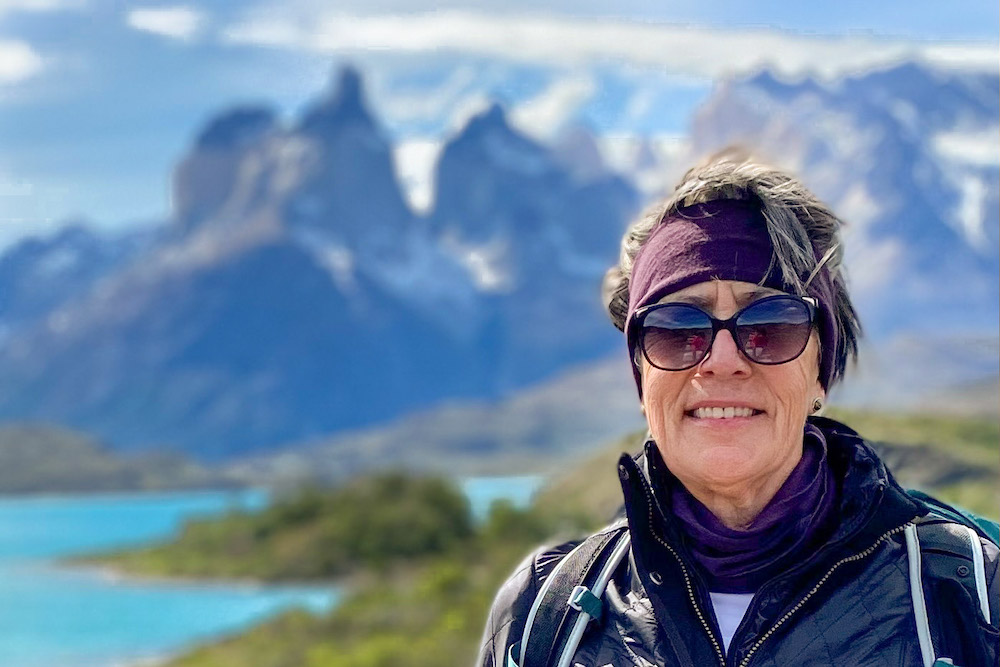
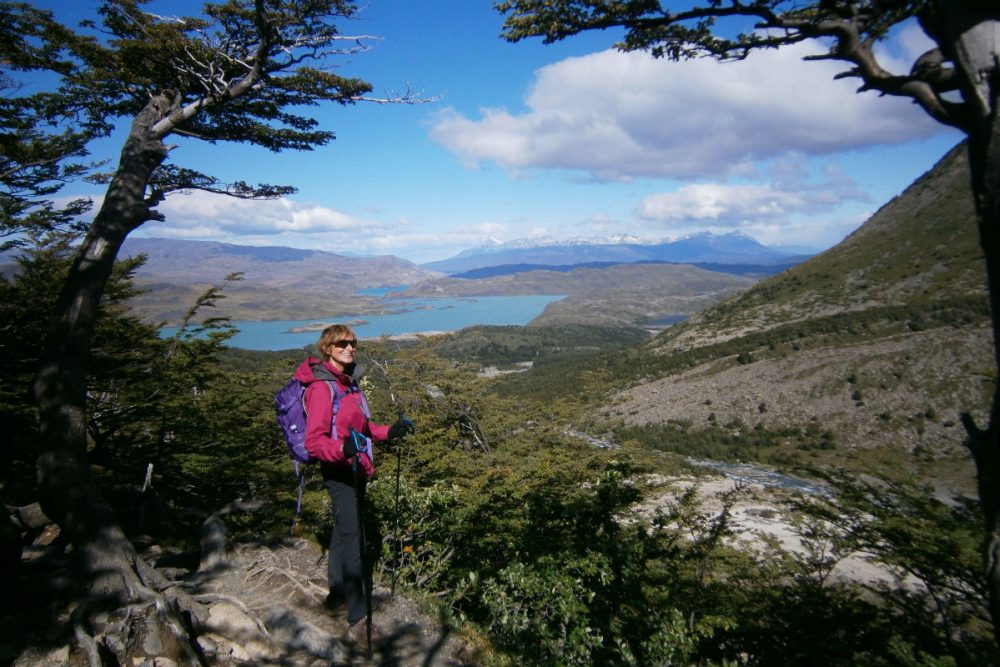
Traveler Jeannie Mullen in Torres del Paine National Park.
“Since returning from two weeks of trekking in Patagonia, I can’t quit showing off my trip photos! Every time I looked, a National-Geographic-worthy photo leapt into my iPhone.
My goal for this trip was to get in as much trekking as possible—specifically, I wanted to see what my improving fitness level would allow me to do and challenge myself to do more but still get home in one piece. Tom‘s trip suggestions and logistics planning were spot-on, and he was able to secure great private trekking guides in each location of the trip, as I wound my way through Chile and Argentina.
First, Torres del Paine: Oh my goodness, what a location. Scenery, wildlife… it absolutely has it all. Tom suggested that Explora was the most advantageous location to do the sort of trekking that I was interested in, and it was perfection.
My guide for three days, Francisca, was delightful, knowledgeable, and encouraging. On our first half-day trek to view wildlife, we saw everything, including the elusive puma… taking an afternoon nap. We had him all to ourselves for over an hour. On some very long, back-to-back treks over the next two days (Grey Glacier and the French Valley), she and I had some terrific conversations, shared our personal stories, and learned a lot from each other, given our different cultures and generations.
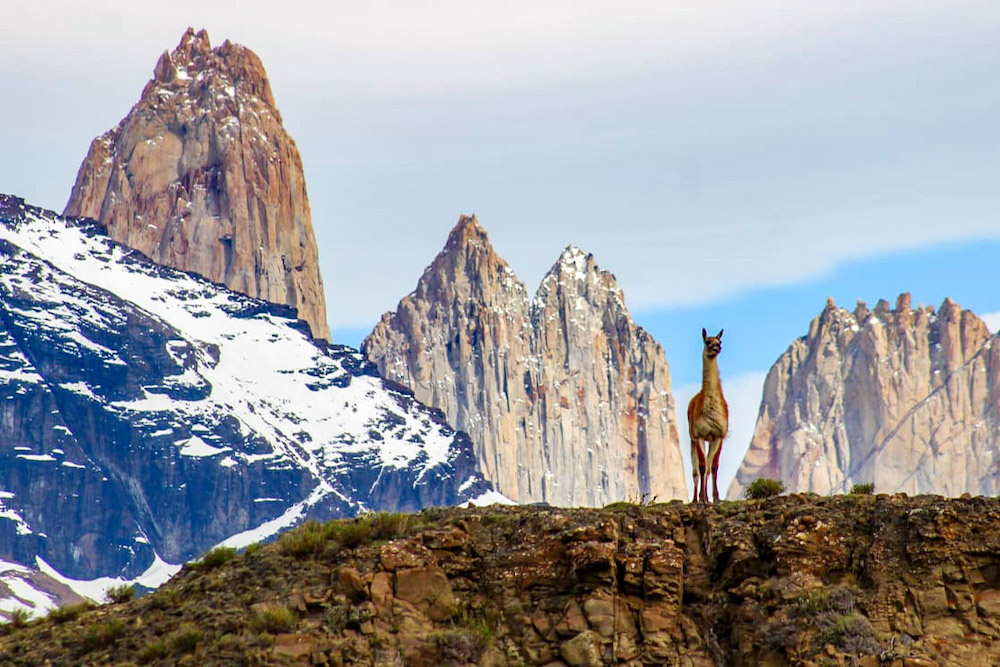
Guanacos (close relatives of llamas) are among the few residents of Patagonia. Photo: Traveler Jeannie Mullen
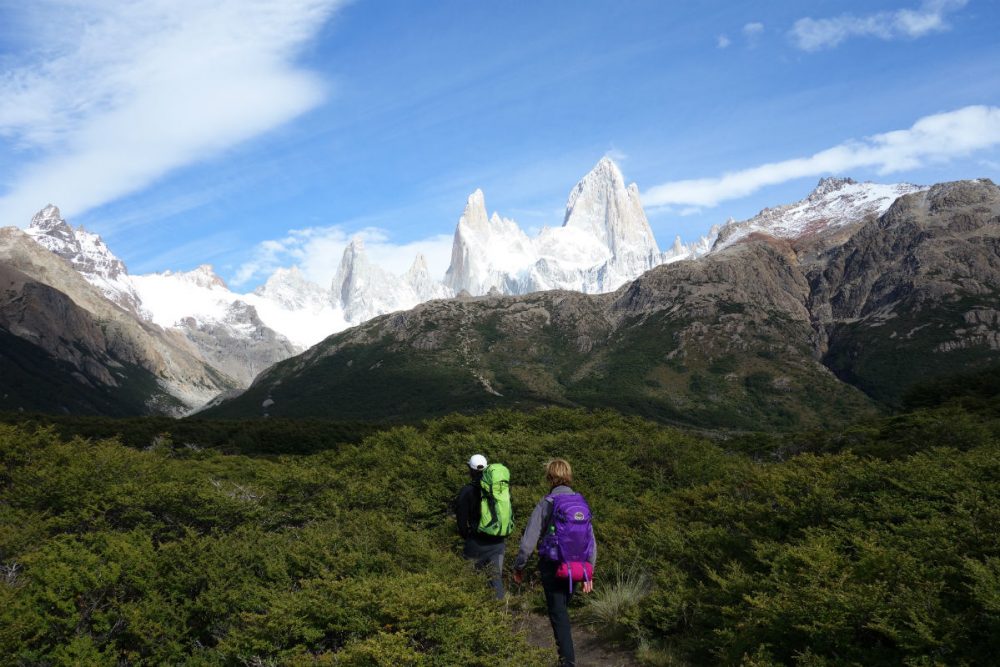
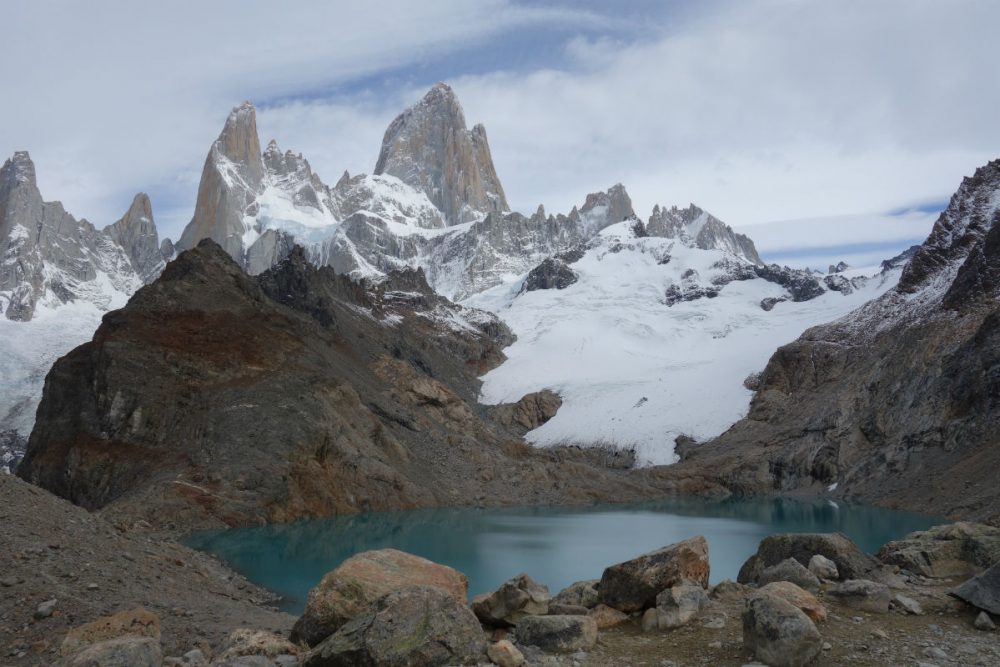
Crossing the border and entering Argentina, I was seamlessly transferred to another guide and driver, Juan and Beto, who showed me some of Argentina’s most gorgeous terrain. We hiked to the base of Cerro Torre and the very next day to the base of Fitz Roy. I have to confess I had serious doubts that I could do these hikes, but Juan was very encouraging and guided me through… he took my goal seriously… and I had three gorgeous treks in El Chalten (and sore feet) to show for it.
On our way back to Calafate to view the Perito Moreno glacier, Juan and Beto invited me to share the mate (mah-tay) experience with them—a tradition practiced by all the locals: a warm emulsion of (mostly bitter) local herbs. I was so thrilled to be offered the opportunity to experience it the way the locals do (versus ordering it at a restaurant just to say that I had). I’m pretty sure that Juan and Beto got a kick out of watching the “gringa” trying to finish it, which one must do before returning it to the one who prepares it.
On to Ushuaia for a final three days of trekking through Glacier National Park. Ushuaia is not on everyone’s radar screen, unless there is a cruise to Antarctica involved, but it should be. It’s an interesting, evolving place in a very remote part of the world that you don’t really hear that much about. The mountains on Beagle Channel make for some really striking views. On our hikes (through sun, wind, light rain, and even a curious 10 minutes of hail which happened on a clear, sunny day) my guide, Santiago, was very engaging and shared a lot about his country (current economy, government, growth and job opportunities in Ushuaia) and his family.
I leave in just under a month for another hiking trip that Tom planned for me over the upcoming holidays—in Chile’s Lake District. Stay tuned!” —Jeannie Mullen
To get your own WOW trip, start with our trip questionnaire, reached via the black button below.
“The real Argentina,” experienced through food, art, people, and nature…
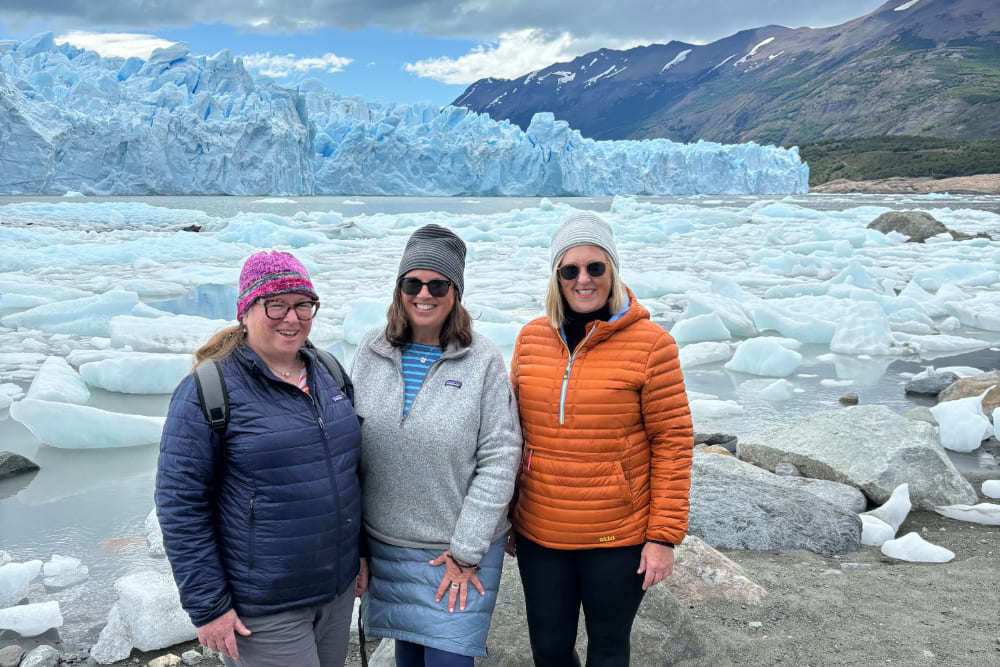
“To see the glaciers up close was an incredible experience!” says traveler Peggy Murphy.
“We have just returned from a wonderful two-week birthday trip to Argentina planned by Maita and Malena. During the planning session we told Maita we wanted to experience ‘the real Argentina’ through food, art, people, and nature. She listened and then planned an exceptional trip that exceeded our expectations.
The tone of our trip was set the minute we landed as we were lucky to see the Jacarandas trees in full bloom. This natural beauty was repeated throughout our adventures in Buenos Aires, Lujan de Cuyo Valley and Uco Valley in Mendoza, and finally Calafate. To see the glaciers up close was an incredible experience. Maita and Malena created many unforgettable moments for this special trip which included birthday wishes at every restaurant and resort. We also enjoyed a variety of restaurants that showed us the many layers of Argentina. Each restaurant was better than the last. One of our favorite dining experiences was at the Asado where all the food was cooked by women chefs! We are looking forward to sharing some of our favorites with our family back in the States, as the team was kind enough to send recipes!
We were also grateful for Maita and Malena’s suggestions where to stay in each location. We loved the seclusion of Eolo and the beauty of Cavas Wine Lodge. Cavas quickly became our favorite resort as we sat on our terrace looking at the sunset sipping wine! Also, the special birthday dinner on our terrace at Cavas with a fire, the sunset, and a sampling of the foods and wines of Argentina will be a memory to last a long time!
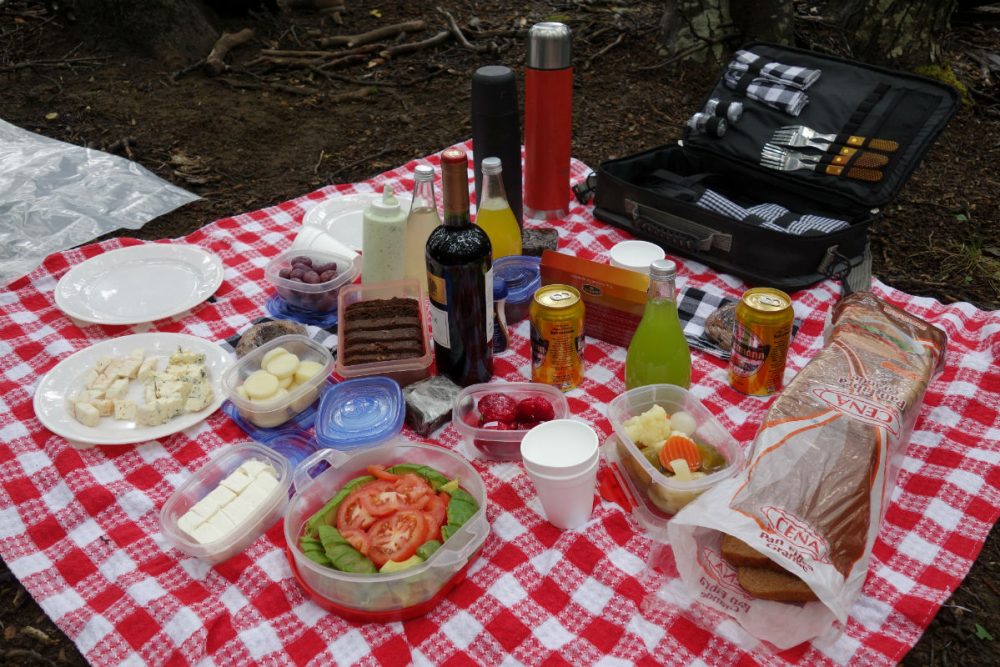
Highlights of our trip included meeting two very talented artists: visual artist Sergio Roggerone and his lovely wife Marina and silversmith Juan Carlos Pallarols. Each of these artists were generous with their time. We enjoyed talking with them, learning about their art, and sharing common experiences. We also enjoyed our visit to the Monastery of the Preaching Christ and spending time with Father Diego and his dog! And of course what would a trip to Argentina be without a little (or in our case a lot) of wine tastings. We most enjoyed wine tasting when it was paired with delicious lunches at Lagarde Winery, Zuccardi Piedra Infinita Winery and our WOW Moment of a gourmet picnic lunch on the grounds of another beautiful winery. We look forward to sharing our wine purchases with friends and family back home!” —Peggy Murphy
To get your own WOW trip, start with our trip questionnaire, reached via the black button below.
“The Moai and the Maipo”: Chile’s Easter Island (Rapa Nui) paired with wine tasting in the Maipo Valley
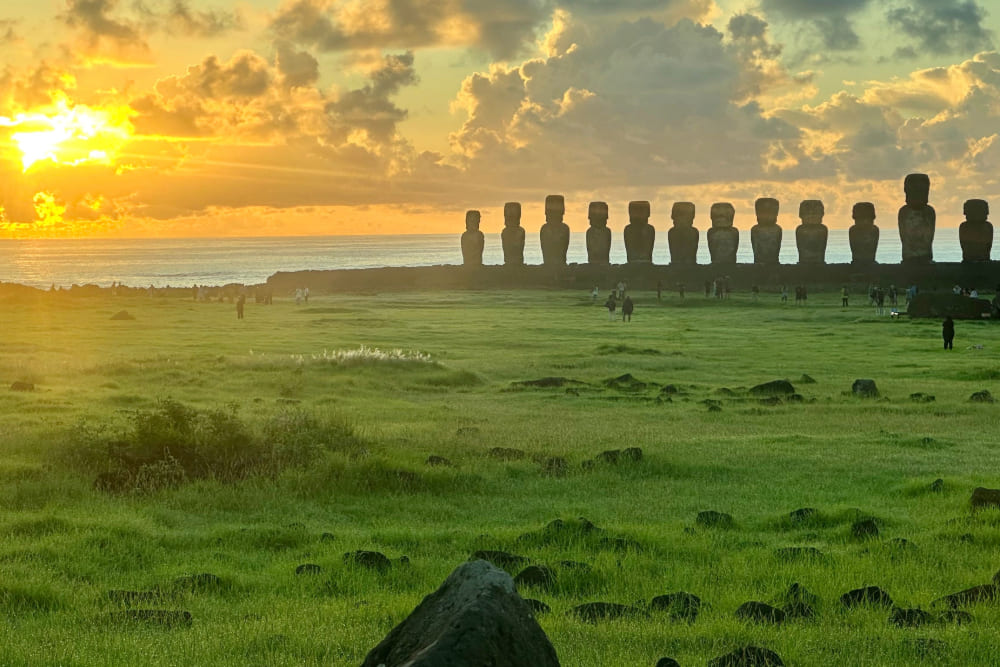
The Rapa Nui statues inspire awe in visitors. Photo: Traveler Michael Ruma
“We enjoyed the nearly 6-hour flight from Santiago to Rapa Nui, home to only 9,000 locals and two daily flights of tourists.
Most visitors spend 2 or 3 nights, but we were grateful to have booked a solid week as there is plenty to discover on the island. We spent our days hiking each of the three extinct volcanoes, snorkeling and scuba diving, discovering caves and lava tubes, and dining on nearly everything offered by Explora. The highlight of our time in Rapa Nui is exceedingly difficult to select as the Moai at sunrise and at the quarry were indescribable, the peak of the Bird Man hike had views of the bluest sea glimmering below the volcanic crater, and the clarity of the ocean water beneath the surface was beyond description. However, we will never forget the serene silence of the island and the mystery of how the Rapa Nui people carved and carried the innumerable statues all around the island.
As we boarded our flight back to Santiago, we were reminded of yet another benefit of traveling under the guide of a trusted travel partner. Just prior to takeoff, Alexander sent me a text to inform us nearly the entire country of Chile was suffering a blackout. He assured me the airport was fully operational due to backup generators and our ride to our hotel in Pirque in the Maipo Valley was on their way and would be waiting for us despite the national power outage. Reassured with the seamless teamwork occurring behind the scenes, we enjoyed our departure and flight back to Santiago.
Arriving late to Hotel Las Majadas, we explored the beautiful palatial grounds before heading out for wine tasting followed by a cocktail making class before dinner. Recognizing our love of wine, the hotel concierge, Pablo Garcés, made sure to share the secrets of the Maipo Valley and places we should not miss during our stay. One of these closely held secrets included Viña Don Melchor, which recently had their cabernet sauvignon named Wine Spectator’s 2024 Wine of the Year. We queried Pablo to see if it was possible to schedule a tasting at Don Melchor and likely due to his relationship with the vineyard, we were able to book a private tasting the next day. Met by the vineyard manager at the large gates of Viña Don Melchor, we were guided through the private gardens, down to the cellar of Casillero del Diablo, and then into the former private home of Don Melchor for a private blending tasting to demonstrate how the winemaker creates the best-in-class cabernet.
It may be possible to purchase a plane ticket and book a hotel room. However, without the assistance of Wendy Perrin and her network, we as travelers would never be able to sew the patchwork of professional drivers and adept guides who created the exemplary experiences and special moments during our trip to the Moai and the Maipo.” —Michael Ruma
To get your own WOW trip, start with our trip questionnaire, reached via the black button below.
Patagonia and Argentina Lake Country: “Imagine hotel rooms with drop-dead views of lakes, mountains and volcanoes…”
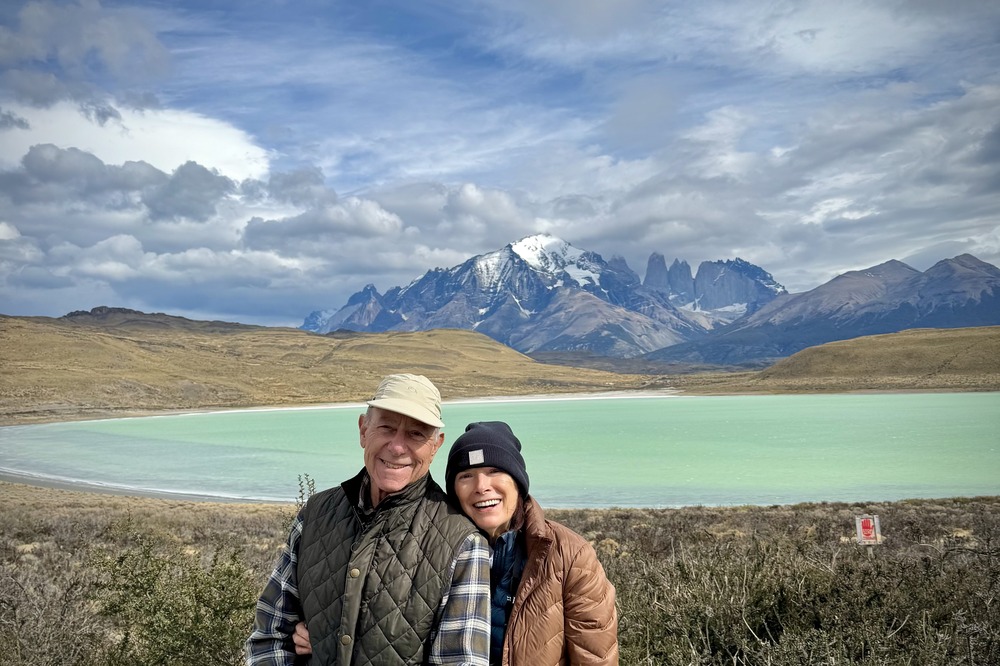
Traveler Kitty Bean Yancey’s guided hike in Torres del Paine National Park.
“Imagine hotel rooms with drop-dead views of lakes, mountains and volcanoes and interacting with some of the warmest people we’ve ever encountered. That made our amazingly well-planned trip to Patagonia and Argentina Lake Country one of the more memorable trips in decades of travel. Krista and Jordan steered us to fantastic hotels and lodges (most off the beaten tourist track as we requested) and secured us exceptional rooms and activities, including dinner at a chef’s home and a private horseback ride.
Our WOW Moment was the best we’ve had. We were taken to an historic estancia and entered the ranch house to find a locally famed musician and his daughter and son ready to give us a private concert of his songs about Patagonia. We’ll remember it always, as well as the four-course lunch including perfectly roasted guanaco and homemade matcha tea/fig ice cream.
I’m a semi-retired travel writer, but use Wendy’s WOW List experts to explore new territory because they can ensure a special trip with insider experiences.” —Kitty Bean Yancey
To get your own WOW trip, start with our trip questionnaire, reached via the black button below.
Be a smarter traveler: Sign up for Wendy’s weekly newsletter to stay in the know. Read real travelers’ reviews, then use the black CONTACT buttons on Wendy’s WOW List to reach out to the right local fixer for your trip.