Tag Archives: airline travel

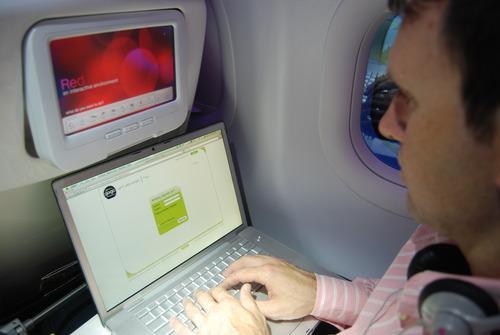
Virgin America Wi-fi

Wi-Fi Report Card: Which Airlines Keep You Connected the Best?

For Internet-addicted business travelers, an in-flight announcement that “Wi-Fi is down at the moment” is enough to induce the shakes. And getting booked on a flight that doesn’t offer Wi-Fi at all is enough to send them into fits of rage.

Fortunately, a new study finds plugged-in road warriors had less reason to panic over their in-flight connectivity last year. And 2015 looks even better.


Also from Yahoo! Travel: The Wi-Fi Race: What Are the Best-Connected U.S. Airlines?


A new report by travel website Routehappy finds U.S. flyers now have at least “some chance” of finding Wi-Fi on 66 percent of domestic flights. In contrast, Routehappy’s last report, in June 2013, found Wi-Fi connectivity on less than half of domestic flights. And the story is getting brighter internationally too.

So what’s the Wi-Fi state of the union? Here are the main highlights of Routehappy’s “Global State of In-Flight Wi-Fi” report.

Routehappy Wi-Fi report

Virgin America is out in front on percentage of flights with Wi-Fi. But when you look at the total number of Wi-Fi-connected flights, it’s another story. (Photo: Routehappy)

Wi-Fi is growing like a weed on U.S. air carriers.

Overall, Virgin America leads Routehappy’s list, with the highest percentage of total flights and flight miles with Wi-Fi (that’s not surprising; unlike many other carriers, all of Virgin America’s planes offer Wi-Fi). Southwest is in second place.

But when you’re talking the raw total number of flights that offer Wi-Fi, Delta Air Lines—which runs many more flights than Virgin—is number one by far. It’s followed by the newly combined American Airlines/US Airways.

Delta Wi-Fi

Because of its size and aggressive upgrades, Delta has more Wi-Fi connected flights than anyone. (Photo: Delta)


Also from Yahoo! Travel: No More In-Flight Wi-Fi for AT&T


United Airlines did top one domestic category: Wi-Fi growth. In Routehappy’s last survey, United offered at least “some chance” of Wi-Fi on 518 U.S. domestic flights. Today, that number is 1,445 flights—a 179 percent increase. American/US was a distant second with a 23 percent increase, followed by Delta with 15 percent.

“Domestically, Wi-Fi is being offered on more flights than ever before,” Jason Rabinowitz, data research manager for Routehappy, tells Yahoo Travel. “All mainline airlines have either finished or are nearly finished rolling out Wi-Fi to their entire domestic fleets.”

It’s not just what airline you fly—it’s where you go.

Routehappy finds that all the busiest U.S. domestic routes (20 daily flights or more in each direction) have Wi-Fi availability on all flights. That includes: New York’s JFK to Los Angeles; New York’s LaGuardia to Boston; LaGuardia to Washington-Dulles; New York’s JFK to San Francisco; and Charlotte to Atlanta.

Wi-Fi and power don’t always go together (but they should).

What’s the point of offering passengers Wi-Fi if their computers, tablets and phones run out of juice while they’re using it? “That drives people crazy,” Rabinowitz says. Offering Wi-Fi without power is like offering mac without cheese: Yeah, you can do it, but what’s the point?

Fortunately, some airlines have gotten that message. In Routehappy’s report, Virgin America leads the way with 100 percent of flight miles with Wi-Fi and in-seat power in Economy class. Alaska Airlines is second, and United is third. But if you’re flying JetBlue or Southwest, you’d better bring a book: Those airlines were found to offer the greatest majority of flights with that unfortunate Wi-Fi/no power combination.


Wi-Fi on international flights

Wi-Fi on international flights is getting much more common, especially on Icelandair. (Photo: Routehappy)

Slowly but surely, Wi-Fi is spreading worldwide.

International airlines have been slower to offer Wi-Fi than U.S.-based airlines, but they’re getting better.  In Routehappy’s latest report, non-U.S. airlines offered at least “some” chance of Wi-Fi on 15 percent of their international flights. That may not seem like much, but it’s still a slight improvement. “As of our last report 18 months ago, very few airlines outside of the United States offered the service, with only a handful of flights each day,” Rabinowitz says. But now, “some airlines have nearly completed the rollout of in-flight Wi-Fi on their entire widebody fleet.”

In all, Routehappy finds nine non-U.S. airlines now offer a “very good” chance of having Wi-Fi on 20 percent or more of their international flight miles: Japan, Emirates, Aeroflot, Iberia, Lufthansa, Singapore and Etihad. On the remaining two airlines—Norwegian and Icelandair—that number tops 80 percent. Overall, the airline with the most international planes with Wi-Fi was United.

Wi-Fi user on a plane

Don’t worry: There’s a lot more Wi-Fi in your future. (Photo: Thinkstock)

The future is bright for Wi-Fi on planes.

Rabinowitz thinks we’re not far from seeing in-flight Wi-Fi that resembles the speedy connections you have at home and the office. “In-flight Wi-Fi will be faster, less expensive and available on airlines you probably wouldn’t have guessed today,” he says. With the launch of newer satellites—which offer better connectivity than the more common land-based Wi-Fi systems—he expects the Wi-Fi experience to greatly improve.

In addition to getting faster, Rabinowitz predicts Wi-Fi will get even more commonplace, with U.S. airlines expanding it to more international routes and to their smaller regional planes as well. “Passengers are not only aware that in-flight Wi-Fi exists, but they actually expect it to be available,” he says.

So it looks like “What do you mean this flight doesn’t have Wi-Fi?” will be a question workaholic business travelers will have to ask less and less.


More from Yahoo! Travel

The Millennial’s Guide to Surviving Your First Business Trip

Confessions: The Top 10 Things That Will Make Your Flight Attendant Hate You

Extreme Weapons the TSA Seized at US Airports in 2014


This article originally ran on Yahoo! Travel

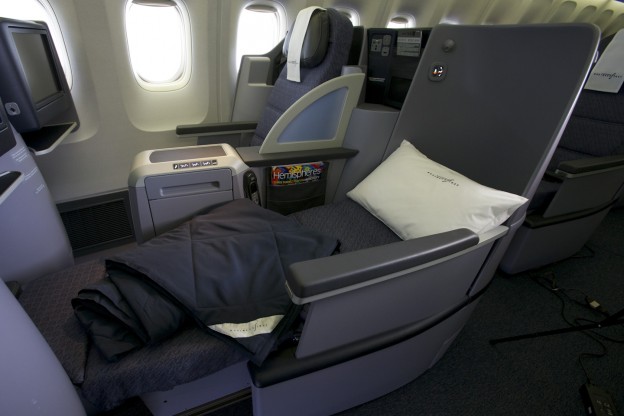
United Airlines Business First class

How to Find the Best Flight with your Frequent Flier Miles

Question:

Wendy, is there someone you recommend to make airline reservations using frequent flier miles? I have a ton of United miles and American Express Membership Rewards points and am looking for someone to figure out the best way for me to use them. We want to fly to Europe this summer in business class.

Thanks,
Francis

Answer:

Francis, I get this question at least once a week. There are a few mileage-award redemption advisory services, but I’ve always sworn by Gary Leff, whose Book Your Award service, geared to travelers who want to fly in first or business class, has been put to the test by thousands of my readers over the years.

Gary is the blogger behind View From the Wing, a co-founder of the frequent-flier community MilePoint.com, and a one-time hilarious guest in a Colbert Report skit. His partner at BookYourAward.com is Steve Belkin, another mileage magician and the founder of Competitours, an Amazing Race–type travel company.

I’ve known Gary and Steve for years. Between them, they can figure out any first-class or business-class mileage ticket you need, taking into consideration your personal requirements (date range, maximum number of stops, etc.) and your available bank of miles, credit-card points, and other loyalty-program points. (And they’ll help you find more if you come up short).

They know which airlines offer the best award-seat value for which destinations. They come up with flights and routes that require fewer miles than you thought you were going to have to spend or that provide a few welcome layover days in a destination you thought you’d have to skip. And, if that’s not enough, once you’ve used your miles, they’ll teach you how to replenish your bank for your next trip. Their flat fee is $150 per ticket. They’re also insanely busy helping people like you so, if you do reach out to Gary and Steve, tell them I sent you.

Beating Jet Lag and Travel Exhaustion with Science and Magic

Note from Wendy: My strategy for beating jet lag when flying across an ocean is, upon landing, to make the rest of the day about getting outdoor exercise and sunlight. I walk around sightseeing all day and don’t stop moving till 8 p.m., when I collapse into bed, taking two Benadryl (the drowsy-making kind) or Tylenol PM to ensure I’ll sleep uninterrupted through the night. When I wake up circa 6 a.m., I find I’m adjusted to the new time zone. We all try different ways of coping with jet lag, though—and I got a kick out of these unusual solutions tested by Yahoo! Travel’s Managing Editor Jo Piazza. Maybe one of them will work for you.


Between June and September, I was on the road for about 20 days out of each month.

By the time October rolled around, I was completely knackered. In my years of traveling, I have learned to conquer traditional jet lag. I stay away from both alcohol and caffeine when I travel. I make sure I get eight hours of sleep a night on the road, and I try to work out for at least 30 minutes outside whenever I land in a new place.

But after hopping from time zone to time zone for three months, the jet lag starts to settle into your bones, along with complete and utter travel exhaustion. My immune system was shot. I couldn’t sleep. When I fell asleep, I couldn’t wake up. My whole body hurt in places where I didn’t know my body could hurt. I came down with bronchitis accompanied by a persistent cough that just wouldn’t go away and made mothers pull their children away from me on the subway.

Something had to change, because my travel schedule certainly wasn’t going to. I started talking to other frequent travelers, doctors, scientists, the checkout guy at GNC, and my acupuncturist, anyone who might have a suggestion for how to conquer my complete and utter exhaustion. And then I tried it all. These are the five things I attempted to rebuild my immune system and boost my energy. I’m still traveling just as much, but I haven’t gotten run down again.

1. Blue Light Therapy
Blue LED technology has been used by NASA to adjust researchers’ body clocks to stay synchronized for important space missions and research has shown that blue light can help to improve mood and energy by regulating your circadian rhythms. I got myself a Philips goLITE BLU, which is small and portable and connected to a timer so that it beams 15 minutes of blue light onto my face right when I wake up at 6 a.m. each morning. It is like Avatar every single day. I also keep one in the office timed to energy dips around 3 p.m. It has replaced my 3:30 p.m. Reese’s Peanut Butter Cups habit, which was causing an unhealthy sugar spike in the afternoon. I bring it along when I travel and put it next to my hotel bed. It is smaller than my Kindle.

 2. A Vitamin IV Treatment
I had heard of friends using intravenous vitamin therapy to cure their hangovers, but I hadn’t even thought about it to cure anything more than a night of too much tequila. But since I was willing to try anything, I went to Fountain Med Spa in New York City, where they customized an intravenous vitamin bag for me with vitamin B-12 (cyanocobalamin) to help with energy and immunity. They added vitamins B-1 (thiamine), B-2 (riboflavin), B-3 (niacin), and B-6 (pyridoxine) to help with my metabolism, fatigue, and skin.

Also from Yahoo! Travel: 10 Ways to Stay Healthy While Flying


“Vitamin C is ascorbic acid, and only a small amount can be absorbed orally a day,” said Dr. Todd Schlifstein of Fountain, explaining why the IV treatment was more effective. “Phosphatidylcholine also helps booster your immune system, which may be lowered due to travel, fatigue, and lack of sleep. Intravenous vitamins are a quick way to recover from jet lag, fatigue, and just feeling rundown after a trip.”

I was a little scared at first. Needles! IVs! But they calmed me down with the promise of a moisturizing facial and after the initial prick, I hardly noticed that I was hooked up to the drip for the better part of an hour.

Dr. Schlifstein told me I might not feel anything right away.

“Some people feel it right after they hop off the table,” he said. “Some don’t.” I didn’t. But within a few days, I definitely noticed a difference in my energy levels. And I haven’t been sick since (fingers crossed).

Also from Yahoo! Travel: These Apps Claim to Help You Get Over Jet Lag — But, Do They Work?


3. Supplements
I have a friend, who shall remain nameless, who is the queen of supplements. If it guarantees that she will look 12 years younger or that it will make her boyfriend perform better in bed, she will buy a crate of it. And so when she recommended something called Youth H2O, I blew her off. But then I chatted with Youth H2O’s nutritionist Manuel Villacorta about what it could do for me.

“Jet lag means low energy. Your immunity is compromised, and your system is unbalanced,” Villacorta said. “Youth H2O is filled with three ingredients that are extremely potent and will get you back up to speed with one shot in this easy energy booster.” The drink, sold in shot form, contains maca, which raises stamina and focus; camu, which supports the immune system; and purple corn, which is filled with antioxidants to ward off exhaustion.

Also from Yahoo! Travel: Everything You Need to Know About Sleeping on the Plane and Beating Jet Lag


4. Acupuncture
Most people think of acupuncture as a way to relieve pain and stress, but it can also do wonders for your immune system.

When we get sick, our immune system is unable to defend against the invading bacteria. Traditional Chinese medicine works to rid the body of blockages that are making the immune system work more slowly or ineffectively. I had four different appointments with an acupuncturist. She selected about 10 points—my wrists, the top of my head, my ear lobes, my belly and my feet—where the needles would help my nervous system to remove those blockages. Each session last about an hour and she gave me a delightful neck rub during each appointment.

5. Magic
I happened to mention my exhaustion to my friend Anabel, who is a practicing Wiccan.

“Where have you been?” she asked.

“All over,” I replied. “Ireland, Bermuda, New Orleans.” She nodded.

“It was New Orleans. You probably have a jinx.”

“A jinx?” I asked.

“A curse, a hex, a jinx.” And so she gave me a jinx-removing candle. I burned it for seven days, and I have to say, I have never felt better.

Royal Palace Madrid Spain

Madrid Airport Layovers: How to Make the Most of Them

Sometimes you just can’t avoid an airport layover. When you find yourself facing a long one, use it as an opportunity to add a great day trip to your vacation plans. It’s easier than you think to escape the airport for a few hours and get a taste of the cultural capital in which you’ve landed. In this series, we talk to experts in some of the world’s most popular airport hubs to get their suggestions for how to make the most of your time on the ground. For Madrid, we asked the city mavens at Context Travel to whip up a few itineraries for those passing through.

The Basics

How to get out of the airport: Madrid city center is just 12 kilometers from the airport, so you won’t waste too much time in transit when you could be exploring the city or savoring a delicious Madrileno meal. These are your options for getting out and getting back.

Taxi: A taxi to the city center is your most expensive but arguably the most convenient option. It will cost you 30 euros (about $38), which is a flat rate adopted by all official taxi companies. Count on 20 to 25 minutes of travel time, and more during rush hour.

Metro: You can access the city metro from terminals T2 and T4. It runs about every five minutes, from 6 a.m. to 2 a.m. It’ll take you about 12 minutes to get to the city center (more if you have to switch to a different line). Single-journey tickets are between 4.5 euros and 5 euros  (about $6), depending on your final destination, and they can be purchased in the metro station (www.metromadrid.es/en).

Bus: Airport bus 200 runs from 6:36 a.m. to 11:45 p.m. Tickets can be purchased on the bus, cash only, for 5 euros each way. Expect 40 minutes travel time, making this the slowest method of transport.

What to do with your luggage: Lockers are available to rent, in 24-hour intervals, in terminals 1, 2 and 4. Cost varies by locker size (small 4.22 euros, medium 4.82 euros, large 5.42 euros), and additional lockers are available for suitcases, bicycles, guitars, and other large objects.


If You Have a 7-Hour Layover

Taking into account airport security, baggage claim, travel time from and to the airport, and arriving back at the airport two hours before your next international flight, this option gives you approximately four hours in the city.

First-time visitors to Madrid should plan a stroll through the city center and historical district. Start at Puerta del Sol, the heart of the city, with arteries leading to the various barrios. Admire the square’s large city hall building, then make your way toward the Opera House and the Royal Palace, which you can gaze at over coffee on one of the peaceful terraces just behind the Opera House. Zigzag through the narrow streets to the Plaza Mayor, a regal 17th-century square lined with shops and cafés. If you still have energy, keep walking into the Huertas district and you’ll come to Plaza Santa Ana, where you can enjoy a beer and some basic tapas at one of Hemingway’s favorite haunts, La Cerveceria Alemana (Plaza Santa Ana 6; +34-91-429-7033, www.cerveceriaalemana.com/). If you prefer a guided walk instead, Context Travel offers an introductory historical walking tour in this area, Madrid Through the Centuries, led by a local scholar. Got kids in tow? Context has a special version of this tour just for families.


If You Have a 9-Hour Layover

Madrid is home to some of the best museums in the world. Spend your on-the-ground time surrounded by the creative genius of Velazquez, Titian, and Goya at the Museo del Prado (Calle Ruiz de Alarcón 23; +34-91-330-2800; www.museodelprado.es/en), or pay homage to Spanish history at Picasso’s monumental tableau Guernica at the Reina Sofia (Calle Santa Isabel, 52; +34-91-774-1000; www.museoreinasofia.es/en), which houses countless other modern masterpieces as well. Afterward meander through nearby 350-acre Buen Retiro Park. Finish your foray with a little window shopping in either the elegant Salamanca district or up-and-coming trendy Chueca before saying adios to Madrid and heading back to the airport.

How about a massage? High-end Spanish spa chain Elysium Travel Spa has an outpost in terminal 4 (+34-91-746-6280). The airport also has VIP Air Lounges, where you can shower (towel, slippers, and shower gel included), eat, watch TV, use Wi-Fi, and flip through newspapers and magazines (prices start at 25 euros). If you didn’t get any sleep on the plane, check out Air Rooms, which can be rented overnight or for three- or six-hour periods during the day (Terminal 4; +34-93-375-8600; www.premium-traveller.com/en).


More Layover Solutions:

Amsterdam Airport Layovers: How to Make the Most of Them

Beijing Airport Layovers: How to Make the Most of Them

Barcelona Airport Layovers: How to Make the Most of Them

Great Paris Hotels for an Airport Layover at Charles de Gaulle

London Heathrow Layover: Great Hotels for a Stopover at LHR

Tokyo Airport Layovers: The Best Way to Spend Them

Be a smarter traveler: Use Wendy’s WOW List to plan your next trip. You can also follow her on Facebook and Twitter @wendyperrin, and sign up for her weekly newsletter to stay in the know.

Wendy Perrin on airplane

How to Find the Best Flight for Your Money

The travel problem: Finding the most comfortable, most convenient flight for your dollar.

The tool that solves it: As Routehappy says on its website, “not all flights are created equal.” And that’s exactly why Routehappy was created—to help you determine which flight will give you the best value for your money. On the surface, this site looks like any flight-search tool, but when it spits back your results, you’ll see a lot more information than just times and fares. By combining data on such things as seat size, legroom, in-flight entertainment, Wi-Fi, baggage fees, and flier reviews (all of which you can expand for more detail), Routehappy creates a Happiness Score for each flight. Once you find the trip that will make you happiest, click the purchase button to be taken to the exact page you need on the airline’s own website. Even if you’ve already booked your flight, this tool can still help: Type in your flight info, and Routehappy—and its growing community of fliers—can tell you what to expect.