Tag Archives: art

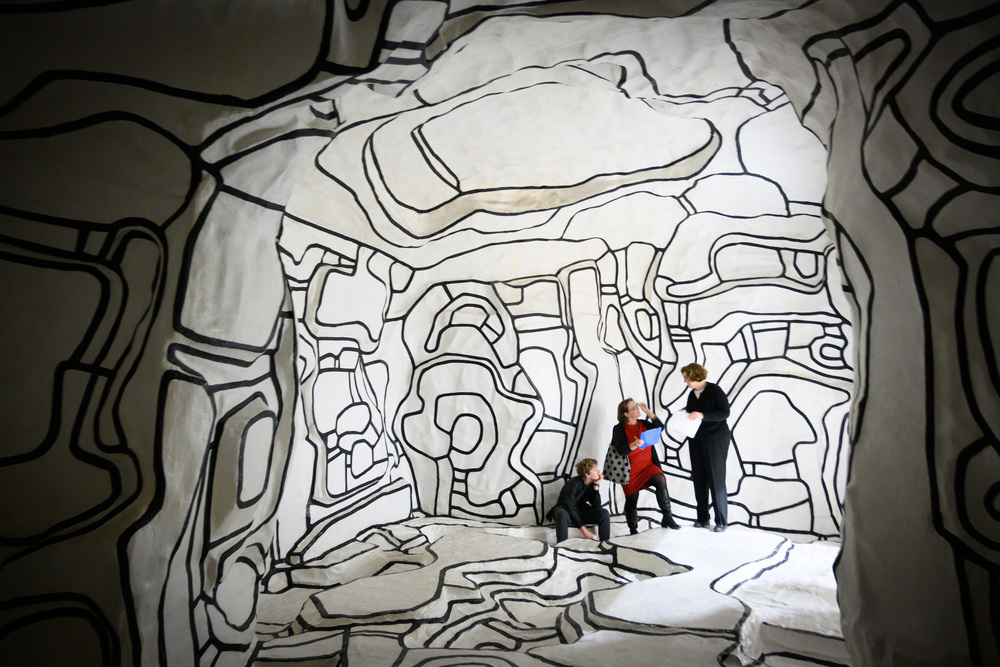
Wendy Perrin at Pompidou Centre in Paris, France.

Immersive Art Experiences Worth Traveling For

With so many powerhouse art exhibitions coming to cultural capitals around the globe in 2026, have you thought about building a trip around one?  Exciting shows range from Metamorphoses at the Rijksmuseum in Amsterdam (February 6 – May 25) and the Galleria Borghese in Rome (June 22 – September 20) to Rememory, the 25th Biennale of Sydney (March 14 – June 14). New museums are also set to open, from London’s V&A East Museum (on April 18) to KANAL-Centre Pompidou in Brussels (on November 28) and, hopefully, the long-anticipated, Frank-Gehry-designed Guggenheim Abu Dhabi.  Long-awaited reopenings include the Musée de la Vie Romantique in Paris (set to reopen on Valentine’s Day) and Mexico City’s Museo Dolores Olmedo, home to the world’s largest collection of works by Frida Kahlo and Diego Rivera.

Smart travelers already know about skip-the-line tickets to new exhibitions—WOW List experts procure these all the time—but are you aware of the array of special experiences of art that can be had in museums, palaces, castles, and artists’ studios around the world?

Above, you see a scavenger hunt that was arranged for my family at the Centre Pompidou in Paris (before it closed for a five-year renovation): We followed an art historian’s clues and ended up inside Jean Dubuffet’s The Winter Garden.  Below, you see a private tour that my family had of the Ceaușescu mansion in Bucharest, Romania: In every room, we were the only visitors allowed.
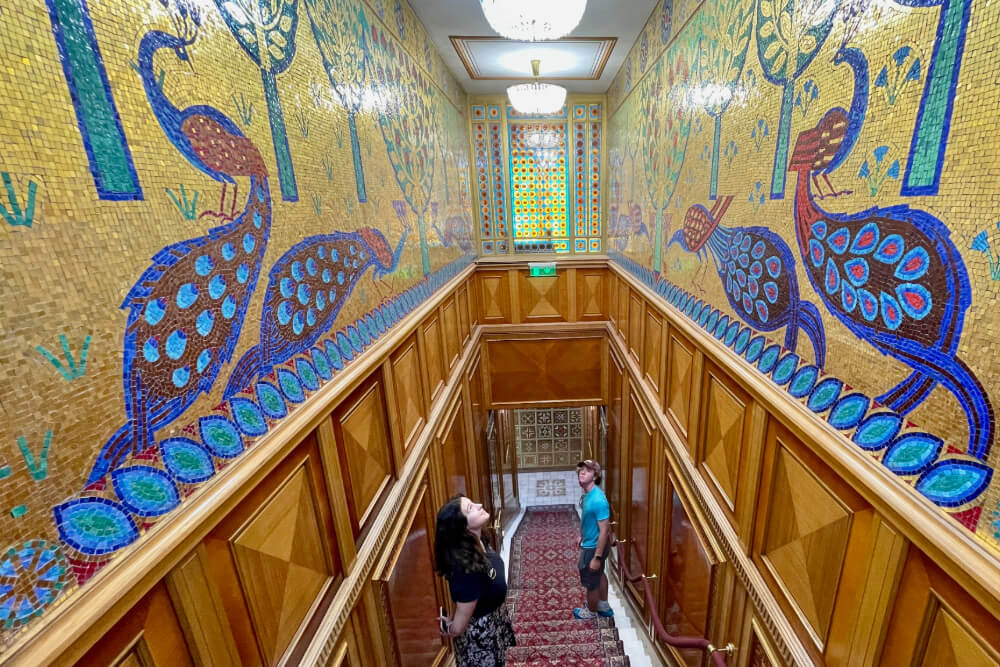
Doug Baker at Casa Ceausescu in Bucharest, Romania.

My family’s private tour of Casa Ceausescu in Bucharest, Romania

Read on for more examples of art access, shared by travelers who booked their trips the WOW way. For me, what’s been most breathtaking is gaining entry to locked palace rooms, and even museum warehouses and private studios, that hold treasures yet are off-limits to the public.

Imagine having a world-class museum, castle, or ancient ruin almost entirely to yourself, before it opens in the morning or after it closes at night!  Such entrée, with the curator as your guide, is one of the biggest travel thrills I know. Not only does it feel like magic, but it can give you a window into the culture that you don’t get any other way. I’ve had the privilege of seeing a number of iconic museums this way, and many’s the time that lens has transformed my understanding of a country’s history.

Wondering about the best such experiences for your own specific interests?  We’re happy to advise via the black button below.

GET A PERSONALIZED TRIP RECOMMENDATION

JAPAN: Hard-to-get art experiences, a museum-hotel stay, meeting with a famous manga artist…
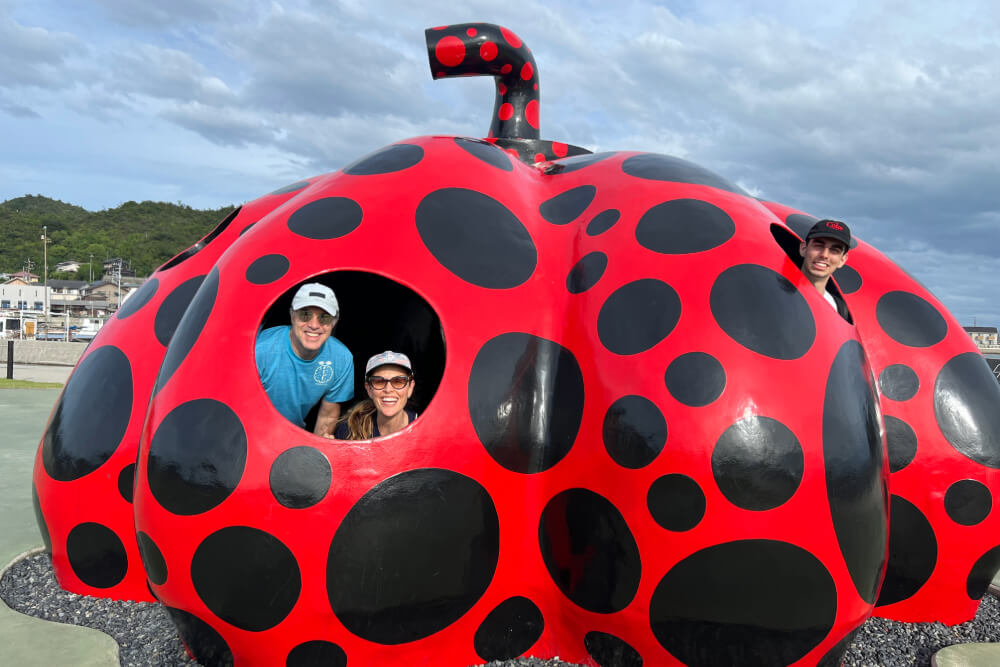
Claudia Sender with her husband and nephew posing in Yayoi Kusama's Red Pumpkin in Naoshima, Japan.

WOW trip traveler Claudia Sender with her husband and nephew on Japan’s Naoshima art island

“This was a special trip with my 19-year-old nephew, and we wanted it to be memorable for him—and fun for myself and my husband as well. So Andrea proposed an itinerary that mixed a rich immersion in Japanese culture, including a tea ceremony, hard-to-get sumo championship tickets, a hike to Mount Fuji, a visit to the Art Islands—with a very-hard-to-get hotel stay at the Benesse House—and activities that a 19-year-old loves, even a manga artist from a very famous manga that my nephew loves!

Andrea also understood how important it was for us to get tickets to Super Nintendo World, which was insane, given the Expo that was going on in Osaka, but he got them anyway. And, on the day that we faced pouring rain in Kyoto, our guide Sae adjusted the itinerary to take us to more secluded temples, and once she learned that I love moss, she adjusted it once more to take us to a temple with an ancient and precious moss garden.

We had the time of our lives, thanks to Andrea and all of the amazing guides. We felt that in a moment when Japan is going through this explosion of tourism, having their advice and guidance was priceless.” —Claudia Sender

To get your own WOW trip, start with our trip questionnaire, reached via the black button below.

START A TRIP TO JAPAN
MORE JAPAN REVIEWS

TUSCANY, ITALY: Workshops with artists, studio visits, immersion in marble sculpture…

A sculptor working on a marble sculpture in Tuscany, Italy.

A sculptor working on a marble statue in Carrara, Italy. Photo: Kay Maeritz / Alamy

“We wanted to be immersed in art, particularly in sculpture, and to see the marble quarries in Carrara.  Alberto and Martina listened intently to our hopes for visiting with artists in their studios who might be willing to share their work process with us. They were able to arrange for three different workshops which gave us entirely unique perspectives. Combining the visit to the marble quarries and learning how the stone makes its way around the world with visits to the studios completed our understanding.

We stayed two nights in Pietrasanta, an arts community near Carrara. It was a magical place that we had read about but exceeded our expectations. Modern sculptures dot the plaza and surrounding streets, murals by Botero in the churches and cafes, boutiques, and restaurants are all within a short walk. All in all, an exceptional experience.” —Andrea Pollinger

To get your own WOW trip, start with our trip questionnaire, reached via the black button below.

START A TRIP TO ITALY
MORE ITALY REVIEWS

LITHUANIA, LATVIA, AND ESTONIA: Curator-led private museum tours, palaces, synagogues…
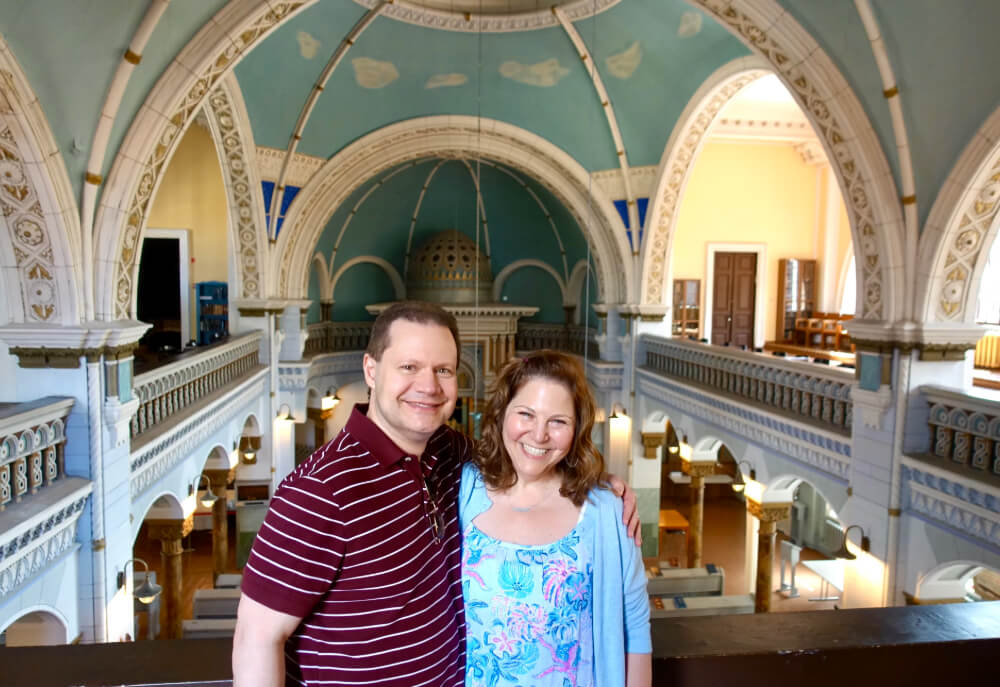
JoEllen Schuleman and her husband in Pylimo Choral Synagogue in Vilnius, Lithuania.

WOW trip travelers JoEllen Schuleman and her husband in Pylimo Choral Synagogue in Vilnius, Lithuania.

“Our two-week Baltics vacation planned by Greg and Leigh was filled with private tours, amazing guides, delicious food, and well-located hotels. Our trip started in Vilnius, Lithuania, at the Hotel Pacai. We had a large room in a renovated palace—great location, walking distance to everywhere. Some of our favorite highlights were a private guided tour of the Holocaust Museum by an Austrian volunteer, and our food tour with a guide who grew up in Soviet-occupied Lithuania and shared how the food and culture were shaped and what it was like during the transition to independence.

Next, we drove to Riga, Latvia, via the Hill of Crosses and Rundāle Palace. We had a docent-guided tour of the palace, first commissioned by the Duchy of Courland, which the Russian Empire annexed, and the palace became one of the residences of the Russian tsars.

The Grand Kempinski in Riga, Latvia, was our favorite hotel. We were upgraded to a suite and had a warm welcome. Riga had several memorable moments, but two surprise curator tours—the Museum of the Occupation of Latvia, and the Latvian National Museum of Art—were a true highlight. The Biķernieki Memorial in Riga is not to be missed. It was moving and emblematic of how the Jewish community was slaughtered during the Occupation.

Next stop was Tallinn, Estonia, and the Nunne Boutique Hotel. Well located at the entrance to the Old Town, this too is a historic hotel. All in all, we learned more about a dark period in history and the resilience of the people. It was a great vacation, and we are grateful to Greg and Leigh, and all of our guides and drivers, for sharing their expertise and cities with us.” —JoEllen Schuleman

To get your own WOW trip, start with our trip questionnaire, reached via the black button below.

START A TRIP TO THE BALTICS
MORE BALTICS REVIEWS

COPENHAGEN: Museum entry before public hours, “Hamlet’s Castle”…
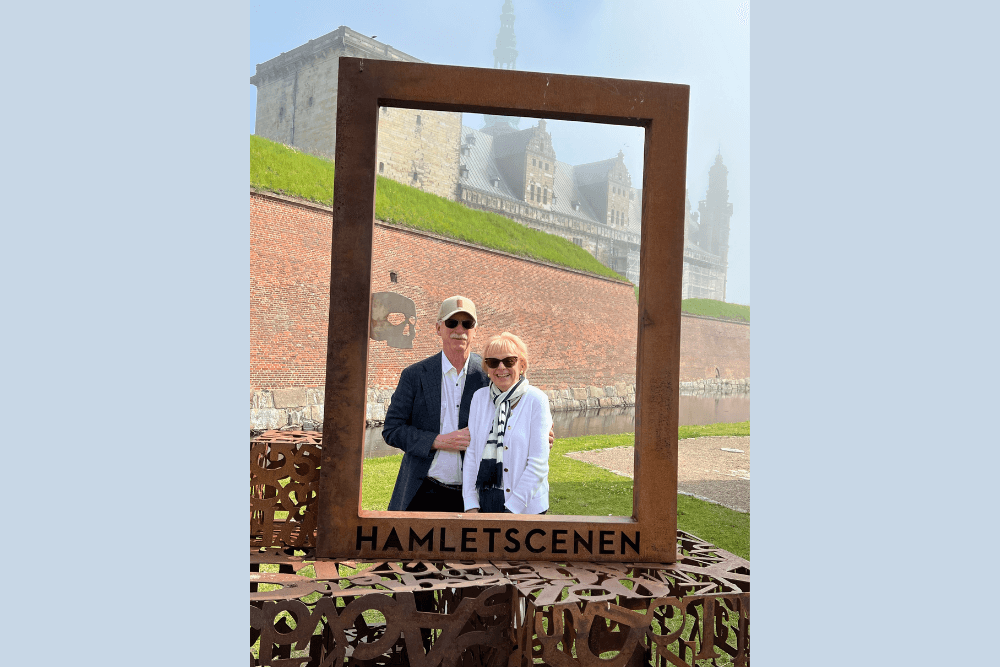
Sonja Haggert at Hamlet’s castle in Helsingor, Denmark.

WOW trip traveler Sonja Haggert was captivated by Hamlet’s castle, seeming to rise from the fog.

“Brian and I visited Copenhagen before, but never like this. What this city offers in history and beauty can only be topped by its fantastic museums and commitment to environmental conservation. Our tour with William, at Mads’ suggestion, was a wonderful opportunity to see some of what the average tourist would overlook. And then there were the hot dogs, but I digress.

Our first day was serious walking and tasting. I mentioned those hot dogs—so many varieties and so little time. But we also tasted real Danish pastry, which William had bought before the tour so that we wouldn’t have to wait in line. Our stop at Torvehallerne, the farmers’ market and food hall, included cheese, some wonderful chocolate, and fish meatballs. You haven’t lived until you’ve tried fish meatballs!

The next day can only be described as out of this world. William took us along the beautiful coastline to Elsinore and the castle that Shakespeare used for Hamlet. The castle sits on a cliff surrounded by a moat. It was foggy, and the castle seemed to rise out of the fog. The Baltic Sea and the North Sea surround the property.

On our way home, we stopped at the Louisiana Museum of Modern Art, which is as dramatic outside as inside. We could have spent most of the day there. If I said the previous day was out of this world, our last day was about to overshadow that: We began at the Copenhagen Contemporary, where we were greeted by our personal guide before the museum officially opened. The museum is located in an area called Reffen, which was formerly a shipbuilding facility. Due to the high ceilings, the museum can accommodate large pieces, and it doesn’t disappoint.” —Sonja Haggert

To get your own WOW trip, start with our trip questionnaire, reached via the black button below.

START A TRIP TO SCANDINAVIA
MORE SCANDINAVIA REVIEWS

PUGLIA, ITALY: Hands-on experiences making art—in a sculptor’s atelier, in a jewelry designer’s home…
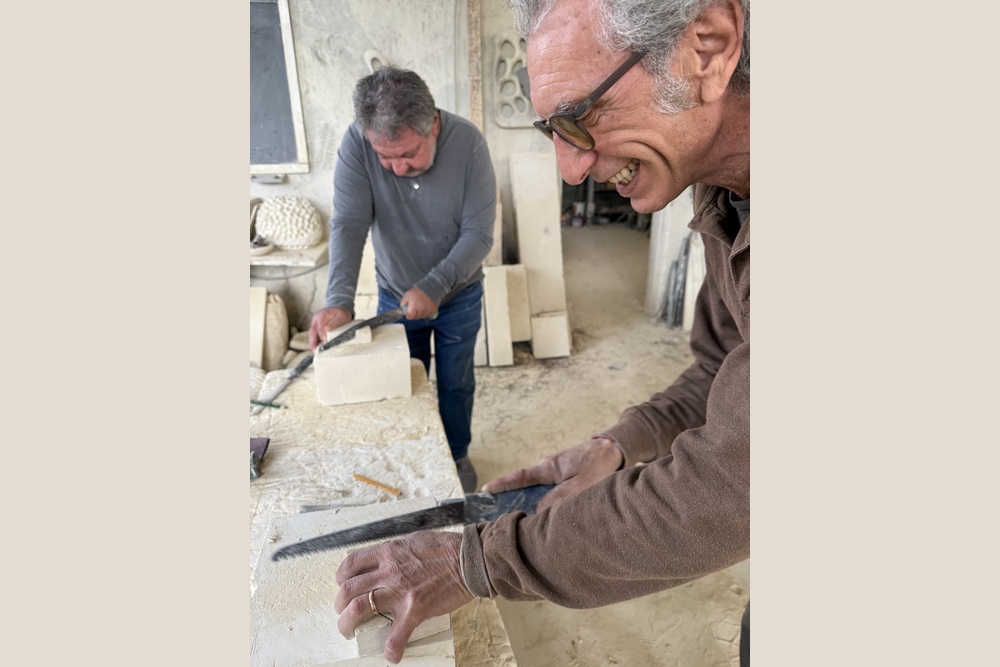
Jeff Weiss learning sculpture from an artist in Puglia, Italy.

Jeff Weiss learned from a renowned sculptor in his home atelier in Puglia. Photo: Traveler Paula Kramer

Antonello and Valeria leveraged their substantial network to create a bespoke itinerary that included experiences that we would not have known to ask for and that wound up elevating our trip beyond our wildest dreams.

Every single day of this trip had a WOW factor, whether it was visits to Pompeii and Herculaneum, our cave-turned-hotel in Matera (Sextantio), or our stays at delightful masserias in Salento. But beyond that, having the chance to sample the delights of a renowned cheesemaker, learn from the third-generation owners of a family-owned flour mill, get expert insights into the complexities of olive oil, or sample gelato with a young woman who is combining innovation with tradition as she expands the gelato business started by her grandfather—these are culinary experiences we could only encounter thanks to Antonello’s deep understanding of and connection with the hidden gems of Puglia. Trust me, you are not going to find these on your own.

If all this wasn’t enough, we spent an afternoon in the home/atelier of a renowned sculptor and another afternoon with a couple that makes jewelry. I confess that, when I first read our itinerary, I thought these sounded weird: Neither my husband nor I would become the next Michelangelo or make jewelry anytime in the near future, so why take time to do this? I could not have been more wrong!

These artists were so genuinely interested in sharing their craft, their food, and their kindness. We were besotted by these one-of-a-kind experiences, making friends and actual art along the way. We even got to visit the private home of a potter who showed us the ancient and Byzantine relics and the Byzantine chapel that he discovered on his property during renovation.” —Paula Kramer

To get your own WOW trip, start with our trip questionnaire, reached via the black button below.

START A TRIP TO PUGLIA
MORE PUGLIA REVIEWS

GREECE: Private tours with archaeologists, a private pottery workshop…
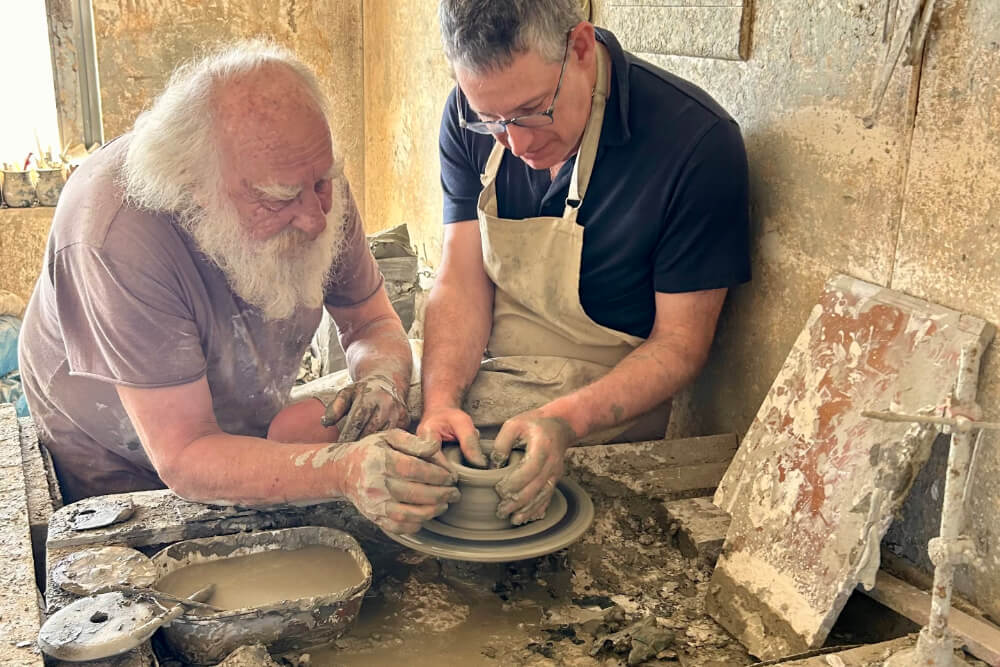
Jonathan Scharfstein and a master potter during a private workshop in Santorini, Greece.

Traveler Jonathan Scharfstein receives private instruction from a master potter.

Jacoline got to know what we were interested in and planned a fantastic trip full of all kinds of unique and special moments. We spent two nights in Athens and three nights each on the islands of Sifnos, Naxos, and Santorini. Jacoline was incredibly helpful in guiding us on which islands to visit and organizing a trip to three offering very different landscapes and experiences.

There were so many highlights to this trip, including a private guided tour of the Acropolis, a fantastic private RIB boat ride on the Aegean with a visit to an uninhabited island (except for goats), a private tour with an archaeologist in Santorini, and a private hands-on pottery workshop.

In addition to all these experiences, we had a WOW Moment in Naxos! This was a fantastic private tour of a family-owned olive farm with a delicious olive oil tasting and meal in an olive garden, while being serenaded by a highly accomplished family guitarist.” —Jonathan Scharfstein

To get your own WOW trip, start with our trip questionnaire, reached via the black button below.

START A TRIP TO GREECE
MORE GREECE REVIEWS


Be a smarter traveler: Sign up for Wendy’s weekly newsletter to stay in the know. Read real travelers’ reviews, then use the black CONTACT buttons on Wendy’s WOW List to reach out to the right local fixer for your trip.
Valle Bavona stone village Ticino Switzerland

Switzerland Is More Than Chocolate, Cheese, and Mountains

Switzerland is an increasingly popular destination for our readers—so much so that I’m spending a few weeks traveling the country to get to know it better and to test different Switzerland travel specialists for potential inclusion on The WOW List in the future. Each Switzerland specialist has different strengths and offers different insider experiences, so if you’re looking for a WOW trip to Switzerland, click over to Ask Wendy to get her recommendation for the right trip designer for your needs. In the meantime, to whet your appetite, here are key things you need to see, taste, and know about traveling in Switzerland—beyond the usual and expected draws (though those are pretty good too).

Follow more of my trip on Instagram @billietravels and at billietravels.com.

Don’t call them macarons.

A post shared by Billie Cohen (@billietravels) on

Zurich confectionary Sprüngli has its own branded version of the colorful almond-flour sandwich cookies. They’re called Luxemburgerli, and they are a little smaller and lighter than classic macarons. Sample the always-available flavors including raspberry, hazelnut, champagne, caramel, and chocolate, but don’t miss the seasonal Luxemburgerli. May’s specials were mango and strawberry-rhubarb.

Wear thick-soled shoes even if you don’t plan on hiking.

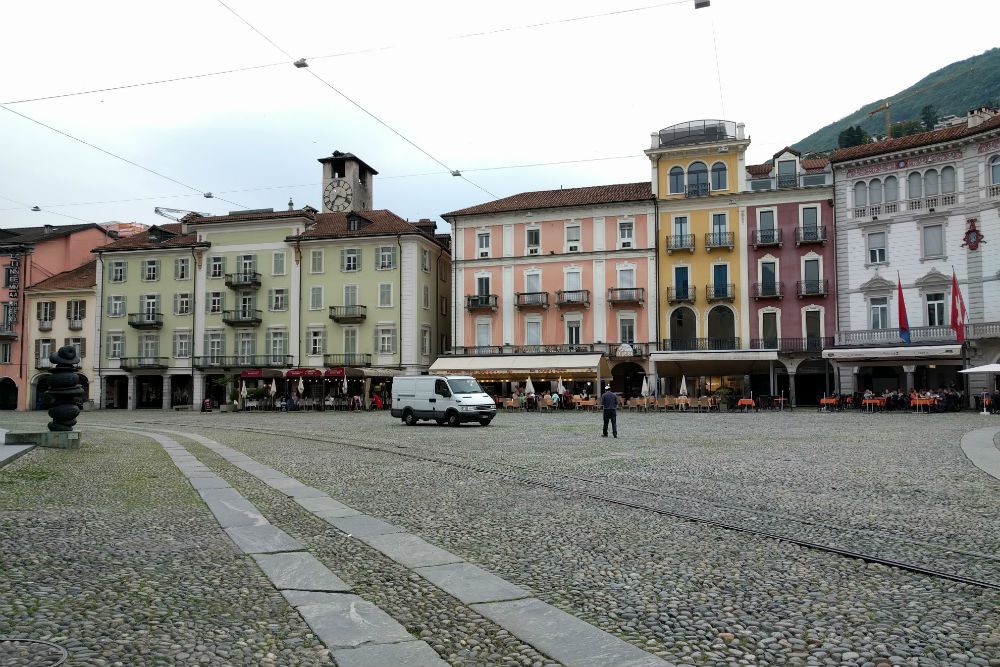
Old Town Piazza Grande Locarno Ticino Switzerland

The old town areas of Swiss cities, like this one in Locarno, are charming—but the uneven stone surfaces can be tough on your feet. Photo: Billie Cohen

You might think you only need solid footwear if you’re going to be trekking in the mountains, but the cobblestone streets of an old town (and every Swiss city has one) will quickly lead to tired, painful feet if you’re wearing thin sneakers or sandals.

The hype is true: The trains are spectacular.

A post shared by Billie Cohen (@billietravels) on


The famed panoramic Glacier Express and Bernina Express live up to their reputation as gorgeous scenic experiences but, honestly, a lot of the regular train rides throughout the country offer equally stunning views. Switzerland Tourism sells a few varieties of train passes to make system-wide travel easier and more economical (you can purchase consecutive-day or flex passes for 3, 4, 8, or 15 days). Since I’m here for about a month, I chose the half-fare travel card; it gave me discounted tickets on long-distance, panoramic trains and local transportation, including buses, trams, and many scenic cable cars and even some local taxi services. I also tested an eight-consecutive-day, first-class Swiss Travel pass, courtesy of Switzerland Tourism, to see what that kind of freedom feels like and to experience first class. The Travel Pass covers all of the above, plus gives you free admission to more than 500 museums and attractions. There is plenty of info on myswitzerland.com to find the right one for your trip.

Second class is really nice.

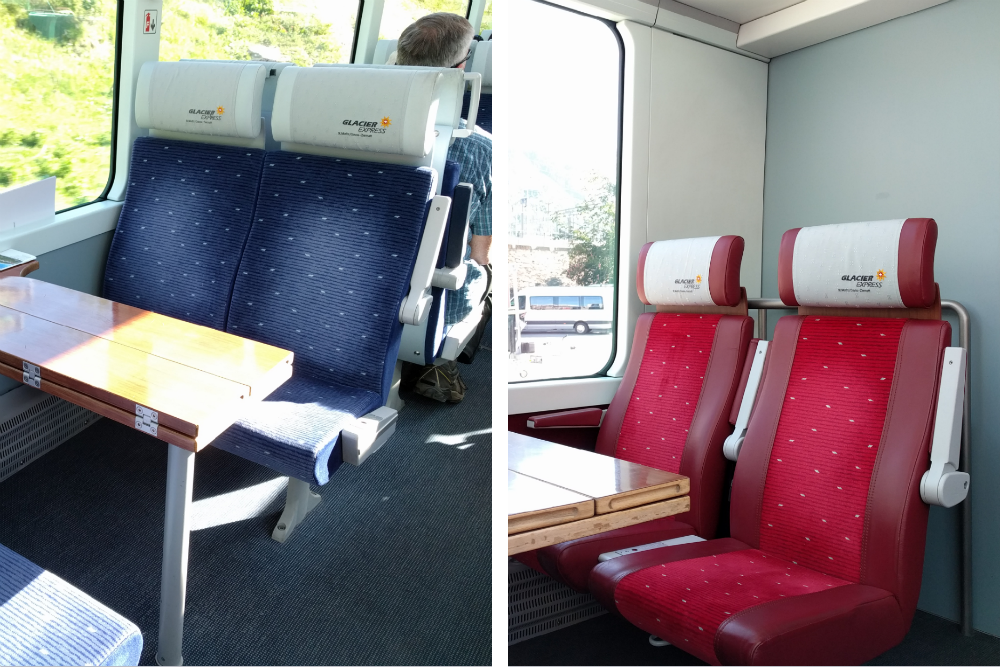
comparison of first and second class seats on Glacier Express train in Switzerland

On the Glacier Express, first-class seats (the red) are a bit roomier than the blue second-class section, and there are fewer seats in each car. But second class is still quite comfortable, even on regular trains. Photo: Billie Cohen

When traveling on trains or buying your Travel Pass, you’ll have a choice between first and second class. As you’d expect, first class is more spacious, the seats are bigger, the tables are bigger, and there are fewer people in each car, but second class is really nice too. This is no coach vs. business class dichotomy here—second class is very comfortable and the seats are roomy. In many cars, if I was sitting in a foursome (two seats facing another two seats with a little table between), I had enough room to keep my roller bag at my feet without crowding the person opposite me. I also found outlets in several second-class cars during my travels. Where I really appreciated first class was on my seven-hour Glacier Express trip. Since I was on that train for so long, it felt luxurious to have room to stretch out, a big table so I could spread out my maps and my laptop, and a less-crowded car.

But trains are not the most scenic way to travel.


That is not to say Switzerland’s trains are not spectacular. They absolutely are. I’ve criss-crossed the country on long-distance routes, inter-city expresses, regional connections, the famed panoramic Glacier Express, and even a 125-year-old cog railway that chugged to the summit of Monte Generoso at 1,704 meters. And I loved every second of every ride. Whether you travel first or second class, trains are comfortable, roomy, clean, and even the most basic local carriages have big windows. So I am not saying you should skip train travel. If you don’t travel by train in Switzerland, you are missing out. But I really shocked myself to find that after a month in this country, my personal favorite way to see it is by bus. Granted, it is slower, but that’s why I prefer it. Buses can also go where trains can’t. (Renting a car and driving introduces complications such as navigating scary roads, not being able to gawk at the scenery and drive at the same time, and not being able to have a local beer or glass of wine with your meal.) I rode the most amazing route in the Ticino region to see the famed Church of San Giovanni Battista in Mogno, by Swiss architect Mario Botta. We started out winding through charming tiny villages (where our driver knew everyone who waved to him from the streets because he’s been driving this route for 28 years) and then graduated to a series of steep hairpin turns that led up a mountain with sheer cliffs on one side and eye-popping views of the valley. I also really enjoyed the fact that we drove through many towns and villages. Yes, this meant a slower ride with more stops, but it also meant I had the chance to see where people lived and get a better sense of how the various villages are connected.

Long-distance routes like this one are run by the PostBus company, which, as its name implies, got its start as a service for delivering mail. It’s still part of the Swiss postal system, but it’s grown into a far-reaching, easy-to-use, and affordable public transportation network that’s also covered by the Swiss Travel Passes. You’ll recognize it by its bright yellow buses. The app even offers downloadable audio guides that point out sights and history along some of the routes.

Don’t miss the toilets on the trains.

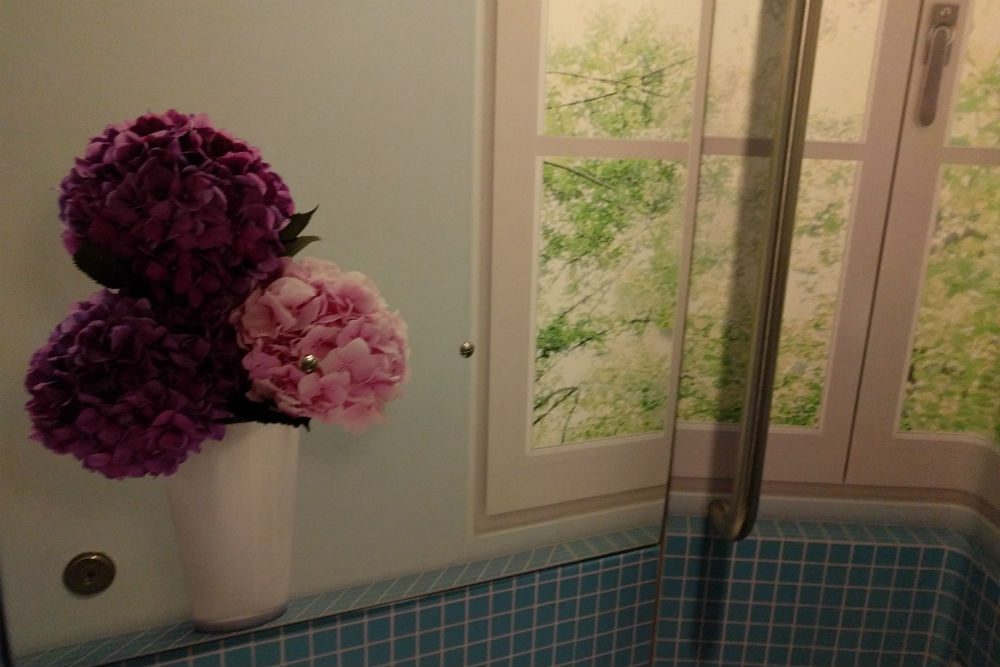
funny design wallpaper in a bathroom on a Swiss train

The bathrooms on Swiss trains are much cleaner and more whimsical than you’d expect. Most of them have some kind of funny wallpaper to make you feel like you’re anywhere but in a train toilet. Photo: Billie Cohen

For one thing, this is practical advice, since bathrooms at train stations often cost a franc, while the toilets on the trains themselves are free. For another, the train toilets (look for the WC sign) are not only clean, they’re adorable. Yeah, I know, that’s not a word anyone would normally use to describe a bathroom, but just look at this picture! Most of the WCs on inter-city routes have whimsical wallpaper that’ll make you feel like you’re somewhere else: a homey powder room, in an under-the-sea submarine looking out a fake porthole, in an airplane flying through the clouds— and I never saw the same design twice. When the bathrooms are this nice, you know trains are a valued, respected, and well-maintained mode of transportation.

Don’t be a hero; take your Dramamine.

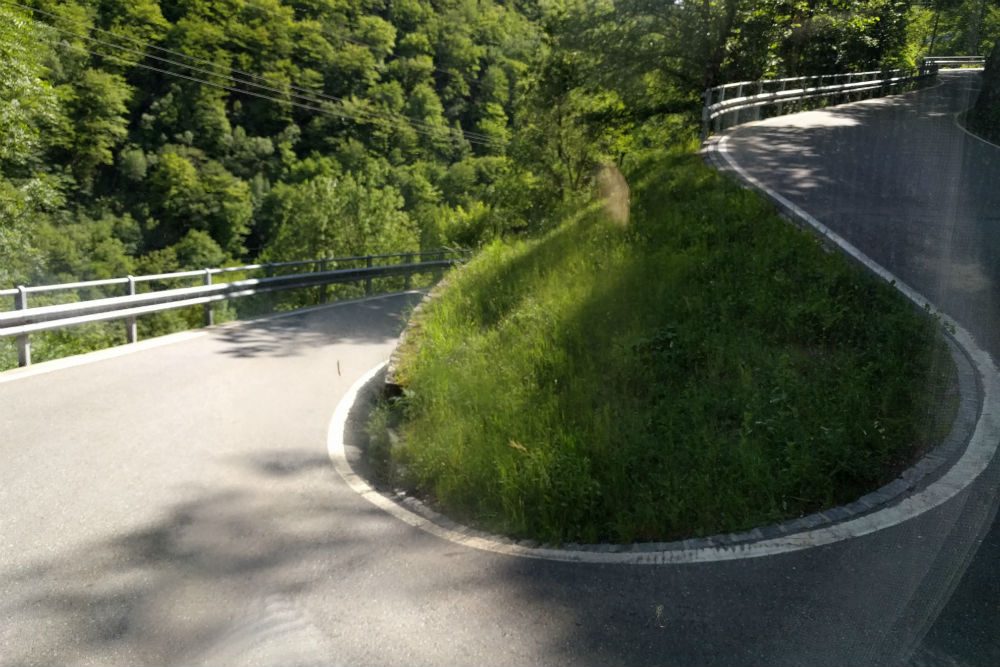
Hairpin turn on road in Ticino Switzerland

One unfortunate consequence of all those beautiful Swiss mountains: very, very, very sharp turns to get up them. Photo: Billie Cohen

The roads in the mountains can be very sinuous—ideal for causing discomfort to those of us who suffer from motion sickness. Even some of the trains rock side to side and may take some windy routes. And then there’s the buses, which can navigate even more serpentine roads and do a lot more stopping and starting. Also keep in mind that all modes of transportation here have front- and back-facing seats, and you may not always get your first choice, so you’ll have that additional trigger to worry about. So do yourself a favor and don’t try to tough it out. You’ll end up feeling too sick to look out the window; take whatever aid helps you feel better. If it makes you tired, you can always pep up with a coffee and a piece of chocolate!

There are gems of modern architecture, but some of them are hidden.

A post shared by Billie Cohen (@billietravels) on


Mario Botta has several structures around Switzerland that are worth visiting. In addition to the San Giovanni Battista church, there’s La Chiesa Santa Maria degli Angeli at Monte Teramo and the Fiore di Pietra at the top of Monte Generoso (both in the Ticino region). Pritzker Prize-winning Peter Zumthor is another Swiss architect worth seeking out. In addition to the Therme Vals (in Vals), he designed a shelter for Roman archeological finds in Chur, Switzerland’s oldest city. That one is way off the main streets; although it’s not widely publicized, you can ask for a key at the tourist information center to access it. If you make the effort, you’ll be rewarded. I had the place entirely to myself when I visited, and I loved the contrast between the way the open-air structure incorporates light and shadow, which are always changing from minute to minute, and the ancient artifacts, which haven’t changed in 2,000 years. Another architectural gem that’s not obvious from the street is in Zurich: Santiago Calatrava’s law library at the University of Zurich is inside another building, so unless you know it’s there, you won’t notice it. The library is free and open to the public and worth the trip. There are so many other gems of modern architecture throughout Switzerland, so be sure to seek them out: the last building Le Corbusier ever designed is in Zurich; creations by Zaha Hadid, Frank Gehry and other starchitects are gathered at the Vitra Campus outside Basel; and Renzo Piano designed the undulating Zentrum Paul Klee in Bern.

It’s very easy to accommodate food allergies and preferences here.

I’m a vegetarian with many food issues, none of which were a problem here. Not only does everyone understand “vegetarian” and “vegan,” but I saw many menus that noted those options as well as gluten-free offerings. In grocery stores, packages mark these things too. Some stores have separate gluten-free sections. And I love to visit grocery stores. The two main ones you’ll see around Switzerland are Coop and Migros; the larger locations have inexpensive buffet-style restaurants and sections of housewares and even clothing.

Try all the Swiss cheese. There’s more than you think.

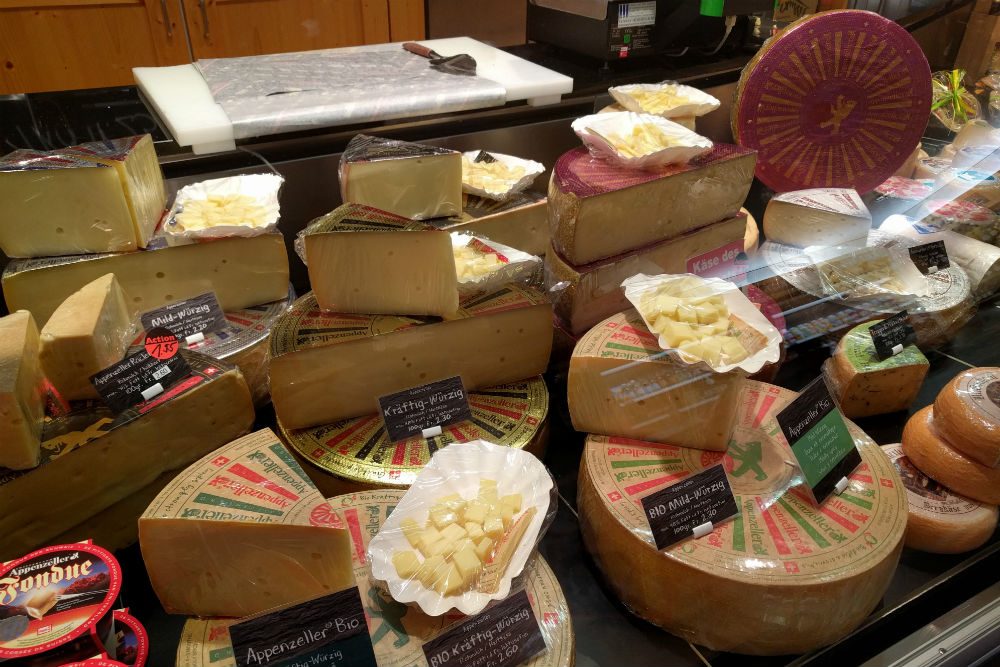
Variety of Appenzeller cheeses in switzerland

There a so many kinds of cheeses to taste in Switzerland, try them all. This selection is from the Appenzeller dairy. Photo: Billie Cohen

There are myriad varieties of cheese here beyond the familiar hole-pocked slices we picture when someone says Swiss cheese: There’s Emmental, Gruyère, Appenzeller, and many that are local to each region. Be sure to try them all and seek out opportunities to see it made. In Appenzell, I visited the Appenzeller show dairy and tasted several varieties. You can also visit the Gruyère factory and Emmentaler show dairy, and a well-connected Switzerland travel specialist can arrange more personal cheese experiences

There’s a rosti for every region and you should taste them all.

A post shared by Billie Cohen (@billietravels) on


If you want to get very basic about it, rosti is just a big hash brown. But that’s really oversimplifying it. When done well, a big fat plate of browned and crispy rosti is exactly what your belly needs after a day of touring or hiking or shopping or whatever it is you did that day. What’s cool is that different regions in German Switzerland have their signature versions: In Appenzell, the rosti is served with a fried egg and Appenzeller cheese. The Bern version has bacon. Ask about it and try them all.

There are also regional desserts. Try those too.

biberli cookie dessert from Appenzell Switzerland

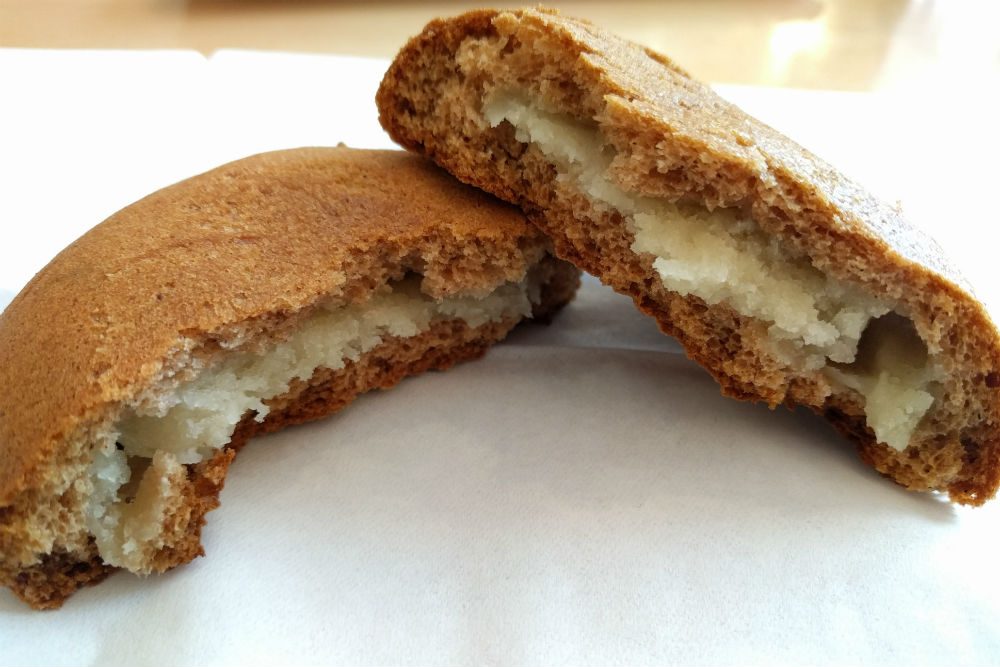
Every region of Switzerland has specialty desserts. This biberli, a gingerbread cookie filled with nut cream, is popular in Appenzell. Photo: Billie Cohen

Keep your eye open for cakes, cookies, and treats in each area you visit. In Zurich and Appenzell, you’ll see a lot of small round mini cakes called biberli, which are soft gingerbread on the outside and filled with a nut cream. In Chur, I was introduced to Bündner Nusstorte (Bündner indicates it’s from the Canton of Graubünden, of which Chur is the capital), which is more like a walnut pie. Birnenbrot, also from Graubünden translates to pear bread. It’s a log of pear filling wrapped in a thin pastry.

Even the grocery stores sell good chocolate.

Swiss chocolate bars in grocery store in Switzerland

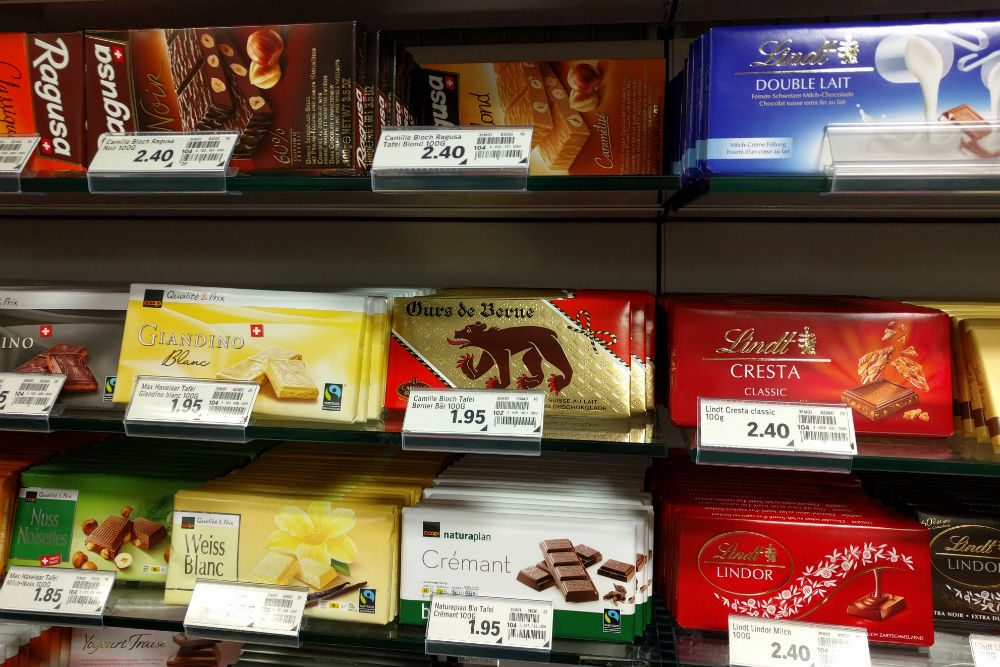
Every grocery store sells a large selection of chocolate at very affordable prices—and it’s good. Photo: Billie Cohen

You will likely want to try the fancy and famous chocolatiers of Switzerland, including Sprüngli in Zurich, Merz in Chur, and my favorite, Chocolat Stella in Bellinzona. And, of course, you should—they’re famous for a reason. But the quality of Swiss chocolate is so high that, as a rule, even the bars you buy in regular grocery stores are delicious. You’ll find large selections including Lindt aplenty, as well as Maison Callier and in-house lines. And whereas bite-size pralines from an upscale shop can cost 1.50 francs, standard chocolate bars are 100g (about twice the size of an American bar) and usually not more than two to three Swiss francs. The Migros grocery store’s house-brand milk chocolate bar is at the inexpensive end, and even that is creamier and more indulgent than any 80-cent chocolate bar has a right to be. Ask a local for his or her favorite brand, and you’ll get a different recommendation every time.

There are villages in the Ticino region where people still live without electricity—by choice.

Valle Bavona stone village Ticino Switzerland

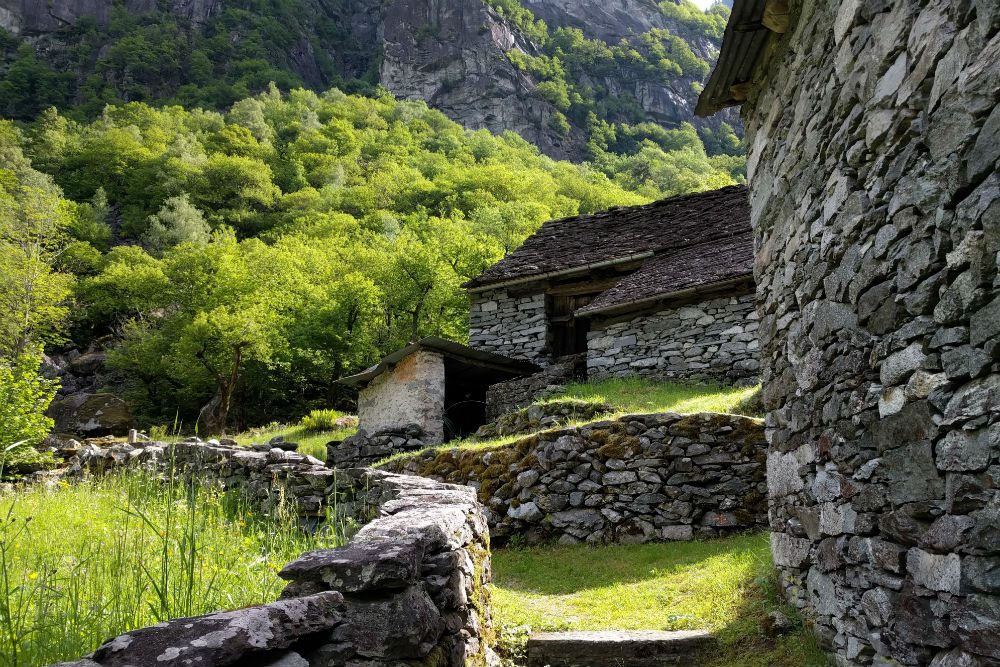
The valleys of Switzerland’s southern Ticino region are dotted with ancient stone villages still in use today. Photo: Billie Cohen

The Ticino region of southern Switzerland is a varied landscape of steep cliffs and verdant valleys. And in those valleys, you can drive right up to—and walk respectfully through—miniscule villages of stone houses that date back hundreds of years. In the Valle Bavona outside the city of Locarno, for example, some families spend their summers in rustic homes, eschewing electricity and modern plumbing in exchange for being surrounded by nature. You can visit these on your own, but a local guide who knows the area, the history, the context, and some of the residents, will make a big difference since there are no signs to give you info on what you’re looking at, how the houses were built, or what daily life here is like. For example, my guide Anna, who still spends summer weekends in a mountain home in the area, shared anecdotes about residents she knew personally and how they handle basic tasks like laundry and gardening, as well as insider stories such as why the locals here chose to refuse electricity (it had to do with taxes in the 1970s), and how those who live in high-up mountain crevices get their supplies (hint: look for ground-level posts topped with orange balls, they mark the beginning of pulley wires that ascend to the heights). Anna also led me through an off-road trail dotted with ancient cave grottos still in use by today’s residents—I never would have found that on my own, or even known to look.

Be a smarter traveler: Use Wendy’s WOW List to plan your next trip. You can also follow her on Facebook, Twitter @wendyperrin, and Instagram @wendyperrin, and sign up for her weekly newsletter to stay in the know.